
For NRIs, interest earned on an NRO (Non-Resident Ordinary) account is generally subject to tax deduction at source (TDS) in India. However, the tax deducted by the bank may be higher than your actual tax liability. In such cases, you may be eligible to claim a refund by filing an Income Tax Return (ITR) in India. In this guide, you’ll learn how NRO account TDS refunds work, who is eligible, which documents are required, and how to claim excess tax deducted on NRO account interest.
Key Takeaways
- ✔ NRO Interest Is Taxable: Interest earned on an NRO savings account or fixed deposit is generally taxable in India, and banks deduct TDS as applicable.
- ✔ Excess TDS Can Be Refunded: NRIs may claim a refund if the tax deducted exceeds their final Indian tax liability.
- ✔ ITR Filing Is Important: Filing and verifying an eligible income tax return allows you to claim credit for TDS already deducted.
- ✔ DTAA Benefits May Apply: Eligible NRIs may receive tax relief under the applicable tax treaty, subject to its conditions and documentation requirements.
- ✔ Check Your Tax Records: Verify Form 26AS, AIS and bank interest certificates before filing to avoid TDS mismatches.
- ✔ Complete Refund Formalities: Use the correct ITR form, verify your return and ensure your bank account is pre-validated for receiving refunds.
What Is TDS on NRO Account Interest for NRIs?
TDS means Tax Deducted at Source, when your NRO savings account or fixed deposit earns interest, the bank cuts tax before it credits the amount to you. This starts once you convert your resident account to an NRO account after moving abroad. The bank deposits this tax with the government in your name. It is only an advance payment, not your final tax. Your final tax is decided when you file your income tax return.
How Much TDS Is Deducted on NRO Account Interest?
Banks deduct TDS on NRO interest at 30%, plus surcharge (if your payment is high) and 4% health and education cess. For most NRIs, the effective rate is 31.2%. There is no minimum limit, so even small interest amounts face this deduction. Interest on an NRE account is tax-free in India, so no TDS is cut there.
Example
Rahul lives in Dubai and earns ₹3,00,000 interest on his NRO fixed deposit. The bank deducts 31.2%, which is ₹93,600. He receives only ₹2,06,400 in his account.
Why NRO TDS Refunds Happen
Banks usually deduct TDS at the highest rate because they do not know your full tax picture. They cannot check your total income or your treaty benefits. So the deduction is often more than your real tax, and the extra amount becomes a refund.
- DTAA Treaty Rate Applies:- If India has a tax treaty with your country, interest may be taxed at a lower rate, often between 10% and 15%. If the bank deducted 31.2% instead, you can claim the difference as a refund.
- Total Income Below the Taxable Threshold:- If your total Indian income is below the basic exemption limit, your tax is nil and the full TDS is refundable. For FY 2025-26, this limit is ₹4 lakh in the new regime and ₹2.5 lakh in the old regime.
Can NRIs Claim a Refund on TDS Deducted From NRO Interest?
Yes. NRIs can claim a refund of excess TDS on NRO interest, but only by filing an income tax return in India. The bank cannot return the money, and the tax department does not refund it automatically. In your return, you show the interest, calculate your actual tax, and claim credit for the TDS already deducted. The extra amount is then paid to your bank account. Before filing, check Form 26AS and your Annual Information Statement (AIS) to confirm that the bank has reported the TDS correctly. Keep your interest certificates and other supporting documents ready. Remember, the refund depends on your final tax liability, applicable deductions or treaty relief, and successful verification of your return.
Who Is Eligible for an NRO Account TDS Refund?
Your eligibility depends on your residential status as an NRI and on how your actual tax compares with the TDS deducted. Here is a quick guide.
| Your Situation | Refund? | Why |
| Total Indian income is below the basic exemption limit | Yes, full refund | Your final tax is nil, so the entire TDS comes back. |
| Your country has a DTAA and the treaty rate is lower than 31.2% | Yes, partial refund | You pay tax at the lower treaty rate. The difference is refunded. |
| Your actual tax is lower than the TDS deducted | Yes, partial refund | The balance after your final tax is refunded. |
| TDS was deducted but you have not filed an ITR | Not yet | A refund can only be claimed through a filed and verified return. |
| Your tax is equal to or higher than the TDS | No | There is no excess amount to claim. |
How to Claim an NRO Account TDS Refund in India (Step-by-Step)
Step 1: Check TDS Deducted on Your NRO Account
Open the interest certificate or Form 16A from your bank. It shows the interest paid and the TDS deducted. Add up the TDS from all your NRO savings accounts and fixed deposits. You can download these from net banking.
Step 2: Verify Form 26AS and AIS
Log in to the income tax portal and open Form 26AS and AIS. Check that the TDS from your bank certificate appears under your PAN. Only TDS shown here can be claimed. If it is missing, ask the bank to correct its TDS return.
Step 3: Calculate Your Actual Tax Liability
Add your NRO interest to other Indian income, such as rent. Subtract the basic exemption and apply the tax slabs. If a DTAA applies, tax the interest at the treaty rate. The TDS deducted minus your final tax is your refund.
Example 1: Rahul’s only Indian income is ₹3,00,000 interest. This is below the ₹4 lakh limit in the new regime, so his tax is nil. His refund is the full ₹93,600.
Example 2: Priya lives in the USA and earns ₹10,00,000 NRO interest. TDS is ₹3,12,000 (31.2%). Using a 15% treaty rate, her tax is ₹1,50,000 (simplified, before any cess). Her refund is about ₹1,62,000.
Step 4: File the Correct ITR Form
NRIs cannot use ITR-1. Use ITR-2 if you have interest, rent or capital gains but no business income. Use ITR-3 for business income. First, update your residential status on the income tax portal, then file the return and e-verify it within 30 days.
Step 5: Verify Your Bank Account for Refund
Add your bank account on the e-filing portal and get it pre-validated. The account must be in your own name and linked to your PAN. Refunds are paid only to a valid Indian bank account, not to a foreign account.
Step 6: Track Your Income Tax Refund
After e-verification, log in to the portal and check the refund status under your filed return. You can also use the NSDL refund status page with your PAN and assessment year. The refund arrives after the department processes your return.
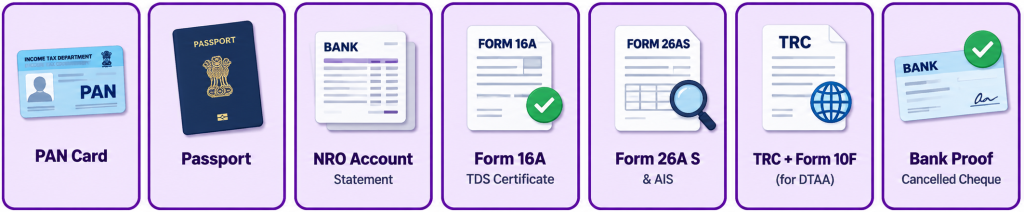
Documents Required to Claim an NRO TDS Refund
Keep these documents ready before you file your return.
How Does DTAA Help NRIs Reduce Tax on NRO Interest?
DTAA stands for Double Taxation Avoidance Agreement. It is a tax treaty between India and your country of residence. For interest income, most treaties set a lower tax rate, usually 10% to 15%, instead of the 31.2% that banks deduct. To use this benefit, you need a Tax Residency Certificate (TRC) from your country, such as the one from the UAE tax authority or Form 6166 from the IRS in the USA. You also need to submit Form 10F and a self-declaration. If you give these to your bank before the interest is paid, it can deduct TDS at the lower rate. If not, you can still claim the difference as a refund through your ITR. Your home country may also tax this interest, but it usually gives credit for tax already paid in India.
Why Is Your NRO Account TDS Refund Delayed or Rejected?
- Return Not E-Verified:- Your return is treated as not filed until you e-verify it, usually within 30 days. Without verification, processing never starts and no refund is issued. Verify right after filing, using net banking, bank account EVC, or a digital signature.
- Bank Account Not Pre-Validated:- Refunds go only to a pre-validated Indian bank account linked to your PAN. If the account is not validated, is closed, or has a name mismatch, the refund fails. Validate the account on the portal before you file.
- TDS Mismatch With Form 26AS or AIS:- If the TDS you claim does not match Form 26AS or AIS, the department may reduce your claim or send a notice. This happens when the bank files late or reports under a wrong PAN. Check both statements before filing.
- Inoperative PAN or Wrong Residential Status:– An inoperative PAN or wrong residential status on your profile can hold your refund. Change your PAN status to NRI before filing so your return is processed correctly and without delay.
- Outstanding Tax Demand:- If you have an old unpaid tax demand, the department can adjust it against your refund and pay you only the balance. Check “Pending Actions” on the e-filing portal and reply to any notice quickly.

Conclusion
Excess TDS on NRO interest is common, but it is not a loss. If your actual tax is lower because of the basic exemption or a DTAA rate, you can claim the extra amount back. File the correct ITR, match your TDS with Form 26AS and AIS, pre-validate your bank account, and e-verify on time. Follow these steps and your refund should reach your account without trouble.
Disclaimer
The content published on NriTaxs is intended for informational purposes only and does not constitute legal, tax, or financial advice. Readers are encouraged to consult qualified professionals before making any decisions based on the information provided.





Related Articles