

If you are buying a flat, plot or house from an NRI, or you are an NRI selling one, the TDS process changed on 1 October 2026. Earlier, a buyer had to get a TAN, deposit the tax, file a quarterly return and then issue a certificate. Many buyers found this confusing and some deals even got stuck. Now, a resident individual or HUF buyer can do the whole job on one online form, Form 141, using only a PAN. But here is the part many people miss: only the paperwork became easier. The TDS rate, the tax on your capital gain and the refund rules are still the same. This guide explains NRI Property Sale TDS Rules From October 2026, new Form 141 process, the TDS rates, how to cut excess TDS using Form 128, what the seller receives, and how to claim a refund, all in simple words.
Quick Answer
From 1 October 2026, a resident individual or HUF who buys property from an NRI deducts TDS under Section 393(2) of the Income-tax Act, 2025 and reports it through Form 141 (Schedule E) using a PAN. No TAN is needed. The buyer then issues a TDS certificate in Form 132 to the NRI seller. TDS rates have not changed.
What Changed for NRI Property Sales From 1 October 2026?
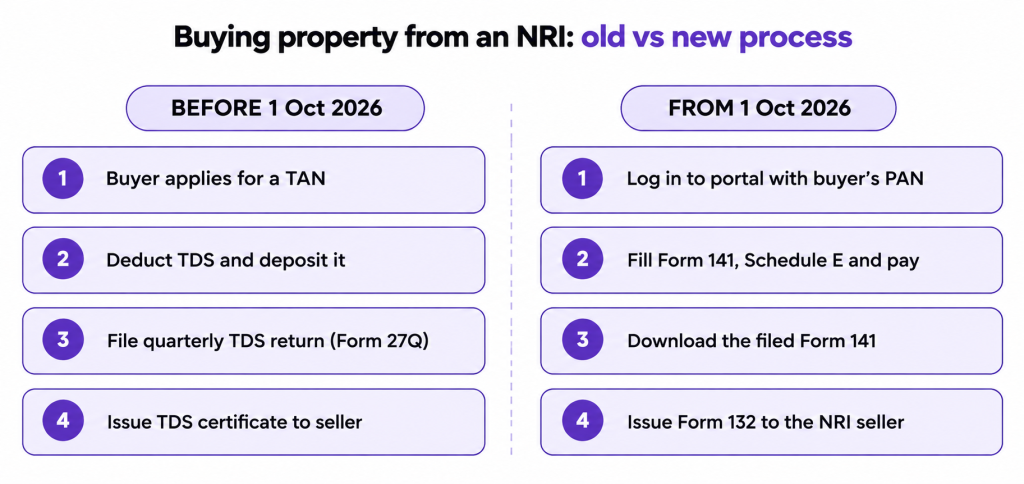
On 22 September 2026, the CBDT issued Notification 121/2026 (the Income-tax Fifth Amendment Rules, 2026). It added a new Schedule E to Form 141 and made the change effective from 1 October 2026. Form 141 is the online challan-cum-statement that replaced the old Form 26QB from 1 April 2026. Now it also covers property bought from non-residents.
In simple terms, the buyer no longer needs a TAN, no longer files the quarterly TDS return for this deal, and does the payment and reporting in one go.
Who Can Use the New Form 141 Route?
This is the first thing to check, because the new route is not for every buyer. It applies when a resident individual or a Hindu Undivided Family (HUF) buys immovable property from a non-resident seller.
| Buyer Type | Process From 1 Oct 2026 |
| Resident individual | Form 141 with Schedule E, PAN only, no TAN |
| Resident HUF | Form 141 with Schedule E, PAN only, no TAN |
| Company, firm or other buyers | The new PAN-only route is not meant for them, so they should keep following the TAN-based process and confirm the exact steps with their CA |
What Are Form 141 and Schedule E?
Form 141 is a “challan-cum-statement”. That means one form works as both the payment slip and the TDS statement. Schedule E is the new part of this form made only for TDS on property bought from a non-resident. It sits under Section 393(2) of the Income-tax Act, 2025, which is the new name for the old Section 195.
In Schedule E, the buyer has to give the property address and type, the PAN and name of each buyer, and each buyer’s share of the sale price. The buyer also reports the seller’s details, the rate used and the tax deducted. The tax reported must include surcharge and cess where they apply.
TDS Rate on NRI Property Sale in 2026
The new form does not change the rate. TDS on property bought from an NRI is deducted from the first rupee. The old ₹50 lakh limit that works for resident sellers does not apply here.
| How Long the Seller Held the Property | Type of Gain | TDS / Tax Rate |
| More than 24 months | Long-term | 12.5% plus surcharge (if any) and 4% cess |
| 24 months or less | Short-term | Normal slab rate of the seller plus surcharge and cess |
| Seller has no PAN | Any | Higher rate, at least 20% |
Is TDS Cut on the Full Price or Only on the Profit?
By default, the buyer deducts TDS on the full sale price, not just on the profit. This surprises most NRI sellers.
Example: Anita, an NRI in Canada, sells a flat for ₹1.5 crore. She bought it for ₹70 lakh six years ago. Her real gain is about ₹80 lakh.
- Tax on her real gain: 12.5% of ₹80 lakh = ₹10 lakh, plus 4% cess = ₹10.4 lakh
- Default TDS on the full price: 12.5% of ₹1.5 crore = ₹18.75 lakh, plus cess = ₹19.5 lakh
- Extra tax stuck with the government: about ₹9.1 lakh until she files her return and claims a refund
(Surcharge is left out here to keep the numbers simple. It can add to both figures.)
How to Reduce TDS Before the Sale: Form 128
The fix for this problem is a lower or nil TDS certificate. Under the old law it was applied for in Form 13 under Section 197. From 1 April 2026 it is Form 128 under Section 395(1) of the Income-tax Act, 2025. The idea is the same: the tax officer checks your real gain and tells the buyer to deduct tax at a lower rate.
- Apply before the sale deed is signed. Once the buyer has paid the full amount with full TDS, the certificate is too late to help.
- Keep your purchase deed, improvement bills, sale agreement and PAN ready.
- Work out your likely gain first. A good capital gains calculator for property sales helps you estimate the tax you will really owe, which is the number the officer will want to see.
- Give the certificate to the buyer. They must then deduct only at the rate shown on it.
A Form 13 certificate issued before 1 April 2026 stays valid for the period written on it. New applications should be made in Form 128.
What the Buyer Must Collect From an NRI Seller
Even with the easier form, the buyer is still responsible for deducting the right amount. So before paying, the buyer should collect:
- The seller’s PAN. If it is missing, a much higher TDS rate applies.
- The seller’s name, address and proof of non-resident status.
- The Form 128 certificate, if the seller has one.
- A Tax Residency Certificate (TRC) and foreign tax ID number, if the seller wants a tax treaty benefit.
As an NRI seller, make sure your PAN records are in order before the deal. If your PAN still shows a resident status or an old address, it can cause confusion at the time of TDS. This guide on changing your PAN status to NRI shows how to fix it.
How the Buyer Files Form 141: Step by Step

- Confirm the seller is a non-resident. Check the passport, visa and overseas address. TDS under Section 393(2) is for non-resident sellers.
- Decide the amount and rate. Use the normal rate, or the lower rate on the seller’s Form 128 certificate.
- Log in with the buyer’s PAN. Go to e-File, then e-Pay Tax, choose the Income-tax Act, 2025, and select Form 141.
- Fill Schedule E and pay. Enter property, buyer, seller and tax details, and pay the amount with surcharge and cess included.
- Download the filed Form 141 and keep it safe. It works as both the challan and the statement.
Do not pay late. Delays can bring interest and make the seller’s refund harder. Ask professional CA to confirm the due date on the portal for your transaction.
Tax Treaty Benefit (DTAA) on a Property Sale
India taxes gains from property located in India, even when the seller lives abroad. Your country of residence may also tax the same gain. A Double Taxation Avoidance Agreement (DTAA) helps you claim credit abroad for the tax paid in India, so you are not taxed twice on one profit. To use it, you will usually need the TRC and tax ID mentioned above. Read this explainer on how NRIs can avoid double taxation on a property sale before you file in your home country.
Form 132: The TDS Certificate the Seller Gets
After the TDS is paid, the buyer issues a TDS certificate to the NRI seller in Form 132. CBDT amended this form as part of the same October 2026 change. This certificate is your proof that tax was paid on your behalf. You need it, along with the entry in your tax records, to claim credit when you file your return. Ask for it right after the deal, not months later.
Does Your Residential Status Matter?
Yes. The whole NRI TDS route depends on the seller being a non-resident for tax purposes. Your status is decided by the days you stayed in India and other tests, and it can change from year to year. If the buyer treats you as a non-resident but your records say resident, or the other way round, the wrong TDS can be deducted and your return can get messy. Check your status carefully, and if needed, update your residential status on the income tax portal before the sale.
How to Claim a TDS Refund After the Sale
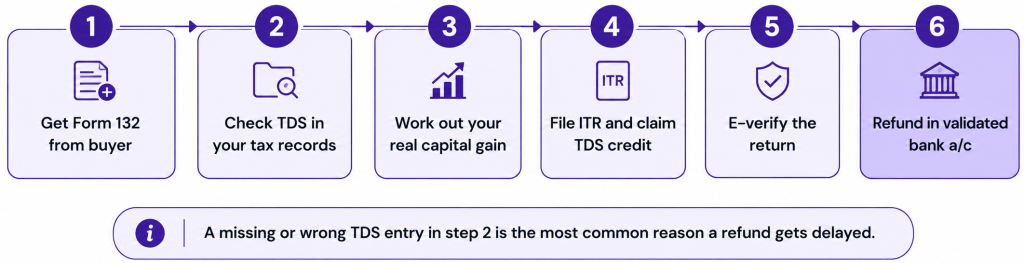
If the TDS deducted is more than your real tax, the extra amount comes back as a refund. You must file an income tax return (usually ITR-2 for capital gains) and follow these steps.
1Get Form 132from buyer2Check TDS inyour tax records3Work out yourreal capital gain4File ITR andclaim TDS credit5E-verifythe return6Refund invalidated bank a/cA missing or wrong TDS entry in step 2 is the most common reason a refund gets delayed.
Step 2 deserves extra care. Your refund is only as good as the TDS entry against your PAN. If the buyer made a mistake in the form, the amount may not show up. Log in a few weeks after the sale and check. Under the new rules, the annual statement is being renamed, so it also helps to read what the new AIS Form 168 means for taxpayers to know which statement to check for your return year.
Where Should the Sale Money Go? NRO Account First
Money from an Indian property sale normally lands in your NRO account, not your NRE account. Make sure your NRO account is active and your KYC is current before the buyer pays, so the funds do not get stuck. If you still hold a resident savings account, learn how to convert a savings account to an NRO account well before the sale date.
Sending the Money Abroad: Forms 145 and 146
To move sale proceeds from your NRO account to a foreign account, you can send up to USD 1 million per financial year. Banks ask for Form 145 (the old Form 15CA) and, where needed, Form 146 (the old Form 15CB, the CA certificate). These replaced the old numbers for payments made on or after 1 April 2026. Before you plan the transfer, understand the difference between NRE and NRO accounts, because the repatriation rules are not the same for both.
Quick Checklist for Buyers and Sellers
| Buyer (resident individual / HUF) | Seller (NRI) |
| Confirm seller’s non-resident status | Keep PAN active and status correct |
| Ask for Form 128 certificate, if any | Apply for Form 128 before signing the deed |
| Deduct TDS at the right rate, with surcharge and cess | Estimate your real capital gain |
| File Form 141 (Schedule E) using PAN | Check that TDS shows against your PAN |
| Issue Form 132 to the seller | File ITR and claim refund of any extra TDS |
Common Mistakes to Avoid
- Thinking the new rule lowers the tax. Only the process changed. The TDS rate and the capital gains tax are the same.
- Using the PAN-only route for the wrong buyer. It is meant for resident individual and HUF buyers.
- Applying the ₹50 lakh limit. That limit is for resident sellers. For NRI sellers, TDS starts from the first rupee.
- Skipping Form 128. Without it, TDS is cut on the full price and your money stays locked.
- Using old form names. Form 13, Form 26QB, Form 15CA and Form 15CB now have new numbers.
- Not checking the TDS entry. A wrong entry in Schedule E can block the seller’s refund.
- Forgetting to file the ITR. TDS is not the final tax. A return is needed for the refund.
Conclusion
The October 2026 change makes life easier for resident individuals and HUFs who buy from NRIs. One online form, Form 141 with Schedule E, and a PAN are enough. But the money side is unchanged. TDS can still be large, so NRI sellers should apply for Form 128 early, keep their documents ready, check the TDS entry and file their return on time. Buyers should deduct the correct amount and issue Form 132 quickly. Get these basics right and the sale, the refund and the transfer abroad all become smoother.
Disclaimer
The content published on NriTaxs is intended for informational purposes only and does not constitute legal, tax, or financial advice. Readers are encouraged to consult qualified professionals before making any decisions based on the information provided.




Related Articles