
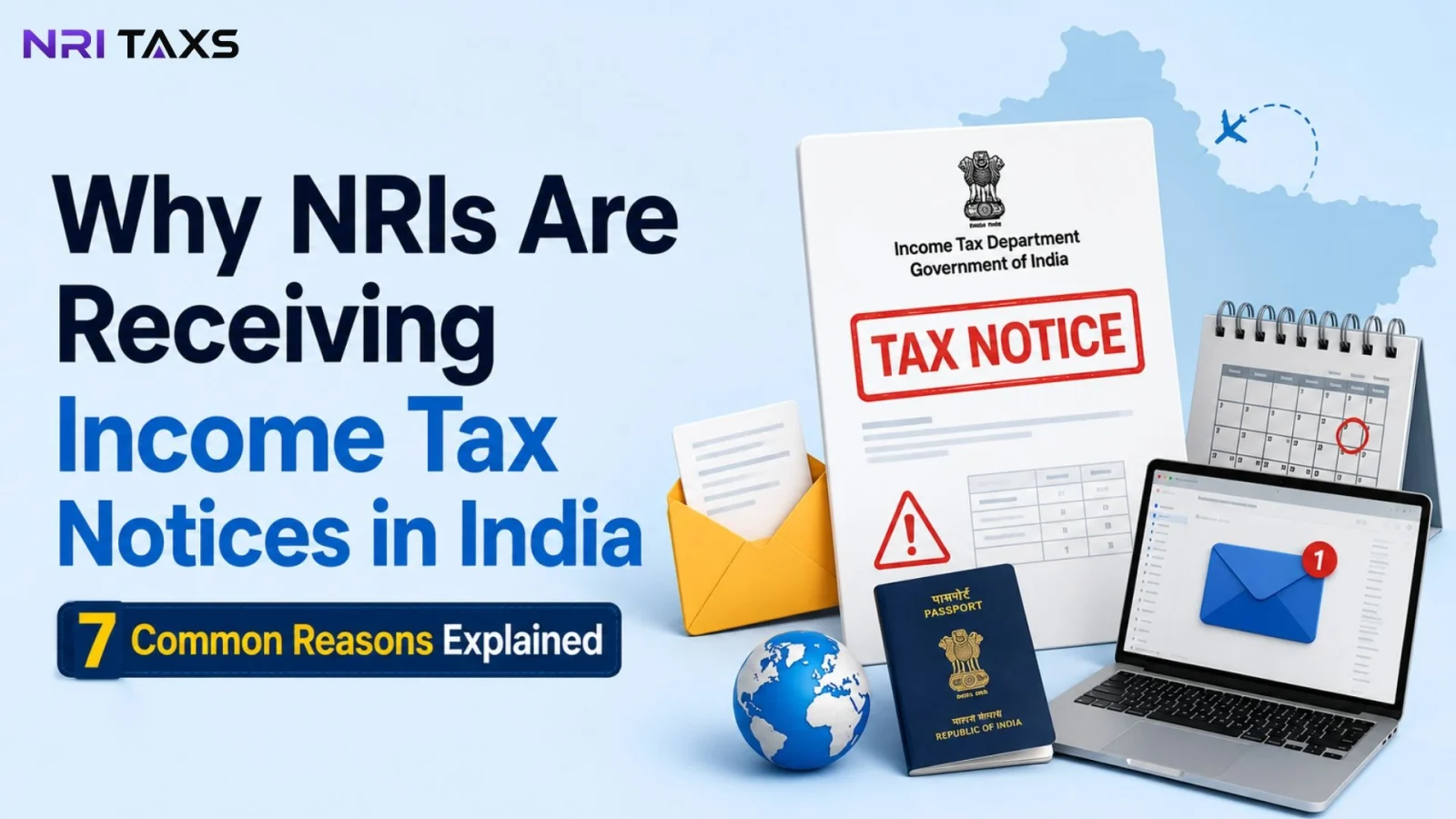
Receiving an income tax notice can be worrying, especially if you’re living outside India. Many NRIs assume that a notice means they’ve made a serious mistake or are facing legal action. In reality, that’s not always the case. In many instances, notices are issued simply because the Income Tax Department needs additional information, finds a mismatch in reported income, or wants clarification on a transaction.
If you’ve recently received an income tax notice or want to avoid one in the future, understanding why these notices are issued is the first step. In this guide, we’ll explain the seven most common reasons NRIs receive income tax notices, what each notice means, and the steps you should take to respond correctly and stay compliant.
Key Takeaways
- ✓ Receiving an income tax notice doesn’t always mean you’ve done something wrong.
- ✓ Most notices arise due to reporting mismatches, incorrect residential status, or unreported income.
- ✓ Always check the notice section, AIS, and Form 26AS before responding.
- ✓ Missing the response deadline can lead to penalties and further scrutiny.
- ✓ Most NRI tax notices can be resolved by responding accurately and on time.
What Is an Income Tax Notice?
An income tax notice is simply a formal communication from the Income Tax Department, usually asking you to clarify, correct, or provide additional information related to your return. It’s issued under specific sections of the Income Tax Act, and the section number tells you exactly why the department has reached out whether it’s a routine intimation, a request for documents, or something that needs a more detailed response. It’s worth repeating: a notice is not the same as a penalty. Most notices are procedural and resolve quickly once you respond with the right information within the deadline.
Why Are NRIs Receiving Income Tax Notices?
NRIs face a higher chance of receiving a notice than resident taxpayers, mainly because their income sources, rental property, capital gains, foreign bank interest are harder for the department’s automated systems to match cleanly against what’s reported in the return. Below are the seven reasons that come up most often.
Reason 1: Not Reporting Rental Income
Many NRIs who rent out property in India assume that since the tenant deducts TDS, there’s nothing left to do. That incorrect rental income earned in India is taxable for NRIs regardless of where they live, and it must still be reported in the ITR even after TDS has been deducted at source. When a tenant or company deducts TDS under Section 195 but the corresponding rental income never shows up in the return, the mismatch between what’s reported to the department and what’s declared by the taxpayer is one of the most common reasons for income tax notice NRI households receive.
Reason 2: Incorrect Residential Status
Your residential status, Resident, Non-Resident, or Resident but Not Ordinarily Resident (RNOR) determines which income is taxable in India. Getting this wrong is a frequent trigger for an NRI residential status notice. Common mistakes include miscounting days spent in India against the 182-day and 120-day rules, or continuing to file as a resident out of habit after moving abroad. Since your tax liability changes significantly based on this status, the department flags returns where the declared status looks inconsistent with travel or income data it holds.
Reason 3: Capital Gains Not Reported
Selling property, mutual funds, or shares in India as an NRI usually triggers TDS at source, but that doesn’t exempt you from reporting the capital gain in your ITR. Whether the sale was disclosed with the correct cost of acquisition, holding period, and exemption claims (if any) is exactly what the department checks. An NRI capital gains notice is often issued when the sale value reported by the registrar or buyer doesn’t match or simply doesn’t appear in the taxpayer’s return.
Reason 4: Mismatch Between ITR, AIS & Form 26AS
This is the single biggest source of notices across all taxpayer categories, not just NRIs. Your Annual Information Statement (AIS) and Form 26AS are populated using data submitted by banks, employers, and other reporting entities, and the department’s system automatically checks this against your filed return. If interest income, dividend income, or TDS entries don’t line up, you’ll likely see an AIS mismatch notice. Note that the government has introduced Form 168 as the eventual replacement for Form 26AS under the new Income-tax Rules, 2026, but it only applies from FY 2026-27 onward for the current filing cycle, AIS and Form 26AS remain the documents to reconcile against. If you’ve identified a mismatch but aren’t sure how to respond to the notice, it’s important to review the details carefully before submitting your reply. You can take help from Income Tax Notice Response Services for professional guidance.
Reason 5: Claiming Wrong TDS Credit
TDS credit can only be claimed to the extent it actually appears in your Form 26AS (or Form 168, once applicable). NRIs sometimes claim credit based on a bank certificate or a Form 16A that hasn’t yet been reflected in the department’s system, or claim credit under the wrong assessment year. Either way, a discrepancy between the TDS you’ve claimed and what the department’s records show is a fast way to trigger scrutiny.
Reason 6: Foreign Income Disclosure Issues
NRIs are only taxed in India on income that is earned or accrued in India salary or investment income earned abroad generally isn’t taxable here. The confusion usually runs in one of two directions: some NRIs mistakenly report their entire global income out of caution, creating unnecessary complications, while others fail to properly disclose India-sourced income that got routed through or connected to a foreign account. Both scenarios can prompt the department to ask for clarification.
Reason 7: High-Value Transactions Flagged
Property purchases above certain thresholds, large fixed deposits, high-value mutual fund investments, and big cash deposits are all reported to the tax department through Statement of Financial Transactions (SFT) filings by banks, registrars, and financial institutions. These show up in your AIS. When a high-value transaction doesn’t have a matching income disclosure to explain the source of funds, it’s a very common trigger and one more reason for income tax notice NRI investors specifically need to watch for, since large one-off transactions (like a property sale or an NRE-to-NRO transfer) are exactly the kind of activity that gets picked up.

What Should You Do After Receiving an Income Tax Notices?
This is the part that actually matters how you respond determines whether the notice resolves in a week or drags on for months.
Step 1: Read the Notice Carefully
Note the assessment year it relates to, the section under which it’s issued, and the exact query being raised. Don’t assume read the specific wording, since two notices under the same section can be asking for completely different things.
Step 2: Check the Section
The section number tells you what kind of notice this is and how urgently you need to act. A Section 143(1) intimation is usually informational, while a Section 148 notice for income escaping assessment needs a far more careful, often professionally guided response.
Step 3: Verify Against AIS
Log in to the income tax portal and cross-check the AIS and Form 26AS entries for the relevant year against what you filed. This usually tells you exactly where the mismatch is coming from before you respond to anything.
Step 4: Collect Supporting Documents
Gather the relevant bank statements, sale deeds, Form 16A/TDS certificates, and computation sheets that support your original filing. Having these ready before you draft a response saves significant back-and-forth.
Step 5: Reply Before the Deadline
Every notice carries a response deadline, and missing it can escalate a routine query into a more serious compliance issue. If you’re not confident about the technical response required, this is the point to bring in a tax professional familiar with NRI filings rather than responding informally.
Missing the response deadline can lead to additional penalties and compliance issues. You can also read our guide on the penalties for late filing or not filing taxes for NRIs to understand the possible consequences.
How to Avoid Income Tax Notices in the Future
Most notices are preventable. Use this checklist every filing season to avoid income tax notice NRI situations before they start:
- ✔ File your ITR on time, every year, even in years with minimal India income.
- ✔ Confirm your residential status correctly before you file.
- ✔ Match every entry in your return against AIS before submission.
- ✔ Match every entry against Form 26AS before submission.
- ✔ Report all capital gains, even when TDS was already deducted.
- ✔ Keep documentation of sale deeds, TDS certificates, bank statements organized and accessible year-round.
If you’re filing your return for the first time as an NRI, follow our step-by-step guide on how to file an Income Tax Return for NRIs.
Contact Us
Common Types of Income Tax Notices NRIs May Receive
Here’s a quick reference for the notice sections that come up most often:
| Section | Why It’s Received |
| 139(9) | Defective return — usually a form error, missing schedule, or inconsistency in the filing itself |
| 143(1) | Intimation — an automated comparison of your return against the department’s records, often just informational |
| 142(1) | Information requested — the department needs specific documents or clarification before completing assessment |
| 148 | Income escaping assessment — the department believes some income wasn’t disclosed in a prior year’s return |
If you’ve already missed the ITR filing deadline, don’t panic. Our complete guide explains the available options to fix missed NRI tax filings and reduce penalties.
Conclusion
An income tax notice for NRIs is far more often a compliance nudge than a legal crisis — but only if you respond correctly and on time. Understanding these seven common reasons for income tax notice NRI cases arise, checking your AIS and Form 26AS every year before filing, and keeping your documentation in order are the simplest ways to make sure you never have to deal with one in the first place.
If you’re unsure how to respond to a notice, getting professional guidance early can help you avoid unnecessary delays, penalties, and repeated notices.
Disclaimer
The content published on NriTaxs is intended for informational purposes only and does not constitute legal, tax, or financial advice. Readers are encouraged to consult qualified professionals before making any decisions based on the information provided.








Related Articles