
Planning for a child’s education is a primary financial goal for many families, and GIFT City Funds for Children’s Education Planning offers a structured approach for this purpose. Non-Resident Indians (NRIs) often seek investment options that align with international standards, offer tax efficiency, and can be managed in foreign currencies. Funds based in Gujarat International Finance Tec-City (GIFT City) are designed to meet these needs, making them a relevant choice for long-term goals like funding a child’s future education. In the blog, we will explore How NRIs Can Use GIFT City Funds for Children’s Education Planning.
Quick Overview Of Gift City Funds
If you want to know what GIFT City is, let us explain. GIFT City, India’s first operational International Financial Services Centre (IFSC), serves as a global financial hub. Its funds operate under an international regulatory framework and offer investment options in foreign currencies such as USD and EUR. Designed for global investors, including NRIs, these funds provide seamless cross-border investment opportunities and professional fund management, making them ideal for long-term financial goals.
Read Also:-
Benefits of GIFT City Funds for Children’s Education Planning
- Currency-Denominated Investments:- Invest in USD, EUR, or other hard currencies to reduce exchange rate risk, especially for funding education abroad.
- Tax Efficiency:- GIFT City offers a favorable regulatory and tax framework, enhancing net returns compared to traditional domestic investments.
- Long-Term Wealth Creation:- Professional management and diversified global portfolios help grow wealth over 10–15 years, meeting future education costs.
- Global Investment Access:- Provides exposure to international markets, allowing NRIs to align investments with global financial opportunities and goals.
Choosing The Right Fund For Nri Children’s Education
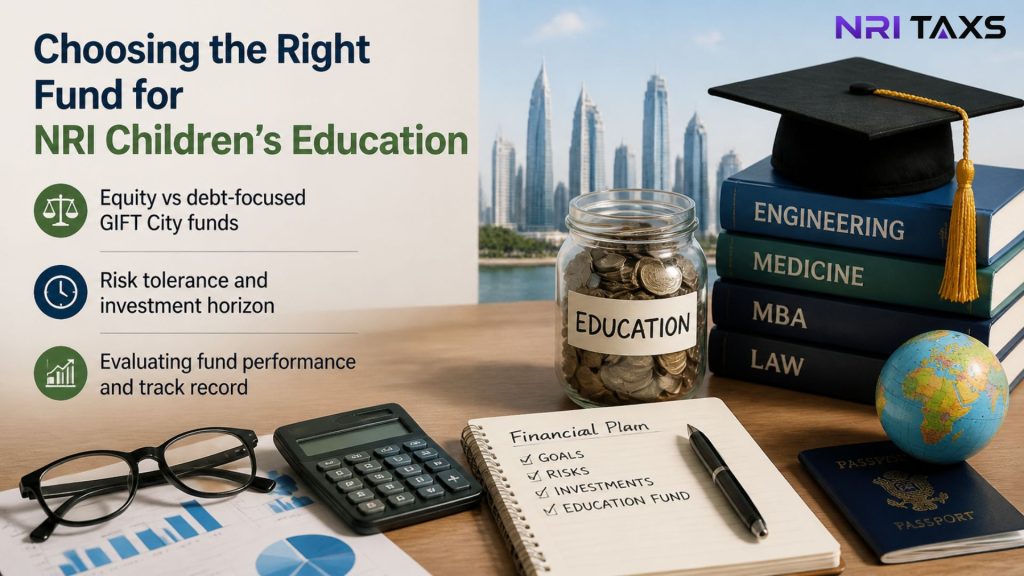
Equity vs debt-focused GIFT City funds
Funds in GIFT City can be broadly categorized into equity-focused and debt-focused. Equity funds primarily invest in stocks and offer higher growth potential, which is suitable for long-term goals. Debt funds invest in bonds and other fixed-income instruments, offering more stability and lower risk. Hybrid funds, which invest in a mix of both, provide a balanced approach. The choice depends on how much time is left until the funds are needed for education.
Risk tolerance and investment horizon
The investment horizon, the time until the money is needed is a key factor. If a child is very young, there is a longer time horizon of 15 years or more. In this case, an equity-oriented fund may be appropriate to maximize growth potential. However, if the education goal is only five years away, a more conservative approach with a higher allocation to debt funds would be more suitable to protect the accumulated capital from market volatility.
Evaluating fund performance and track record
Before investing, it is important to evaluate the fund’s history and the credibility of the fund management team. While past performance does not guarantee future results, it provides valuable insight into the fund’s management style and its consistency. We recommend reviewing the fund’s investment philosophy, its historical returns, and the experience of the asset management company to make an informed decision.
How Nris Can Use Gift City Funds For Children’s Education Planning?
Setting Clear Education Financial Goals
The first step is to define the educational goal. This includes deciding on the type of education (e.g., an undergraduate degree in technology), the potential country (e.g., UK, Australia, India), and the year the funds will be required. A clear goal makes it easier to estimate the total cost and create a focused investment strategy.
Estimating Future Education Costs
Education costs tend to rise faster than general inflation. It is crucial to estimate the future cost of the desired course, factoring in tuition fees, accommodation, and other living expenses. Online calculators and educational consultant reports can help project these costs accurately. This target amount becomes the financial goal for the investment plan.
Choosing the Right GIFT City Funds
Based on the financial goal and the time horizon, we can select the right mix of funds. For a long-term goal (over 10 years), a higher allocation to equity funds can be considered. For a medium-term goal (5-10 years), a balanced or hybrid fund may be ideal. The choice should also align with the currency of the target education destination.
Creating a Long-Term Investment Plan Using SIPs
A Systematic Investment Plan (SIP) is an effective way to invest for long-term goals. By investing a fixed amount regularly (e.g., monthly), one can benefit from cost averaging and build a disciplined investment habit. SIPs make it easier to manage cash flow while steadily building the education corpus over time.
Managing Risk Based on Time Horizon & Currency Impact
As the education goal gets closer, it is important to reduce risk. We suggest gradually shifting the investment from equity funds to more stable debt funds in the last two to three years before the funds are needed. This step helps protect the accumulated capital from any short-term market downturns just before withdrawal.

Case Studies / Examples
- NRI Family Investing for School Education in India
Consider an NRI family living in Singapore with a four-year-old child. They plan to send their child to a premium international school in India for high school in ten years. They estimate the total cost to be around ₹50 lakhs. The family decides to start a monthly SIP in a balanced hybrid fund in GIFT City. This approach provides a mix of growth and stability, helping them build the required corpus over the next decade.
- Planning for Higher Studies Abroad
Another example is an NRI family in the UAE with a nine-year-old child who aims to pursue a master’s degree in the US in about 12 years. They estimate the future cost to be around $150,000. To align with this goal, they choose a USD-denominated, equity-focused fund in GIFT City. They start a monthly SIP of $500, which allows them to build the required amount in the target currency, minimizing exchange rate risk.
Conclusion
GIFT City Funds for Children’s Education Planning provide NRIs with a structured, tax-efficient, and globally aligned investment option to secure their children’s academic future. By setting clear financial goals, choosing the right mix of equity, debt, or hybrid funds, and following disciplined investment strategies like SIPs, parents can steadily build a long-term education corpus. Proper risk management and currency alignment ensure that funds are available when needed, making GIFT City Funds an effective solution for planning a child’s education.
Disclaimer
The content published on NriTaxs is intended for informational purposes only and does not constitute legal, tax, or financial advice. Readers are encouraged to consult qualified professionals before making any decisions based on the information provided.










Related Articles