
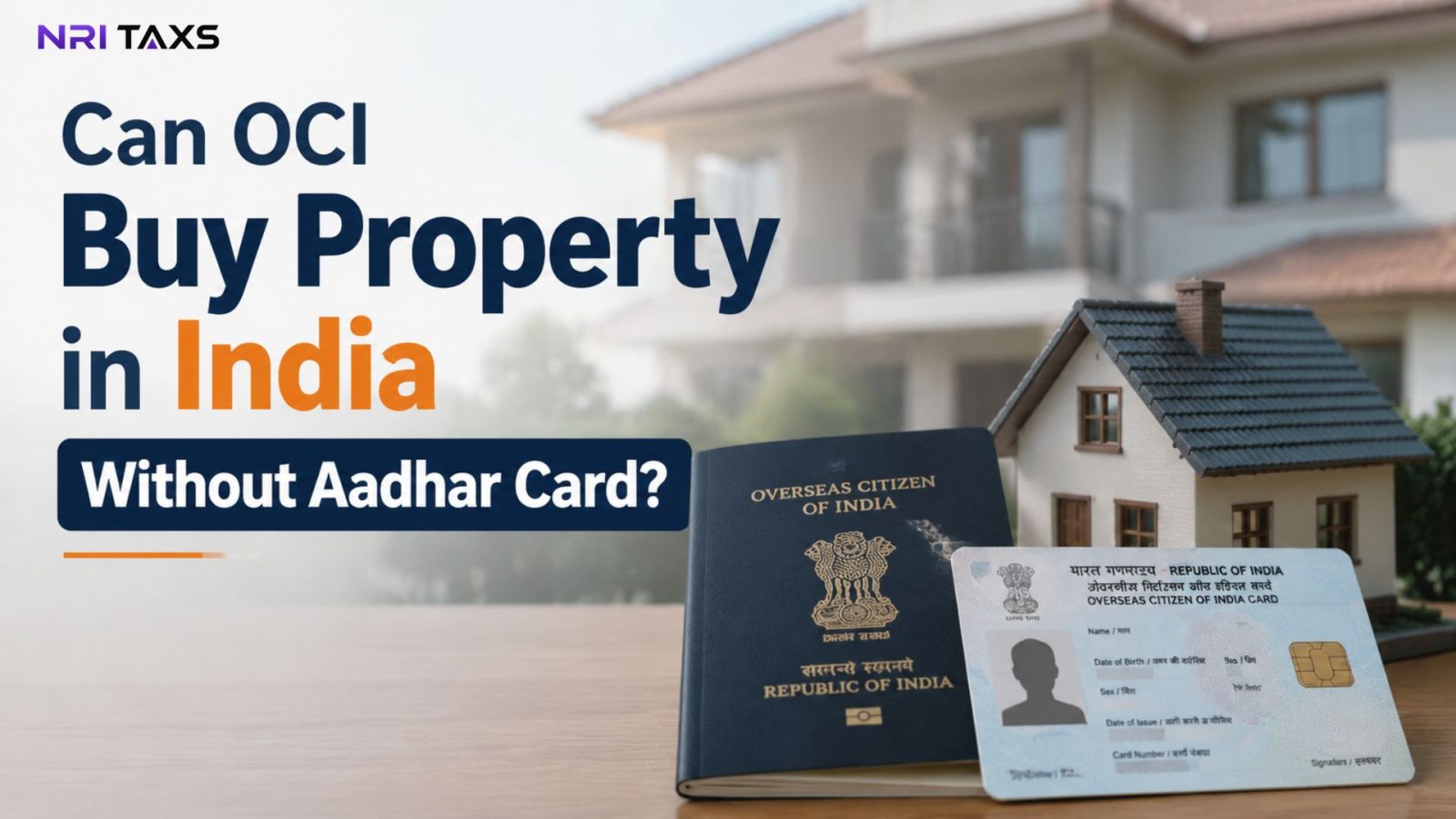
If you hold an Overseas Citizen of India (OCI) card and you’re planning to invest in real estate back home, one question probably comes up before anything else: can OCI buy property in India without Aadhar card?
The short answer is yes. An OCI cardholder can legally buy residential or commercial property in India without an Aadhaar card. Aadhaar is not a mandatory requirement for OCIs under Indian property law; your OCI card, passport, and PAN card are what actually matter.
That said, “legally not required” and “practically smooth” aren’t always the same thing in India. Some sub-registrar offices still ask for Aadhaar out of habit, even when it isn’t legally necessary. This guide breaks down exactly why Aadhaar isn’t mandatory, what documents you actually need, what the FEMA and RBI rules say, and how to handle a registrar who insists on Aadhaar anyway.
Why Aadhaar Is Not Mandatory for OCI Property Buyers?
Aadhaar was designed as an identity document for residents of India. Under the Aadhaar Act and related rules, only an individual who has resided in India for 182 days or more in the 12 months preceding the application is eligible to even apply for Aadhaar. OCI cardholders living abroad usually don’t meet this residency threshold, so the law doesn’t expect them to have one.
NRC cardholders such as PIO and OCI holders, along with foreign passport holders and Indian passport holders living abroad, are all permitted to purchase residential and commercial properties without requiring Aadhaar. Instead, your OCI card and address proof are treated as the essential identity documents for the transaction.
This isn’t a loophole, it’s built into how property registration law treats non-resident buyers. RBI guidelines allow OCI holders to buy and sell immovable property in India, except agricultural land, plantation property, or a farmhouse, and Aadhaar is not a stipulated requirement for such transactions.
Documents Required for OCI to Buy Property in India
Even though Aadhaar is off the table, you can’t buy property on goodwill alone. Here’s the real document checklist for OCI property purchase in India.
| Document | Purpose |
| OCI Card | Establishes your overseas citizen status and eligibility to purchase immovable property in India. |
| Valid Passport | Serves as your primary international identity proof across all legal transactions. |
| PAN Card | Mandatory for tracking financial transactions, direct tax compliance, TDS depositing, and property registration. |
| Address Proof (Foreign or Indian) | Confirms your active, current residential address for official KYC and notice records. |
| Passport-Size Photographs | Required at the local Sub-Registrar office during the execution of the final Sale Deed. |
| Power of Attorney (PoA) | Required if you are not physically present in India; allows a trusted local representative to execute the transaction on your behalf. |
| Property Title Documents | Includes the primary Title Deed, Encumbrance Certificate (EC), No-Objection Certificates (NOCs), and Approved Building Plan to confirm the property is legally clear. |
A PAN card, unlike Aadhaar, genuinely cannot be skipped. A PAN card is a legal requirement for NRIs and OCI holders conducting any financial activity in India, including property transactions, NRO account opening, and fund repatriation. The good news: NRIs and OCI holders are formally exempt from linking PAN with Aadhaar, an exemption that applies to all non-residents and foreign citizens.
Compliance Insight: Avoid common funding errors by reviewing our guide on NRE vs NRO Account Regulations for Property Investment.
The Legal Backbone: FEMA and RBI Rules
OCI property rights in India don’t come from a single circular — they sit inside a broader regulatory framework.
Since October 17, 2019, rule-making power over immovable property transactions shifted from RBI to the Central Government, and Chapter IX of the Foreign Exchange Management (Non-Debt Instruments) Rules, 2019 now governs purchase, sale, gift, and inheritance of property in India by persons resident outside India — including NRIs, OCIs, and foreign citizens of Indian origin. RBI continues to regulate and monitor compliance, often through Authorized Dealer banks.
Under this framework:
- OCI holders can buy residential and commercial property without prior RBI approval.
- Transactions must be carried out in Indian Rupees, funded through normal banking channels or NRE, NRO, or FCNR accounts.
- Agricultural land, plantation property, and farmhouses cannot be purchased by OCI holders, though inherited restricted property can usually be retained.
- A person who bought property as an Indian citizen and later became an OCI cardholder can continue holding it without needing fresh RBI approval.
What OCI Holders Cannot Buy?
Aadhaar or no Aadhaar, certain property categories stay off-limits for OCI cardholders:
| Property Type | Can OCI Buy It? |
| Residential Flat/House | Yes — Fully permitted without any special RBI approval. |
| Commercial Office or Shop | Yes — Fully permitted for investment or business purposes. |
| Agricultural Land | No — Strictly prohibited from fresh purchase or joint acquisition. |
| Plantation Property | No — Strictly prohibited from fresh purchase or joint acquisition. |
| Farmhouse | No — Strictly prohibited from fresh purchase or joint acquisition. |
| Inherited Agricultural Land | Allowed to hold — Restrictions apply on resale (can only be sold or gifted to resident Indian citizens). |
OCI cardholders can purchase residential and commercial properties in India, but they are not permitted to purchase agricultural land, including farmland or any kind of plantation property.

How Can OCI Buy Property in India?
Here is a quick steps:
- Identify and verify the property, confirm clear title, RERA registration, and encumbrance-free status.
- Arrange funds through an NRE, NRO, or FCNR account, or via normal banking channels from abroad.
- Sign the agreement and pay the token amount through a traceable banking transaction.
- Apply for a PAN card if you don’t already have one; this is non-negotiable.
- Execute Power of Attorney if you can’t be physically present; have it notarized at the Indian consulate and registered in India.
- Register the sale deed at the local Sub-Registrar Office using your OCI card, passport, PAN card, and address proof.
- Complete payment and collect possession and ownership documents.
The process generally involves choosing a legally verified property with clear title, signing the agreement, paying through banking channels, registering at the Sub-Registrar Office, and finally receiving possession and ownership documentation.
What If a Registrar Insists on Aadhaar Anyway?
This is the most common real-world friction point. Many Sub-Registrar offices use Aadhaar-based e-KYC software by default and may push back even though it isn’t a legal requirement for OCIs.
If this happens:
- Politely clarify that you are an OCI cardholder, not an Indian resident, and cite that Aadhaar eligibility itself requires 182+ days of residency in India.
- Offer your OCI card + passport + PAN card as alternative identity proof.
- If the registrar still refuses, you can ask the registrar to reject the registration document by giving reasons in writing, after which you can file an appeal before the district registrar.
Keeping this paper trail matters, a written rejection gives you something concrete to escalate, rather than a verbal “no” that’s hard to challenge.
Selling Property Later? Aadhaar Still Isn’t Required
If you’re an OCI thinking ahead to eventually selling the property, the same logic applies on exit. There’s no TDS specifically tied to Aadhaar for the purchaser in a property transaction — stamp duty and registration charges apply to the buyer, while capital gains tax applies to the seller. On the seller side, funds from a sale must be routed through an NRO account, with proof of sale, tax clearance, and Form 15CA/15CB as mandatory paperwork, while the buyer deducts TDS at 20% for long-term gains or 30% for short-term gains, plus surcharge and cess.
If you want the full picture on the disposal side, our detailed guide on repatriating sale proceeds as an NRI or OCI walks through the LRS limits and bank paperwork.

OCI vs NRI vs PIO: Quick Clarification
A lot of confusion around Aadhaar and property rules stems from mixing up these three categories.
| Status | Definition | Aadhaar Required for Property? |
| NRI | Indian citizen residing outside India for employment, business, or vocation. | No — Passport and PAN are sufficient for registration. |
| OCI | Foreign citizen of Indian origin holding a lifetime OCI visa card. | No — OCI card, foreign passport, and PAN are sufficient. |
| PIO | Older status category, now completely merged into the OCI framework. | No — However, PIO cards can no longer independently be used to acquire new property under current regulatory rules. |
Under the new 2019 rules, PIO is not allowed to acquire property in India independently anymore so if you still hold an old PIO card, converting it to OCI is worth doing sooner rather than later. For a full breakdown, see our related post on OCI vs PIO card: which one do you actually need.
Final Thoughts- Can OCI Buy Property in India
So, can OCI buy property in India without Aadhar card? Yes clearly and legally. The real groundwork lies in getting your PAN card, OCI card, passport, and NRO/NRE banking in order, not in chasing an Aadhaar card you’re not even eligible to hold in most cases. Where you might hit friction is at the registrar’s desk, and that’s a documentation-awareness problem, not a legal barrier.
If you’re actively planning a purchase, it’s worth getting a property lawyer or NRI-focused consultant to review your specific deal before you sign anything — FEMA compliance mistakes are expensive to undo after the fact.
Need help vetting your property documents or PoA before you buy? Talk to our NRI property consultants today for a free document checklist review.
Disclaimer
The content published on NriTaxs is intended for informational purposes only and does not constitute legal, tax, or financial advice. Readers are encouraged to consult qualified professionals before making any decisions based on the information provided.






Related Articles