

Many NRIs run a business, consultancy or freelance work with Indian clients. When those clients pay you, they often deduct TDS first, and the amount can be much higher than the tax you actually owe. Many NRIs assume the deduction is final, but it is not. TDS is only an advance payment of tax. If it is more than your real tax bill, you can get the extra money back by filing an income tax return. This guide explains how TDS on NRI business income, when you can claim a refund, which ITR form to use, how the refund is calculated, and the steps to follow in 2026. We also cover deadlines and common mistakes.
Quick Answer
Yes, an NRI can claim a refund of excess TDS on business income earned in India. File ITR-3 on the income tax portal, show your business profit after expenses, claim credit for the TDS shown in Form 26AS, and e-verify the return. The refund is the TDS and other taxes paid minus your final tax.
What Is TDS on NRI Business Income in India?
TDS means Tax Deducted at Source. When an Indian client or company pays an NRI for business income, it must deduct tax under Section 195 before making the payment. The rate depends on the type of payment and any tax treaty benefit, and surcharge and cess may apply. The deduction is usually made on the gross payment, not on your profit. So the tax deducted can be higher than your final tax.
Is Business Income Earned by NRIs Taxable in India?
Business Income Earned in India
Business income is taxable in India for an NRI if it is earned, received or accrued in India. This includes profits from a business, shop, consultancy or services provided to Indian clients, even if you live abroad.
Business Income Earned Outside India
Income from a business run fully outside India is generally not taxable in India for an NRI. It becomes taxable only if the money is received in India. Always keep proof showing where the work was done and paid.
Role of DTAA in NRI Business Taxation
India has tax treaties (DTAA) with many countries. Under most treaties, business profits are taxed in India only if you have a permanent establishment here. To understand how treaties stop double tax, see how NRIs can avoid double taxation.
When Can NRIs Claim a TDS Refund on Business Income?
- When TDS Deducted Exceeds the Actual Tax Liability:- If TDS deducted by your clients is more than the tax on your actual profit, the extra amount is refundable. This is common because TDS is cut on gross receipts, before business expenses are subtracted.
- When No Tax Is Payable After Calculating Taxable Income:- If your taxable income after expenses falls below the basic exemption limit, no tax is due. The full TDS then comes back to you as a refund, but only after you file your return.
- When Eligible Business Expenses Reduce Taxable Income:- Genuine business expenses like rent, salaries, software, travel and depreciation reduce your taxable profit. Lower profit means lower tax, so more of your TDS is refunded. Keep bills and records ready for every expense.
Which ITR Form Should NRIs Use for Business Income?
NRIs with business or professional income in India must file ITR-3. ITR-1 and ITR-4 (Sugam) are not available to non-residents, and ITR-2 cannot be used when there is business income. Presumptive schemes such as Section 44AD and 44ADA are meant for residents, so an NRI should maintain books of accounts and show actual profit in ITR-3.
| Your Income Type | ITR Form for NRIs |
| Business or professional income in India (with or without other income) | ITR-3 |
| Only salary, house property, capital gains or interest (no business) | ITR-2 |
| Business run through a partnership firm, LLP or company | ITR-5 or ITR-6 (filed by the entity) |
| ITR-1 and ITR-4 | Not allowed for NRIs |
If you are also filing for other Indian income, the overall process is covered in our guide on how NRIs can file taxes in India for FY 2025-26.
Documents Required for NRI Business ITR and TDS Refund
| Document | Why You Need It |
| PAN card | Needed to file the return and match TDS credit |
| Passport and visa/residence permit | Proof of NRI status and days spent in India |
| Form 26AS and AIS | Shows the TDS deducted and income reported against your PAN |
| TDS certificates from clients | Backup proof for every TDS amount claimed |
| Invoices and bank statements | Proof of business receipts |
| Profit and loss account, balance sheet | Shows net business income |
| Expense bills and depreciation details | Supports the deductions you claim |
| Pre-validated Indian bank account | Needed to receive the refund |
| Tax Residency Certificate and Form 10F | Needed if you claim DTAA benefit |
| Tax audit report (if applicable) | Required when turnover crosses the audit limit |
How to Claim a TDS Refund on NRI Business Income in India
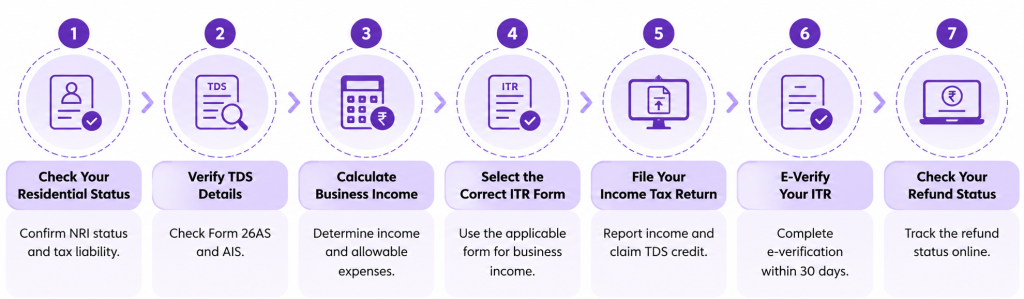
Step 1: Check Your Residential Status and Tax Liability
First confirm that you are an NRI for the year, based on your days in India. Then check which income is taxable in India. Your status decides how your income is taxed and which ITR form you can use. If you are unsure, read who is an NRI and the tax rules.
Step 2: Verify TDS Details in Form 26AS
Log in to the income tax portal and download Form 26AS and your AIS. Check that every TDS entry matches your client’s payment records, PAN and amount. If something is wrong, ask the client to correct it. See our guide on AIS vs Form 26AS mismatch to fix differences.
Step 3: Calculate Business Income and Allowable Expenses
Add all business receipts for the year and subtract allowable expenses and depreciation. The result is your net business income. Add other Indian income, such as NRO interest, then apply deductions if you choose the old tax regime. Keep proper books, as NRIs cannot use presumptive schemes.
Step 4: Select the Correct ITR Form
Choose ITR-3 if you have business or professional income in India. ITR-4 is not available to NRIs. Choosing the wrong form can lead to a defective return notice and delay your refund by weeks or even months.
Step 5: File Your Income Tax Return and Claim TDS Credit
Enter your income, expenses and tax details in the return. In the taxes paid section, add each TDS amount exactly as shown in Form 26AS. Add your pre-validated bank account for the refund, review the refund shown by the system, and submit.
Step 6: E-Verify Your ITR
Your return is not complete until it is verified. E-verify within 30 days of filing. NRIs without Aadhaar can use net banking, bank account or demat account EVC, or a digital signature. An unverified return is treated as not filed.
Step 7: Check Your Refund Status Online
After processing, check the status on the income tax portal under e-File, Income Tax Returns, View Filed Returns, or on the NSDL refund page. The refund goes to your validated bank account. If it shows failed, correct the bank details and request a reissue.
How Is the TDS Refund Amount Calculated for NRIs?
The refund is simply the tax you have already paid minus the tax you finally owe. Tax already paid includes TDS, advance tax and self-assessment tax. Your final tax is worked out on your net income after expenses, plus surcharge and 4% cess.
Taxes PaidTDS + advance tax +self-assessment tax−Final TaxTax on net income+ surcharge + 4% cess=Your RefundTDS refund formula for NRIs
Example (Illustrative)
Arjun, an NRI in Dubai, provides consulting services to Indian clients and earns ₹15,00,000 in the year. Clients deduct 10% TDS, which is ₹1,50,000. His genuine business expenses are ₹5,00,000, so his net business income is ₹10,00,000.
Under the new tax regime slabs, tax on ₹10,00,000 is ₹40,000 (5% on ₹4–8 lakh and 10% on ₹8–10 lakh). Adding 4% cess of ₹1,600 makes his final tax ₹41,600.
Refund = ₹1,50,000 − ₹41,600 = ₹1,08,400.
Your actual figure will differ based on your tax regime, other income, surcharge and deductions. NRIs cannot claim the Section 87A rebate. If the refund is delayed, you may also get interest on it under Section 244A. To avoid waiting for refunds in future, you can apply for a lower TDS deduction certificate before the client pays you.
NRI Business ITR Filing Rules and Deadlines in 2026
NRIs with business income must file ITR-3 and keep books of accounts. A tax audit is needed when turnover crosses the Section 44AB limit (₹1 crore, or ₹10 crore if cash transactions are within 5%). These dates apply to FY 2025-26 (AY 2026-27):
| Return Type | Due Date |
| ITR-3, business income without audit | 31 August 2026 (already passed) |
| ITR-3, tax audit cases (audit report due 30 September) | 31 October 2026 |
| Belated return | 31 December 2026 |
| Revised return | 31 March 2027 |
If you missed the non-audit date, you can still file a belated return by 31 December 2026 and claim your refund. Expect a late fee under Section 234F and possible interest, and note that you may lose the benefit of carrying forward business losses. Dates can change, so confirm them on the income tax portal before filing.

Common Mistakes to Avoid When Claiming an NRI TDS Refund
- Selecting the Wrong ITR Form:- NRIs with business income must use ITR-3. Using ITR-2 or ITR-4 can make the return defective, delay processing and may lead to a notice. Check your income sources before choosing a form.
- Incorrect or Missing TDS Credit:- Claiming TDS that does not appear in Form 26AS causes a mismatch and can reduce or reject your refund. Check every entry first and ask clients to file corrected TDS returns if needed.
- Not Reporting All Taxable Income:- Skipping NRO interest or other Indian income can cause mismatches with AIS and may trigger notices or refund adjustment. Report every taxable Indian income, even if TDS was already deducted.
- Incorrect Bank Details:- A refund fails when the bank account is not pre-validated or details are wrong. Make sure the account is active and linked to your PAN, and update your KYC status from resident to NRI with the bank.
- Missing ITR Verification :-Filing without e-verification makes the return invalid and no refund is processed. Verify within 30 days of filing and keep the acknowledgement safely for future reference.
Conclusion
TDS on NRI business income is only an advance tax, not your final bill. If your clients deducted more than you owe, you can claim the difference by filing ITR-3, matching your TDS with Form 26AS, and e-verifying the return. Keep proper books, use a validated bank account, and file on time. A little preparation helps you recover your money faster and avoid notices.
Disclaimer
The content published on NriTaxs is intended for informational purposes only and does not constitute legal, tax, or financial advice. Readers are encouraged to consult qualified professionals before making any decisions based on the information provided.







Related Articles