
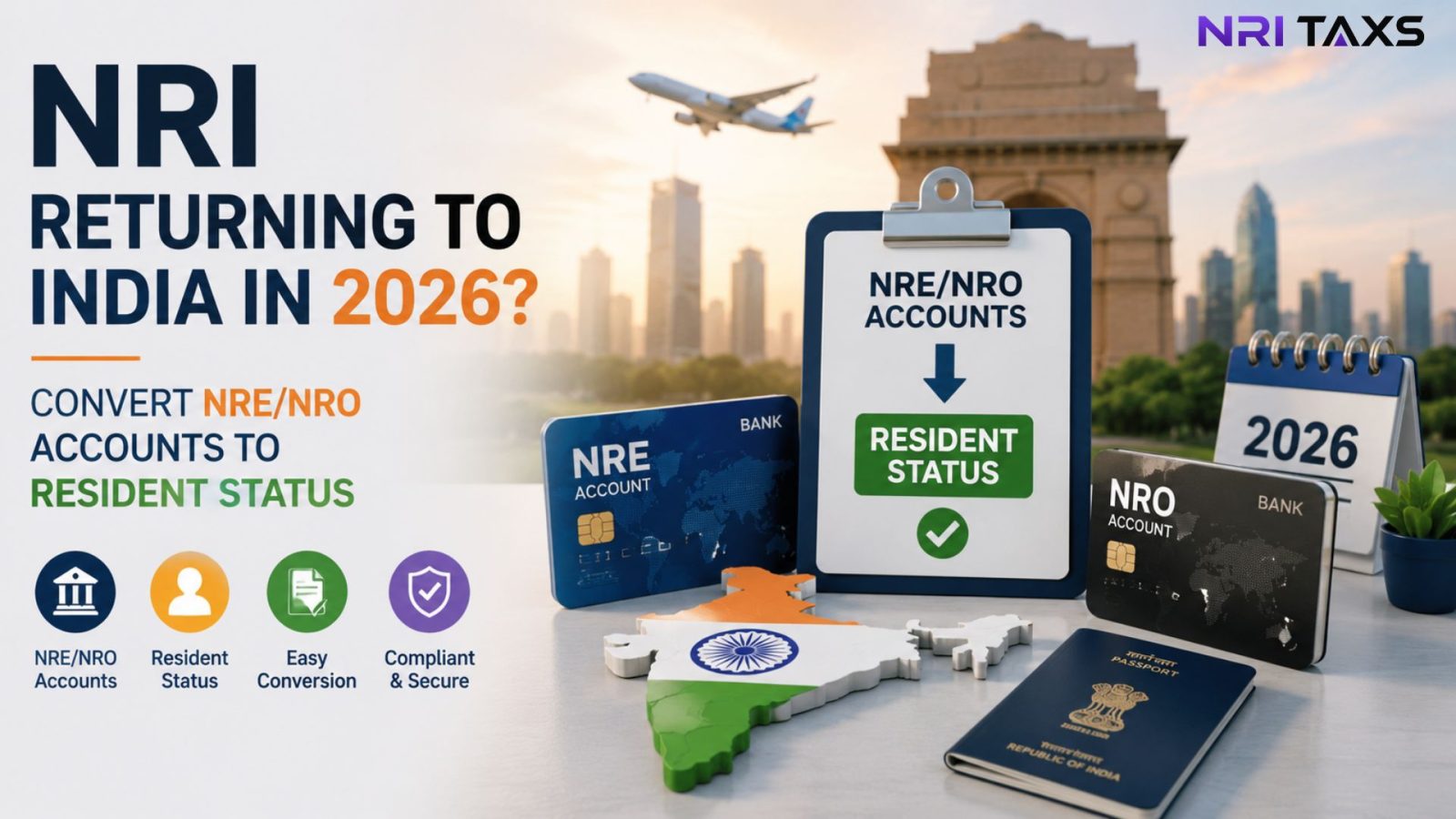
If you’re moving back to India in 2026, one of the first things you need to review is the status of your NRE and NRO bank accounts. Returning to India can change your residential status under FEMA, which means your existing NRI accounts may need to be redesignated. The process is not simply about changing an account name, it can also affect interest, repatriation, KYC and the way your banking transactions are handled.. This guide walks you through exactly when to convert, how to convert NRE/NRO Accounts to Resident Account, what documents you’ll need, and what happens if you don’t.
Key Takeaways
- ✔ Your FEMA residential status changes on your actual date of permanent return, not when you notify the bank.
- ✔ NRE accounts convert to Resident Rupee or RFC accounts, not to NRO accounts.
- ✔ NRO accounts simply get redesignated as regular resident savings accounts.
- ✔ NRE interest exemption ends on the day your FEMA status changes; delaying account conversion does not extend the exemption.
- ✔ Not converting your accounts after returning to India can be a FEMA contravention and may lead to compounding proceedings or tax-related issues later.
When Should an NRI convert NRE/NRO Accounts to Resident Account?
The key question is whether you are returning to India with the intention of staying permanently or for an uncertain period. Your FEMA residential status and income-tax residential status are separate concepts, so they should not be confused.
Once your status changes under the applicable FEMA rules, you should inform your bank and review your NRE/NRO accounts. The bank can then determine the appropriate redesignation based on your circumstances.
Do not rely on a fixed number of days as a universal conversion deadline. The exact process and documentation can vary by bank and by your circumstances.
How to convert NRE/NRO Accounts to Resident Account?
The process itself isn’t complicated, but the order you do things in matters especially if you also want to preserve tax-free interest on foreign currency deposits through an RFC account. If you are specifically looking for the fund-transfer process, see our guide on How to Transfer Funds from NRE to Resident Account Here’s the sequence banks generally follow.
Step 1: Inform Your Bank About Your Return
Write to every bank where you hold an NRE, NRO, or FCNR account and formally declare your change in residential status and intent to stay in India permanently. If you originally set these accounts up while abroad, it helps to revisit how NRE and NRO accounts are structured and what each one is meant to hold, since that distinction is exactly what determines how each gets redesignated. Do this in writing (email counts, but a signed letter or the bank’s own declaration form is safer) and do it at every branch and every bank — there’s no centralised system that updates all your accounts at once.
Step 2: Submit the Residential-Status Change Request
Most banks have a specific “change of residential status” form separate from a standard KYC update. Ask for this by name branch staff sometimes default to a generic KYC refresh, which doesn’t actually redesignate the account type in the bank’s core system.
Step 3: Submit the Required Documents
You’ll need proof of your return and updated identity documents (the full list is in the section below). Banks won’t process the redesignation without this, so gathering these before you walk in it saves at least one extra branch visit.
Step 4: Bank Redesignates the Account
After reviewing your residential-status change request and documents, the bank will redesignate the account according to the applicable rules. An NRO account may be redesignated as a resident account, while an NRE account may be redesignated as a resident account or, where eligible, the funds may be transferred to an RFC account.
The exact treatment can depend on your circumstances and the bank’s process, so confirm the final account status with your bank.
Step 5: Update KYC, FATCA/CRS & Contact Details
Your KYC needs to reflect your new resident status, and your FATCA/CRS self-certification should be updated too, you’re no longer a tax resident of your previous country of stay, and continuing to be flagged as one can create reporting mismatches down the line.
Step 6: Review FDs, Standing Instructions & Linked Services
Existing NRE fixed deposits can usually run to maturity at their contracted rate before you decide whether to move the proceeds into a resident deposit or an RFC account. Also check anything linked to your NRE/NRO accounts SIPs, insurance premium debits, PPF contributions since some of these have their own resident/non-resident eligibility rules.
Step 7: Confirm the New Resident Account Status
Ask the bank for written confirmation once the redesignation is complete, along with the effective date. This date matters for tax purposes, since it marks when interest income stops qualifying for the NRE exemption.

Documents Required for NRE/NRO to Resident Conversion
| Document | Purpose |
| Passport with entry stamp / visa cancellation page | Proof of date of return to India |
| Updated address proof (Indian address) | KYC update |
| PAN card | Mandatory for resident account operations |
| Declaration of change in residential status | Bank-specific form confirming FEMA status change |
| Employment/relocation letter (if applicable) | Supports intent-to-stay-permanently claim |
| Existing NRE/NRO account passbook or statements | Reference for account redesignation |
| FATCA/CRS self-certification form | Updated tax residency declaration |
Tax Implications After Becoming a Resident
When an NRI returns to India, becoming a resident can change how their income is taxed. The exact treatment depends on whether they become ROR, RNOR, or remain an NRI for the relevant financial year.
- NRE Interest: Tax treatment can change after becoming a resident, so the account should be redesignated as required.
- NRO Interest: NRO interest remains taxable under the applicable tax rules.
- FCNR Deposits: Eligible returning NRIs may continue certain FCNR deposits until maturity, subject to applicable rules.
- Foreign Income: Whether foreign salary, interest, or investment income is taxable depends on the individual’s residential status.
- Foreign Assets: Returning NRIs should also review the reporting requirements for overseas bank accounts and investments.
Important: Becoming a resident does not automatically make every foreign income taxable. Your ROR/RNOR status and the nature of the income should be checked for the relevant financial year.
Timelines and Penalties for Not Converting NRE/NRO Accounts After Returning to India
There is no single universal number of days or fixed penalty that applies to every returning NRI for redesignating an NRE or NRO account. However, once your residential status changes, you should inform your bank and complete the required account-status update without unnecessary delay.
Delaying the update can create practical compliance issues, particularly if your bank records, KYC information and actual residential status do not match. It can also create confusion around interest taxation, account operations and repatriation.
The safest approach is simple: inform your bank as soon as your residential status changes, submit the required documents, and obtain confirmation that your NRE/NRO accounts have been appropriately redesignated. For a detailed explanation of the compliance risks and consequences of delaying the redesignation, see our guide on Penalty for Not Converting NRE Account to Resident Account
Best Practices for NRI Bank Account Compliance After Returning to India
- Notify every bank in writing within 30 days of your return, even if you’re still finalising other logistics.
- Don’t rush to convert everything to rupees moving FCNR or NRE deposit proceeds into an RFC account preserves foreign currency and keeps the RNOR-linked exemption alive.
- Keep a written record of the exact date your bank confirms the redesignation — you’ll need it for tax filing.
- Update every linked service: mutual fund folios, insurance, PPF, and any investment accounts still tagged as NRI.
- File your first return as a resident using the correct ITR form — most returning NRIs with foreign assets or income need ITR-2 or ITR-3, not ITR-1.
Contact Us
Post-Conversion Impact on NRE/NRO Accounts, Interest & Repatriation
Once your NRE/NRO account is redesignated as a resident account, the account will no longer be treated as an NRI account. This can affect the interest taxation, repatriation options, account features, and linked banking services.
- NRE Account: The account is redesignated as a resident account, and the tax treatment of future interest can change.
- NRO Account: It is redesignated as a resident account, with interest treated according to the applicable resident tax rules.
- Repatriation: The special repatriation benefits available to NRE accounts may no longer apply after redesignation.
- FDs & Investments: Review your NRE/NRO fixed deposits, recurring deposits, standing instructions, and linked investments after the status change.
- KYC & Banking Details: Update your Indian address, mobile number, tax residency and other KYC information with the bank.
- Foreign Currency Funds: If you continue to hold foreign currency savings after returning to India, check whether an RFC account is appropriate for your situation.
In short, converting the account is not just a name change, it can affect how your money is taxed, held and repatriated after you become a resident.
What If You Don’t Convert Your NRE/NRO Account After Returning to India?
Leaving accounts unconverted doesn’t quietly resolve itself, it usually surfaces later, often at the worst possible time: during a tax audit, a loan application, or when the bank’s own systems flag a mismatch between your KYC address and your account type. At that point, you could face FEMA compounding proceedings, retroactive tax demands on interest that was wrongly treated as exempt, and in some cases, restrictions on operating the account until the status is corrected. None of this is designed to be punitive for genuine delays, but it does require you to proactively fix it, the system doesn’t do it for you.
Conclusion
Returning to India involves more than changing your address or closing your overseas arrangements. Your NRE and NRO accounts should also be reviewed once your residential status changes. The right process is to inform your bank, submit the required documents, redesignate the accounts appropriately, and review your FDs, FCNR deposits, RFC options and linked investments.
Most importantly, don’t assume that NRE, NRO and resident accounts have the same tax and repatriation treatment. Getting the account status right early can help you avoid unnecessary banking and tax complications later.
Disclaimer
The content published on NriTaxs is intended for informational purposes only and does not constitute legal, tax, or financial advice. Readers are encouraged to consult qualified professionals before making any decisions based on the information provided.








Related Articles