

Gold has always been the default “safe” investment for Indian families, and Sovereign Gold Bonds were, for years, the smartest way to hold it, no locker, no making charges, and interest on top. So it’s a fair question once you move abroad: can NRIs invest in Sovereign Gold Bonds the same way resident relatives do? The short answer is no, but there’s a lot of nuance around existing holdings, taxation, and what to do instead, and that’s exactly what this guide walks through.
What Are Sovereign Gold Bonds (SGBs)?
Sovereign Gold Bonds are government securities issued by the RBI on behalf of the Government of India, denominated in grams of gold. Instead of buying physical gold, an investor buys a paper (or demat) claim on gold, which tracks the market price and pays interest on top.
Key Features of Sovereign Gold Bonds (SGBs)
- ✓ Issued by the Reserve Bank of India (RBI) on behalf of the Government of India under the Sovereign Gold Bond Scheme, 2015.
- ✓ Each bond represents one gram of gold, with its value linked to prevailing market gold prices.
- ✓ Earns a fixed interest of 2.5% per annum, paid semi-annually, in addition to any appreciation in gold prices.
- ✓ Has an 8-year maturity period, with premature redemption allowed after 5 years on scheduled interest payment dates.
- ✓ Can be held in certificate or demat form and is tradable on the NSE and BSE.
- ✓ No new SGB tranche has been issued since February 2024, but existing bonds continue to be available through the secondary market or can be held until maturity.
Can NRIs Invest in Sovereign Gold Bonds (SGBs)?
To answer is no, NRIs cannot invest in Sovereign Gold Bonds, whether through RBI’s original issuance or through secondary market purchases on the NSE/BSE. The Sovereign Gold Bond Scheme has, since its 2015 launch, restricted subscription to resident Indians, HUFs, trusts, and specific institutions. Residency status is checked at the time of subscription, and once you’re classified as an NRI under FEMA, that door closes for fresh purchases even though the exchange-traded units are technically visible and tradable to anyone with a demat account.
Why Are NRIs Not Allowed to Buy Sovereign Gold Bonds?
This restriction comes directly from RBI and FEMA rules, not from any tax office or brokerage policy. A few reasons explain why NRI Sovereign Gold Bonds were never part of the design:
- FEMA classification: SGBs are rupee-denominated government securities. Under the Foreign Exchange Management Act, 1999, this category is reserved for residents to keep the scheme’s foreign exchange impact predictable.
- RBI’s scheme notification: When SGBs launched in 2015, the notification explicitly restricted sale to resident Indian entities; it was never opened to non-residents at any point.
- Eligibility design: The scheme’s eligible categories are resident individuals, HUFs, trusts, universities, and charitable institutions registered in India. NRIs and foreign nationals were not included in this list.
- Resident-only intent: SGBs were designed to reduce India’s physical gold imports by giving resident Indians a paper alternative, a goal specific to domestic investor behaviour.
? If you’re unsure whether you currently qualify as a resident or NRI for this purpose, it’s worth reading our detailed guide on Residential Status for NRIs, since your status on the subscription date is what determines eligibility.
What Happens If You Become an NRI After Buying SGBs?
This is the situation that affects most NRIs. If you purchased Sovereign Gold Bonds while you were a resident Indian and later moved abroad, your existing investment remains valid. Here’s what changes and what doesn’t:
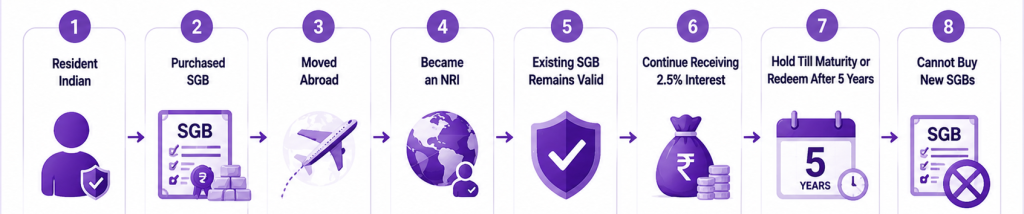
- Hold Until Maturity: Your SGBs remain completely valid even after becoming an NRI. You don’t need to sell, transfer, or redeem them simply because your residential status has changed. You can continue holding them until the full 8-year maturity.
- Interest Continues: You’ll continue to receive the 2.5% annual interest on schedule, just as you did before becoming an NRI. The interest is generally credited to your linked NRO account.
- Premature Redemption: You can still redeem your SGBs early after completing 5 years, provided the redemption is made on the designated interest payment dates through the issuing bank, post office, or SHCIL.
- Maturity Proceeds: At the end of the 8-year tenure, your redemption amount is paid in Indian Rupees based on the prevailing gold price and credited to your NRO account.
- Nomination Benefits: If you’ve already registered a nominee, the nomination remains valid even after you become an NRI. The nominee can inherit the bonds according to the scheme’s rules.
The only major restriction is that you cannot purchase any new Sovereign Gold Bonds after becoming an NRI. Your existing holdings remain unaffected, but you cannot increase your investment under the SGB scheme.
Can Existing SGB Holders Continue Holding Their Bonds After Becoming NRIs?
Yes. This is worth repeating on its own because it’s the part people worry about most: becoming an NRI does not force a sale, redemption, or transfer of your existing SGBs. Your holding stays exactly as it was: same interest rate, same maturity date, same redemption rights. The only restriction that kicks in is on repatriation: interest and maturity proceeds are credited in rupees to your NRO account and are subject to standard NRO repatriation limits, rather than being freely remittable like NRE funds.
Can NRIs Buy New Sovereign Gold Bonds?
No and this is true regardless of the channel. NRIs cannot subscribe through RBI’s primary issuance, and they cannot pick up new-issue SGBs on the NSE or BSE secondary market either, since the restriction is based on residency status rather than the point of purchase. In practice, this question is somewhat moot right now: the RBI has not opened a new SGB subscription window since February 2024, and no issuance calendar has been announced for FY 2026-27. So even resident Indians currently cannot buy freshly issued SGBs. The only way to add exposure today, resident or not, is buying existing bonds on the secondary market, and NRIs remain excluded from that route as well.
Are NRIs Allowed to Invest Jointly with Resident Indians?
This is a grey area many NRI families ask about “if my father in India applies and adds me as a joint holder, does that work?” In practice, RBI’s eligibility framework ties the subscription itself to residency status, and the scheme has consistently been documented as resident-only at the application stage. Most issuing banks will not process an SGB application where a proposed joint holder is a non-resident, since it risks the same FEMA classification issue as a direct NRI purchase. If you’re considering this route with a family member, it’s best to confirm directly with the issuing bank or SHCIL before assuming it’s permitted, since interpretation can vary by institution.
Sovereign Gold Bonds vs Gold ETFs for NRIs
Since direct SGB investment isn’t available, Gold ETFs are the closest comparable product NRIs can actually access. Here’s how they stack up:
| Feature | Sovereign Gold Bonds (SGB) | Gold ETF for NRIs |
| NRI eligibility | Not eligible for new purchases | Eligible, subject to normal NRI demat/trading account rules |
| Interest income | 2.5% per annum, paid semi-annually | None — returns come only from price movement |
| New issuance availability | Paused since February 2024; secondary market only | Available anytime through the stock exchange |
| Lock-in | 8-year tenure; early exit after 5 years | None — can be bought or sold any trading day |
| Storage/making charges | None | None (fund management expense ratio applies instead) |
| Repatriation of proceeds | Via NRO account, subject to NRO limits | Depends on funding account (NRE/NRO) and applicable limits |
Best Gold Investment Alternatives for NRIs
Since SGBs are off the table, here are the realistic ways NRIs can still build gold exposure connected to India or global markets:
- Gold ETF: Exchange-traded funds that track domestic gold prices, tradable through an NRI demat/trading account with no lock-in and no residency restriction.
- Gold Mutual Fund: Fund-of-fund structures investing in Gold ETFs, useful for NRIs who want SIP-style, rupee-cost-averaged exposure without managing a demat account actively.
- Physical Gold: Still an option on visits to India or through jewellers abroad, though it carries storage, insurance, and making-charge costs that paper gold avoids.
- International Gold ETFs: Gold ETFs listed on US, UK, or UAE exchanges, useful for NRIs who’d rather hold gold exposure entirely within their country of residence for simpler tax reporting.
- GIFT City Funds: Gold-linked funds and ETFs available through India’s GIFT City IFSC, which some NRIs use for dollar-denominated exposure without routing money through onshore Indian accounts.
Contact Us
Taxation of SGBs for NRIs
If you’re an NRI who became one after buying SGBs, here’s how the current tax treatment works following the Budget 2026 changes effective from 1 April 2026:
- Interest: The 2.5% annual interest is fully taxable under “Income from Other Sources,” at your applicable slab rate this hasn’t changed.
- Capital Gain at maturity: If you originally subscribed through RBI’s official issuance as an individual and hold the bond to its full 8-year maturity, capital gains remain completely tax-free; this exemption survived Budget 2026 for original RBI subscribers.
- Premature redemption: Gains on early redemption (after 5 years, via the RBI’s official redemption window) are taxed as long-term capital gains at 12.5%, without indexation, if the redemption happens on or after 1 April 2026.
- Secondary market purchases: If your bonds were bought on the NSE/BSE rather than RBI’s primary issuance, gains are now taxable even at maturity 12.5% long-term capital gains (holding over 12 months) or slab-rate short-term gains (12 months or less), with no indexation benefit.
- TDS: No TDS is deducted on the 2.5% interest payment, but it must still be declared and taxed in your ITR.
- DTAA: Since SGB interest and capital gains are Indian-sourced, they’re taxable in India first; check the applicable Double Taxation Avoidance Agreement between India and your country of residence to claim credit and avoid being taxed twice on the same income.
? For a full breakdown of how capital gains from Indian investments are taxed for non-residents, see our detailed guide on NRI Capital Gains Tax.
FEMA Rules for NRIs Investing in Gold
Beyond SGBs specifically, FEMA sets out separate rules for how NRIs can hold gold in other forms:
- NRIs can freely invest in Gold ETFs and gold mutual funds through their NRI demat and trading accounts, since these are treated as regular securities rather than restricted government instruments.
- Physical gold brought into India by an NRI is governed by customs duty-free allowance limits, which are separate from FEMA investment rules.
- Funds used to buy gold-linked instruments must be routed through NRE, NRO, or FCNR accounts as applicable, following standard NRI banking rules.
- Repatriation of sale proceeds depends on which account funded the original purchase NRE-funded investments are typically freely repatriable, while NRO-funded ones are subject to the usual USD 1 million per financial year limit (post applicable taxes).
Conclusion
So, can NRIs invest in Sovereign Gold Bonds? Not directly, and that restriction has held steady since the scheme launched in 2015; it’s a FEMA-based rule, not a temporary policy gap. If you already hold SGBs from your resident days, there’s nothing to worry about: hold them through to maturity, keep collecting the interest, and let the redemption happen on schedule. For any fresh gold exposure, Gold ETFs, gold mutual funds, or GIFT City funds are the more realistic route for NRIs today, especially with RBI’s primary SGB issuance itself on pause since 2024.
Not sure how your existing SGBs should be reported in your NRI tax filing, or which gold alternative fits your situation? Talk to our team at NRITaxs for a residency-specific review before your next filing deadline.
Disclaimer
The content published on NriTaxs is intended for informational purposes only and does not constitute legal, tax, or financial advice. Readers are encouraged to consult qualified professionals before making any decisions based on the information provided.










Related Articles