
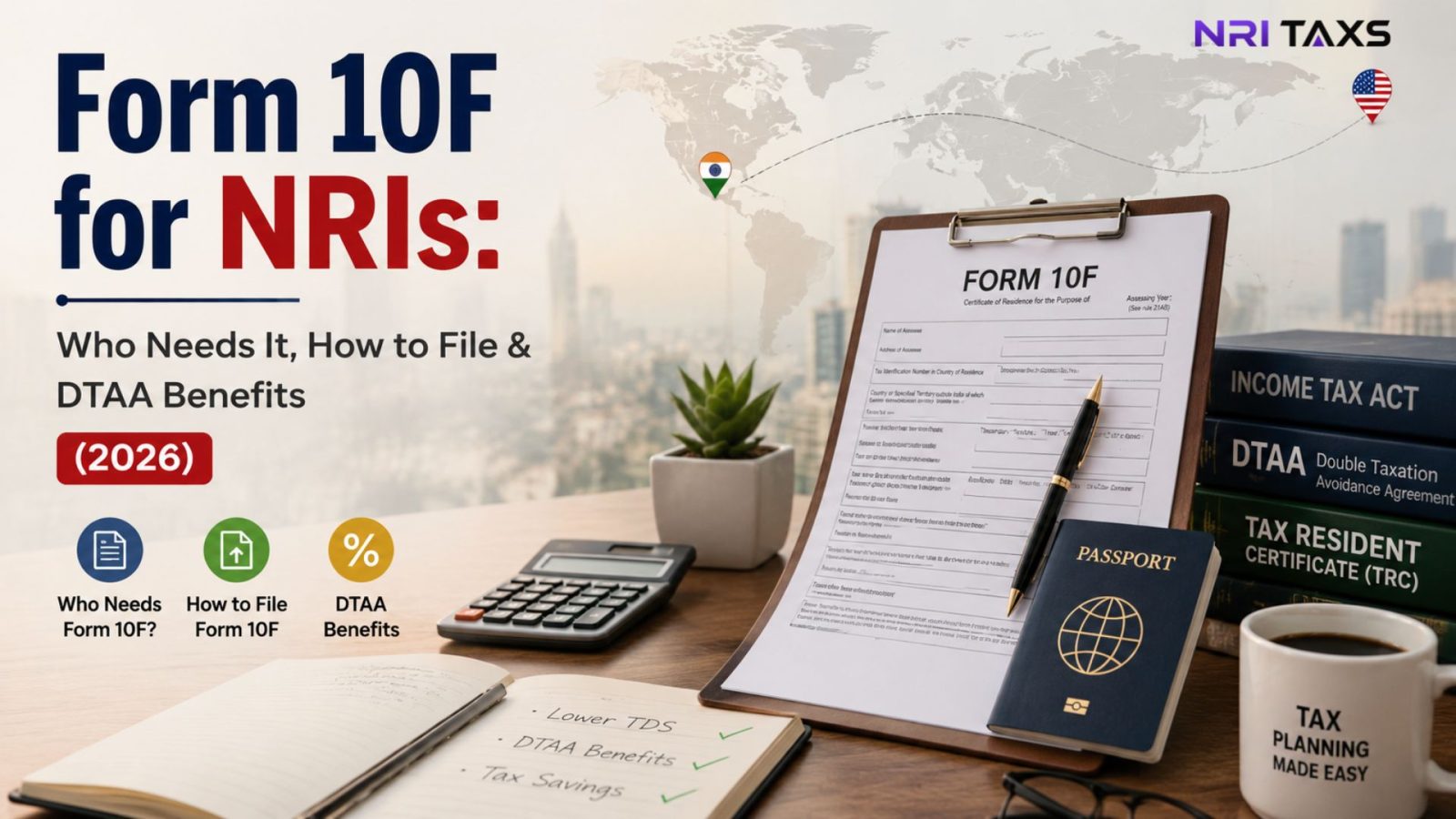
If you’re an NRI earning income from India, such as dividends, interest, royalties, or professional fees, you may end up paying higher tax unless you submit the required documents to claim tax treaty benefits. One of the most important documents for this is Form 10F. It allows eligible non-residents to claim benefits under the Double Taxation Avoidance Agreement (DTAA), helping them avoid paying tax twice on the same income. Form 10F is generally required when your Tax Residency Certificate (TRC) does not contain all the information prescribed under Indian tax rules.
By filing this form along with a valid TRC, you can claim the applicable DTAA benefits and, in many cases, reduce the amount of tax deducted at source (TDS) on income earned in India. In this guide, we’ll explain who needs to file Form 10F, the documents required, the online filing process, common mistakes to avoid, and how it helps NRIs claim DTAA benefits.
Key Takeaways
Form 10F for NRIs is a self-declaration required to claim DTAA benefits when your Tax Residency Certificate (TRC) does not contain all the prescribed details.
Electronic filing of Form 10F is mandatory for most non-residents, and paper filing is no longer accepted.
You can file Form 10F online without a PAN by registering under the “Non-residents not holding and not required to have PAN” category on the Income Tax e-Filing portal.
Without a valid Form 10F, eligible NRIs may not receive DTAA treaty rates, and tax may be deducted at the applicable domestic TDS rates.
Form 10F is generally valid for one financial year and should be filed each year along with a valid Tax Residency Certificate (TRC) when claiming DTAA benefits.
What Is Form 10F?
Form 10F is a self-declaration form that eligible non-resident taxpayers submit to the Indian Income Tax Department to claim tax treaty benefits under the Double Taxation Avoidance Agreement (DTAA). It is generally required when the Tax Residency Certificate (TRC) issued by your country of residence does not contain all the information prescribed under Indian tax laws. By submitting Form 10F along with a valid TRC, NRIs can claim the applicable DTAA benefits and, where eligible, avoid higher Tax Deducted at Source (TDS) on income earned in India.
The form collects important details such as your name, nationality, tax identification number (TIN), country of tax residence, and the period for which you are claiming treaty benefits. Indian banks, companies, financial institutions, and other deductors use this information to verify your eligibility before applying the reduced tax rates available under the relevant DTAA. Without a valid Form 10F (where applicable), the payer may deduct tax at the higher rates prescribed under the Income Tax Act, even if you’re otherwise eligible for treaty benefits.
Why Is Form 10F Important for NRIs?
Claim DTAA Benefits
India has Double Taxation Avoidance Agreements (DTAAs) with more than 90 countries, including the United States, the United Kingdom, the UAE, Canada, Singapore, and Australia. These agreements help eligible NRIs avoid paying tax twice on the same income. By submitting Form 10F along with a valid Tax Residency Certificate (TRC), eligible taxpayers can claim the reduced tax rates available under the applicable DTAA.
Reduce Higher TDS
Without Form 10F (where applicable), Indian payers may deduct tax at the rates prescribed under the Income Tax Act instead of the lower DTAA rates. Filing Form 10F along with the required documents helps eligible NRIs claim the treaty benefits and may reduce the amount of Tax Deducted at Source (TDS), depending on the applicable tax treaty and the nature of income.
Support Your Tax Residency Claim
Form 10F complements your Tax Residency Certificate (TRC) by providing additional details that may not be included in the certificate, such as your nationality, Tax Identification Number (TIN), and residential status. This information helps support your claim for DTAA benefits under Indian tax laws.
Ensure Correct Taxation of Indian Income
Whether you earn interest, dividends, royalties, rental income, or professional fees from India, Form 10F helps ensure that your Indian income is taxed according to the applicable DTAA provisions, provided you meet all eligibility requirements.
Who Needs to File Form 10F?
Non-Resident Individuals (NRIs)
Any NRI earning taxable income from India, interest on NRO deposits, dividends from Indian shares or mutual funds, rental income, capital gains, or professional fees and who wants to claim the reduced DTAA rate instead of the standard non-resident rate needs to file Form 10F.
Foreign Companies and LLPs
Companies and LLPs incorporated outside India that earn Indian-sourced income royalty, technical fees, interest, or business income even without a permanent establishment in India also fall under the Form 10F requirement when claiming treaty benefits.
Trusts, HUFs, and Other Non-Resident Entities
Non-resident trusts, Hindu Undivided Families (HUFs) with non-resident status, partnerships, and associations of persons that derive income from India are equally required to file Form 10F if they want DTAA rates applied.
OCI (If Applicable)
OCI cardholders who are tax residents of another country and earn income from India bank interest, dividends, or property income are treated the same as any other NRI for this purpose. Holding an OCI card doesn’t change your tax residency; if you’re a non-resident for Indian tax purposes, the same Form 10F filing requirement applies to you.
Who Does Not Need to File Form 10F?
Not every NRI needs to go through this process. You can generally skip Form 10F if:
- Your income from India is entirely below the basic exemption threshold and no DTAA rate is being claimed.
- You’re comfortable being taxed at standard domestic rates and have no intention of claiming a treaty benefit.
- Your TRC already contains every single detail mandated under Indian tax rules; in practice this is rare, since most foreign TRCs are formatted for domestic use, not for Indian compliance.
- You have Resident status for the relevant financial year rather than Non-Resident, in which case DTAA relief works differently and Form 10F doesn’t apply the same way.
When Do NRIs Need to File Form 10F?
NRIs generally need to file Form 10F when they want to claim DTAA benefits on income earned in India. The requirement commonly arises for the following types of income:
Royalty
Royalty payments received from India, such as licensing fees, intellectual property income, or payments for technical know-how, may qualify for a reduced tax rate under the applicable DTAA. To claim this benefit, eligible non-residents are generally required to submit Form 10F along with a valid Tax Residency Certificate (TRC).
Interest
Interest earned on NRO accounts, corporate bonds, or government securities is one of the most common triggers for Form 10F filing among NRIs, since NRO interest is otherwise taxed at a high flat rate.
Dividend
Dividend income from Indian companies and mutual funds is taxable for non-residents, and most DTAAs cap the rate well below the domestic withholding rate but only if Form 10F is on file with the payer or the tax department.
Capital Gains
Certain capital gains, particularly on debt instruments or specific asset classes covered under a treaty’s capital gains article, can also benefit from reduced or exempted treatment under DTAA provisions, again contingent on Form 10F.
Documents Required for Form 10F
Before you start Form 10F filing, gather the following. Having these ready in advance is the single biggest time-saver in the entire process.
| Document | Why It’s Needed |
| Tax Residency Certificate (TRC) | Mandatory supporting document issued by your country’s tax authority, confirming your tax residency for the relevant year |
| PAN (if available) | Speeds up filing and helps banks/payers match your records; not mandatory, but recommended. |
| Passport | Establishes nationality and identity, especially for non-PAN registrations |
| Proof of foreign address | Confirms your permanent address outside India for the declaration |
| Tax Identification Number (TIN) | Your unique taxpayer number in your country of residence (e.g., SSN/ITIN in the US) |
| Residency period details | The exact period your TRC covers, which must align with the Form 10F declaration |
If you don’t already have one, check out our guide on How NRIs Can Apply for a PAN Card before starting your Form 10F application.
How to File Form 10F Online (Step-by-Step)
Here’s how to file Form 10F on the Income Tax e-filing portal (incometax.gov.in). The process is largely the same whether or not you hold a PAN, with one key difference at the registration stage.
Step 1: Registering on the Income Tax e-Filing Portal
If you already have a PAN, log in normally with your PAN as the user ID. If you don’t have a PAN, click Register, select “Others,” then choose “Non-residents not holding and not required to have PAN” from the dropdown. If you’ve misplaced your PAN details, you can first download your e-PAN card online and then continue with the registration process. You’ll need to provide your name, date of birth, country of residence, TIN, email, and mobile number to complete registration. Non-PAN filers will also need a Digital Signature Certificate (DSC) to authenticate their submission later.
Step 2: Filling Form 10F with Section 90/90A Details
Once logged in, go to e-File → Income Tax Forms → File Income Tax Forms, and look for Form 10F under “Person not dependent on any Source of Income.” Select the relevant assessment year, then fill in your taxpayer status (individual, company, trust, etc.), nationality or country of incorporation, your TIN, your complete address outside India, and the period for which your TRC is valid — this establishes your claim under Section 90 or Section 90A of the Income Tax Act, depending on whether the DTAA is bilateral or a specified association agreement.
Step 3: Uploading TRC and Supporting Documents
Attach a scanned copy of your Tax Residency Certificate along with any other supporting documents requested. Files must typically be under 5MB each, with a 50MB total limit, in PDF or ZIP format. If your TRC isn’t in English, you’ll also need to attach a certified English translation.
Step 4: Verifying and Submitting Form 10F
Reviewing all details on the preview screen carefully mismatches between your TRC and your Form 10F entries are one of the most common reasons filings get flagged. Verify using your DSC (mandatory for non-PAN filers) or your Electronic Verification Code (EVC) if you hold a PAN. Once submitted, you’ll receive an acknowledgment confirming your Form 10F filing is complete for that financial year.

What Happens If You Don’t File Form 10F?
Higher TDS Deduction on Indian Income
This is the most immediate and painful consequence. Indian banks, tenants, and companies are legally obligated to deduct TDS at the full domestic rate, often 20% or higher plus surcharge and cess rather than the reduced DTAA rate, simply because they have no valid Form 10F on record to justify the lower rate.
Loss of DTAA Benefits
Even if a DTAA genuinely applies to your situation and would reduce your tax liability significantly, none of that matters procedurally without Form 10F. The treaty benefit exists on paper, but you can’t access it without the documentation Indian tax law requires.
Classification as Assessee in Default
If you or your payer applies a reduced rate without a valid Form 10F backing it up, the Income Tax Department can classify you as an “assessee in default.” This can trigger notices, interest on the shortfall, and complications with future remittances from your NRO account, since banks scrutinize documentation more closely once a discrepancy is flagged.
Tax Benefits of Filing Form 10F for NRIs
Done correctly and on time, Form 10F filing translates into real, recurring savings:
- Significantly lower TDS on NRO interest, dividends, royalty, and eligible capital gains often cutting the effective rate by 5 to 15 percentage points.
- Avoidance of double taxation, since the same income won’t be fully taxed again in your country of residence once treaty relief is properly documented.
- Smoother, faster processing of refunds when your ITR is filed, since TDS was already deducted correctly at source.
- A clean compliance record that simplifies future NRO fund repatriation and reduces the odds of scrutiny notices.
Tax Residency Certificate (TRC) vs Form 10F
NRIs frequently confuse these two documents, but they serve different functions and both are usually required together.
| Aspect | Tax Residency Certificate (TRC) | Form 10F |
| Issued by | Your country’s tax authority (e.g., IRS, HMRC) | Self-declared by you, filed on India’s e-filing portal |
| Purpose | Proves your tax residency status abroad | Supplies missing details the TRC doesn’t cover |
| Format | Varies by country, often not India-specific | Standardized Indian government form |
| Filing mode | Obtained from your home tax authority, then uploaded | Filed electronically on the Indian e-filing portal |
| Validity | One financial year | One financial year, must match the TRC period |
Is Form 10F Mandatory Without PAN?
Yes, and this is one of the more helpful updates in recent years. Since October 2023, NRIs and foreign entities without a PAN can register on the e-filing portal under “Non-residents not holding and not required to have PAN” and complete Form 10F filing entirely online, using a Digital Signature Certificate for verification instead of an EVC. Filing without a PAN is fully valid; it simply requires an extra registration step and a DSC, which PAN holders don’t need.
Can NRIs File Form 10F Without a Tax Residency Certificate?
No. A valid TRC is a mandatory prerequisite under Section 90(5) and 90A(5) of the Income Tax Act there’s no substitute document that Indian tax authorities will accept in its place. Form 10F works alongside the TRC, not as a replacement for it. If you don’t yet have a TRC from your country of residence, that should be your first step before attempting Form 10F filing.
Form 10F Validity
Form 10F is valid for exactly one financial year and must strictly match the period covered by your TRC for that year. Even if nothing about your residency status has changed, you cannot reuse a previous year’s Form 10F; it must be refiled annually alongside a fresh TRC.
Processing Time
Submission of Form 10F itself is typically instant once verified you receive an acknowledgment the same day. However, allow additional time upfront: obtaining a TRC from your country’s tax authority can take anywhere from a few days to 4–6 weeks depending on the country, so it’s worth starting that process well before you need the lower TDS rate applied, ideally at the start of the financial year rather than close to a payment or filing deadline.
Common Mistakes NRIs Make With Form 10F
Even NRIs who know Form 10F filing is required often lose money or time to a handful of avoidable errors:
- Waiting until TDS is already deducted. Filing Form 10F after your bank or tenant has already withheld tax at the domestic rate means you’re stuck claiming a refund through your ITR instead of getting the lower rate upfront.
- Letting the TRC lapse before renewing Form 10F. Since both documents must cover the same period, a gap of even a few weeks between an expired TRC and a new one can leave you without valid DTAA coverage during that window.
- Entering address or residency-period details that don’t match the TRC exactly. Even minor inconsistencies in a different date format or an abbreviated address can trigger a mismatch flag during processing.
- Assuming Form 10F alone is enough. Many NRIs file Form 10F on the portal but forget to also share a copy with their Indian bank, tenant, or company. The payer needs their own copy on file to actually apply the lower TDS rate.
- Not budgeting time for the TRC. Since TRC issuance abroad can take several weeks, starting the process only when a payment is imminent often means missing the lower-rate window entirely for that transaction.

Conclusion
Form 10F for NRIs isn’t just paperwork, it’s the difference between paying 10–15% tax on your Indian income and paying 20–30%. The process itself takes minutes once your TRC is in hand, and it’s now fully accessible online whether or not you have a PAN. If you’re earning any interest, dividend, rental, or capital gains income from India, filing Form 10F at the start of each financial year should be a standing item on your NRI tax checklist, not something you scramble to arrange after a bank has already over-deducted your tax.
Need help getting your Form 10F, TRC, and DTAA documentation in order? Reach out to our team for a personalized NRI tax compliance review before your next TDS deduction.
Disclaimer
The content published on NriTaxs is intended for informational purposes only and does not constitute legal, tax, or financial advice. Readers are encouraged to consult qualified professionals before making any decisions based on the information provided.







Related Articles