
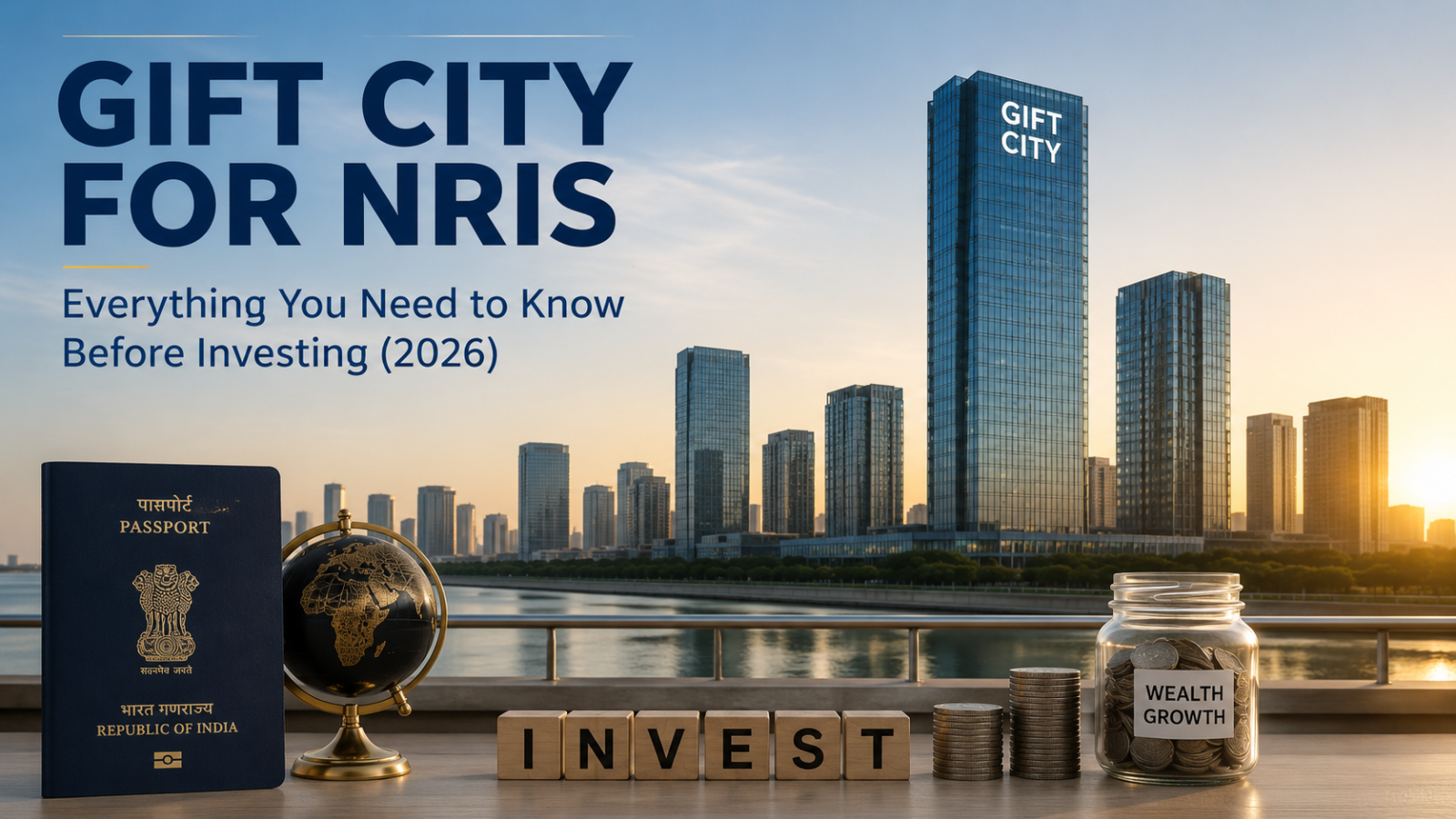
If you’re an NRI looking to invest in India while enjoying easier access to global markets, you’ve probably heard about GIFT City. It has quickly become one of the most talked-about investment destinations for NRIs, offering access to US stocks, global ETFs, mutual funds, bonds, and other investment opportunities through India’s International Financial Services Centre (IFSC).
But is GIFT City the right choice for you? What tax benefits does it offer? How does it work, and how is it different from investing through a regular Indian broker or an overseas platform?
In this complete guide, you’ll learn everything about GIFT City for NRIs, including how it works, who can invest, available investment options, tax benefits, potential risks, and whether it fits your long-term financial goals in 2026.
What is GIFT City?
GIFT City (Gujarat International Finance Tec-City) is a purpose-built smart city between Ahmedabad and Gandhinagar in Gujarat. Inside it sits GIFT IFSC, India’s first International Financial Services Centre, launched in 2015 as a Special Economic Zone (SEZ).
The detail that matters most for investors: under the Foreign Exchange Management Act (FEMA), the SEZ portion of GIFT City is treated as foreign soil, even though it’s physically inside India. Every account, transaction, and product inside the zone runs in foreign currency USD, GBP, EUR, AED, and others not rupees.
A single regulator, the International Financial Services Centres Authority (IFSCA), oversees everything here: banks, brokers, exchanges, fund managers, and insurers. Think of IFSCA as doing the combined job of the RBI, SEBI, IRDAI, and PFRDA, but only for this zone a big part of why GIFT City feels simpler than juggling multiple Indian regulators for an overseas investment.
Two stock exchanges operate inside GIFT IFSC NSE IFSC (NSE IX) and India INX both trading in foreign currency, functioning like a USD version of the NSE and BSE.
Why Was GIFT City Created?
Before GIFT City existed, Indian companies, funds, and wealthy individuals routinely went to Singapore, Mauritius, Dubai, or the Cayman Islands whenever they needed sophisticated offshore financial services. That meant Indian financial talent, fees, and infrastructure spending went abroad too.
GIFT City was built to bring that business back onshore to create an Indian financial centre that competes with Singapore and Dubai on regulatory ease, tax efficiency, and dollar-denominated transactions, without anyone needing to leave the country.
To make that attractive, the government backed GIFT City with a long tax holiday for entities operating there. Budget 2025 had already extended this incentive period to March 2030, and Budget 2026 went further — doubling the tax holiday for IFSC units from 10 to 20 consecutive years. Combined with a single-window regulator (IFSCA) instead of dealing with RBI, SEBI, IRDAI, and PFRDA separately, this is the policy backbone behind GIFT City’s rapid growth: registered entities jumped from 82 in 2020 to over 1,000 by September 2025 — a 12x increase in five years.
Why Are NRIs Investing Through GIFT City?
A few regulatory changes over the past two years have made GIFT City genuinely useful for everyday NRIs, not just an HNI playground:
- 100% NRI ownership allowed: SEBI removed the previous 50% ownership cap on GIFT IFSC funds in June 2024, opening these funds fully to the NRI/OCI community.
- Entry barriers have crashed: AIF minimums dropped from $150,000 to $75,000 in February 2025, and retail mutual funds now start from just $500 (Tata India Dynamic Equity Fund, launched September 2025) down from the old $150,000+ HNI-only threshold.
- The ecosystem is genuinely large now: over 200 fund management entities and 340+ AIFs are registered with IFSCA, managing targeted commitments crossing USD 80 billion.
- Fund relocation tax break: from April 2026, mutual funds and ETFs can relocate to GIFT City from Mauritius or Singapore without triggering capital gains tax — pulling more global funds, and more product choice, into the zone.
- No PFIC headache for US NRIs: regular Indian mutual funds are classified as PFICs (Passive Foreign Investment Companies) under US tax law, meaning painful Form 8621 filings and punitive tax treatment. GIFT City’s structure generally sidesteps this.
- Double-zero tax for Gulf NRIs: for NRIs in the UAE, Saudi Arabia, Qatar, Oman, or Kuwait countries with no personal income tax GIFT City’s concessional Indian tax treatment plus zero tax at home can mean close to nil tax on both sides, subject to DTAA conditions.
Who Can Invest?
GIFT City products are open to:
- NRIs and OCIs of any nationality and country of residence, in most cases
- Resident Indians, who can invest under the RBI’s Liberalised Remittance Scheme (LRS), up to $250,000 per financial year
Before you commit money, check two things:
- Country-specific eligibility: some funds exclude US and Canada-based investors due to FATCA compliance requirements (the Edelweiss Greater China Equity Fund is one example). Always confirm with the platform or AMC before investing.
- KYC requirements: most products need a PAN card, though GIFT City’s KYC is increasingly aligned with international standards, and many platforms now offer 100% digital onboarding with no India visit required.
Investment Options
Here’s the full menu currently available to NRIs through GIFT City:
| Investment Type | Available? | Typical Minimum / Notes |
| US Stocks | ✅ | From $1 (fractional), via GAP brokers like INDmoney; 9,000+ stocks |
| Global ETFs | ✅ | Via GAP brokers; growing list of global ETFs across markets |
| GIFT City Mutual Funds | ✅ | From $500 (retail feeder funds); $5,000+ for outbound global funds |
| Bonds | ✅ | Foreign & rupee-denominated bonds on IFSC exchanges; concessional 4–9% tax |
| AIFs | ✅ | From $75,000 (or $50,000 for accredited investors in select strategies) |
| PMS | ✅ | Typically $75,000+ |
| Foreign Currency FDs | ✅ | From $500–$1,000; 4.5–5.5% p.a., interest tax-free in India |
| REITs / Real Estate (via AIFs) | ✅ | Accessed through Category II real estate AIFs |
Tax Benefits of GIFT City
This is the section most NRIs are actually here for, so let’s be precise. Tax treatment depends on your specific product, residency, and your country’s DTAA with India —this is a general overview, not personalised tax advice.
Transaction-level savings (apply to nearly everything):
- No Securities Transaction Tax (STT)
- No Commodities Transaction Tax (CTT)
- No stamp duty
- No GST on financial services for non-residents
Income-level benefits:
- Interest income from foreign currency deposits and bonds is tax-free in India.
- Dividend income from IFSC unit dividends is taxed at a concessional 10%, versus 20% for non-IFSC companies.
- Income from derivatives — including non-deliverable forwards and OTC derivatives with FPIs is exempt under Section 10(4E).
- Many GIFT City retail mutual funds qualify under Section 10(4D): if your only Indian income is from IFSC investments, you may not need a PAN card or an Indian income tax return at all.
- Capital gains on rupee-denominated bonds traded on IFSC exchanges attract concessional rates of roughly 4–9%, far below standard bond taxation.

How to Open a GIFT City Investment Account
- Confirm your eligibility:- Check your NRI/OCI status and verify your country of residence is eligible for the specific fund or broker you’re considering (US and Canada-based NRIs should specifically check FATCA compliance first).
- Pick your entry route:- Three common doors in: a bank’s IFSC Banking Unit (IBU) for foreign currency deposits and FDs; a GAP (Global Access Provider) broker like INDmoney for stocks and ETFs; or directly through an AMC for GIFT City mutual funds.
- Complete KYC:- Most platforms offer fully digital KYC using your PAN and Aadhaar/passport typically under five minutes, no India visit required.
- Remit funds under LRS:- You can remit up to $250,000 per financial year. Most GAP platforms handle the LRS paperwork (including Form A2) automatically inside the app.
- Funds land in your account:- Money usually reaches your GIFT City wallet or IFSC account within 24 hours to a few business days.
- Start investing:- Buy stocks, ETFs, mutual funds, or bonds — holdings sit in a demat account, often with India International Depository IFSC Ltd (IIDI) for securities bought via NSE IFSC.
- Track everything for tax time:- Keep records of every remittance, TCS deduction, and dividend/interest credit — you’ll need these for both your Indian and home-country tax filings.
Best Banks in GIFT City
- ICICI Bank (IFSC Banking Unit) — foreign currency savings, current, and term deposit accounts; widely used for GIFT City FDs and as a feeder account for securities trading.
- HDFC Bank (IFSC Banking Unit) — strong presence in GIFT City banking and securities settlement; commonly paired with HDFC Securities for trading.
- State Bank of India (SBI) — India’s largest bank also runs an IBU in GIFT City, useful if you already bank with SBI domestically.
- HSBC — an international bank with a GIFT City presence, useful for NRIs who prefer a globally recognised name and multi-currency banking outside the Indian-bank ecosystem.
Other banks with GIFT City units worth knowing about: Axis Bank, IDFC FIRST Bank, and global names like JP Morgan, Barclays, and Standard Chartered, depending on the currency and service you need.
GIFT City IBUs typically offer: foreign currency savings/current accounts, fixed deposits (7 days to 39 months) at roughly 4.5–5.5% p.a., loans against deposits, and faster international remittances than standard Indian banking channels.
Best Brokers
- INDmoney — the platform most NRIs land on first. Licensed by IFSCA as a Global Access Provider (GAP), giving access to 9,000+ US stocks and ETFs, fractional investing from $1, and in-app LRS/remittance handling.
- Interactive Brokers (IBKR) — not a GIFT City entity itself, but the most common comparison point: a direct foreign brokerage offering 10,000+ securities and the widest possible market access, at the cost of dealing with a foreign regulator instead of an Indian one.
- Anand Rathi IFSC, HDFC Securities, Motilal Oswal — other IFSCA-registered brokers operating inside GIFT City, generally accessed through their respective banking or brokerage relationships.
- Zerodha — announced in October 2025 that it would launch US stock access via GIFT City in early 2026; worth checking current availability before assuming it’s live in your region.
All of these ultimately route trades through NSE IFSC (NSE IX) or India INX, GIFT City’s two foreign-currency stock exchanges.
GIFT City vs Investing Directly in US Stocks
| Factor | GIFT City (via GAP, e.g. INDmoney) | Direct Foreign Broker (e.g. IBKR) |
| Regulator | IFSCA (India) | Foreign regulator (SEC/FINRA etc.) |
| Stock/ETF universe | 9,000+ via GAP brokers | 10,000+, broadest access |
| KYC & onboarding | PAN + Aadhaar, fully digital, India-based | Foreign KYC process, can be slower for NRIs |
| Compliance handling | LRS/Form A2 often automated by platform | You self-manage LRS, FBAR/FATCA reporting |
| PFIC exposure (US NRIs) | None for direct stock ownership | None for individual stocks; risk is with foreign mutual funds |
| Dispute resolution | Indian law, IFSCA arbitration | Foreign jurisdiction’s legal system |
| Best suited for | India-regulated comfort, simpler compliance | Widest market access, comfortable with foreign admin |
GIFT City vs Indian Mutual Funds
| Factor | GIFT City Mutual Funds | Regular Indian Mutual Funds |
| Currency | USD | INR |
| PFIC status (US NRIs) | Generally avoided | Classified as PFICs — triggers Form 8621 |
| Capital gains tax | Largely tax-neutral fund structure | Standard 12.5% LTCG / 20% STCG slabs |
| Minimum investment | From $500 | Often ₹500–5,000 |
| Currency risk | Principal stays in USD throughout | Rupee depreciation risk on conversion |
| Repatriation | Simple, FEMA-cleared | Subject to NRO/NRE rules, more documentation |
| Fund universe | Growing, ~270 funds | Thousands of schemes across dozens of AMCs |
Advantages
- Real tax efficiency: no STT/CTT/stamp duty/GST, concessional dividend tax, tax-free interest income.
- USD-denominated investing: no rupee conversion friction, no currency risk on principal.
- One regulator, not four: IFSCA replaces the RBI + SEBI + IRDAI + PFRDA maze for this zone.
- Full repatriation without separate RBI approval.
- Avoids PFIC classification for US-based NRIs investing in GIFT City mutual funds.
- Genuinely low entry points now: $500 retail mutual funds, $1 fractional stocks.
- A broad and growing menu: stocks, ETFs, bonds, AIFs, PMS, insurance, FDs.
- Faster, often cheaper international remittances than traditional channels.
- Extended trading hours — up to 21 hours across Asian, European, and US sessions on some exchanges.
Risks
- Smaller universe than a full foreign brokerage — 9,000 stocks via GAP brokers versus 10,000+ at platforms like Interactive Brokers.
- Liquidity risk on certain products AIFs and PMS structures often carry lock-ins; exits aren’t as instant as a domestic mutual fund..
- Currency and market risk still apply to your returns, even though principal stays in USD.
- A young, evolving framework rules have changed multiple times since 2022, and more change is likely.
- Country-specific exclusions some funds aren’t available to US/Canada-based NRIs due to FATCA.
- 20% TCS still applies on remittances above ₹10 lakh per financial year, even though it’s refundable.
- Scam risk always verify a bank, broker, or fund against the official IFSCA directory before sending money..
Who Should Invest?
- NRIs already investing meaningfully overseas ($5,000–10,000+ a year) who’d rather do it through an India-regulated route.
- US and Canada-based NRIs wanting global equity or mutual fund exposure without PFIC reporting headaches.
- Gulf-based NRIs (UAE, Saudi Arabia, Qatar) looking for the rare double-zero tax combination.
- NRIs wanting a higher-yield USD-denominated FD alternative to a standard FCNR deposit.
- Investors comfortable doing their own diligence in a regulatory space that’s still actively evolving.
Who Should Avoid?
- First-time or occasional investors with very small, irregular surplus funds.
- Anyone needing same-day liquidity — AIFs and PMS products often have multi-year lock-ins.
- Investors chasing the absolute widest stock and ETF selection — a full foreign brokerage still wins on choice.
- NRIs who don’t want to track regulatory changes — GIFT City rules have shifted several times in two years.
- Anyone looking for a short-term parking spot for emergency funds — this is built for medium- to long-term goals.

Real Example: Rahul’s ₹25 Lakh Decision
Rahul is an NRI based in California, working in tech, with ₹25 lakh (roughly $30,000) he wants to invest with a long-term, 7–10 year horizon. He’s been burned before by the PFIC paperwork on a regular Indian mutual fund he bought years ago and wants to avoid repeating that mistake.
Here’s how the GIFT City route stacks up against his alternatives:
- Regular Indian mutual funds (bought directly from India): ruled out. As a US tax resident, these are PFICs meaning Form 8621 every year and potentially punitive tax treatment on gains. Not worth the compliance cost for Rahul.
- Direct US brokerage (Interactive Brokers): gives him the widest stock universe, but he’d be managing FBAR/FATCA reporting on a foreign account entirely on his own, with no India-side support.
- GIFT City route via INDmoney (GAP): Rahul splits his $30,000 part into a GIFT City retail mutual fund (like the Tata India Dynamic Equity Fund) for India-equity exposure without the PFIC problem, and part into direct US stocks/ETFs through the same INDmoney GAP account, since individual stock ownership was never a PFIC issue in the first place.
One practical note for Rahul: since his $30,000 remittance is well above the ₹10 lakh threshold, he’ll see a 20% TCS deducted upfront on the remitted amount. That’s not lost money — it’s a credit he claims back when he files his US and Indian tax returns but he needs to plan for the temporary cash-flow hit.
This split-route approach GIFT City mutual fund for India exposure, direct stocks for global diversification — works for a lot of US-based NRIs in Rahul’s position, not just as a one-off.
Conclusion- Gift City For NRIs
GIFT City offers NRIs a modern and India-regulated way to access global investment opportunities, including US stocks, ETFs, mutual funds, and bonds. While it provides several potential tax and operational advantages, the right investment approach depends on your financial goals, tax residency, and risk profile. Before investing, compare your options carefully and choose a strategy that supports your long-term objectives.
Disclaimer
The content published on NriTaxs is intended for informational purposes only and does not constitute legal, tax, or financial advice. Readers are encouraged to consult qualified professionals before making any decisions based on the information provided.







Related Articles