

When investing in Indian real estate, many Non-Resident Indians (NRIs) and Overseas Citizens of India (OCIs) opt to co-own property with a resident family member such as a spouse, parent, or sibling. Typically, this is done to boost home loan eligibility or to make local property management smoother.
But can NRI Buy Property Jointly with Resident Indian?
Yes, absolutely. The Foreign Exchange Management Act (FEMA) and RBI guidelines fully permit joint ownership. However, if you enter a joint transaction without understanding the underlying tax implications and ownership ratios, your resident relative could end up receiving an unexpected compliance notice from the Income Tax Department. In this blog, we will learn more about an NRI purchasing joint property in India.
Why NRIs Choose to Co-Own Property with Resident Indians?
There’s nothing wrong with wanting a partner in this. The common reasons NRIs go for joint ownership include:
- Buying with parents or siblings so there’s someone local to manage the property day-to-day
- Co-owning with a resident spouse, which is one of the most frequent joint-purchase structures
- Splitting the financial load on a high-value property that would be hard to fund alone
- Wanting a local point of contact for paperwork, society dealings, and physical inspection
These are all legitimate, sensible reasons. The problem isn’t the reason for joint ownership it’s that emotional trust gets treated as a substitute for legal clarity. It rarely holds up that way once money, time, or family dynamics shift.
FEMA Rules for NRI Buy Property Jointly with Resident Indian
FEMA governs how NRIs can acquire, hold, and transfer immovable property in India. Here’s what applies specifically to joint purchases.
What property can NRIs co-own?
NRIs can jointly purchase residential and commercial property without any RBI approval. What they cannot buy solely or jointly includes:
- Agricultural land
- Farmhouses
- Plantation property
(There are limited exceptions for inherited agricultural land, but fresh purchase is restricted regardless of how many co-owners are involved.)
Who can an NRI co-own property with?
There’s no restriction on who the resident co-owner can be spouse, parent, sibling, relative, friend, or unrelated business partner are all permitted under FEMA. The compliance requirements stay the same either way.
Does the resident co-owner’s status matter?
Yes, indirectly. The resident Indian co-owner has no FEMA payment restrictions they can pay however they normally would. The compliance burden sits squarely on the NRI’s portion of the funding.
Payment Rules: How NRIs Must Fund Their Share
This is the part NRIs get wrong most often, usually out of convenience rather than ignorance.
Your contribution toward the property must:
- Come from an NRE or NRO account, or arrive as a direct inward remittance from abroad through normal banking channels
- Be clearly reflected in the sale agreement and your bank’s transaction trail
- Match the ownership percentage recorded in the documents
What NRIs should never do
A very common shortcut and a very common mistake is having the resident co-owner pay the full amount from their own account, with the NRI “settling up” later through informal transfers or cash. This single decision can cause two separate problems:
- FEMA violation: the NRI’s investment in Indian property isn’t routed through an authorized account, which RBI can flag during scrutiny.
- Ownership dispute: with no payment trail in your name, you have no documented proof of your share leaving you legally exposed if the relationship later sours.
Rule of thumb: If your name is on the sale deed but your money never touched an NRE/NRO account or inward remittance, you don’t have a clean ownership claim you have a verbal understanding.
Confused about managing funds for property transactions? Check our detailed guide on NRE and NRO banking compliance rules.“
Types of Joint Ownership: Pick the Right Structure
Not all “joint ownership” is the same. The legal structure you choose decides what happens to your share when you die, when you want to sell, or when there’s a disagreement.
| Type | How It Works | Best For |
| Joint Tenancy | All co-owners hold equal, undivided rights. On one owner’s death, their share passes automatically to the surviving co-owner(s) not to their own legal heirs. | Couples who explicitly want survivorship rights between just the two of them. |
| Tenancy in Common | Each co-owner holds a specific, defined share (e.g., 60:40). On death, that share passes to the deceased owner’s own legal heirs, not automatically to the co-owner. | Most NRIs — especially when buying with parents, siblings, or anyone whose heirs you want to control your own share. |
For most NRIs, tenancy in common is the safer default, because it keeps your share traceable to your own family line rather than defaulting to whoever you bought the property with.
Common Risks NRIs Face in Joint Property Purchases
These aren’t hypothetical. They show up again and again in real NRI cases.
1. Loss of practical control
The resident co-owner is physically present so they end up handling property access, maintenance decisions, society interactions, and local paperwork by default. Over time, “by default” can quietly become “by right” in everyone’s mind, including the courts’, if there’s no agreement saying otherwise.
2. Exit and resale complications
If you want to sell your share and your co-owner doesn’t agree, you’re stuck. Selling an undivided share independently is legally possible, but practically very difficult without buyer interest or co-owner cooperation. Entering a joint purchase is easy. Exiting one is not.
3. Inheritance and succession conflicts
Succession laws apply separately to each co-owner’s share. When one owner passes away, that share goes through its own inheritance process and verbal “we always meant it to be 50-50” understandings carry no legal weight when actual heirs get involved. NRIs abroad face real delays asserting their rights from a distance.
4. Unauthorized use of the property
It’s common for resident co-owners to occupy the property, let extended family stay there, or make alterations all without the NRI’s consent. Because the NRI isn’t on-site, they often only find out after the situation has already escalated.
5. Ambiguous ownership share
If the sale deed doesn’t clearly state who owns what percentage, the law tends to treat owners as equal by default regardless of who paid more. That default almost always benefits whichever co-owner has easier physical and legal access to the property: the resident, not the NRI.

Why a Clearly Defined Ownership Share Matters
This single document, the sale deed, is your strongest protection. Get it right and most of the risks above become manageable. Get it vague and they become inevitable.
Make sure of the following:
- Payment ratio = ownership ratio. If you pay 50% of the cost but the deed shows only 30% ownership, the extra 20% can be treated as a gift or even an unsecured loan to the co-owner creating tax exposure and weakening your legal claim.
- The deed explicitly states the split — e.g., 70:30 or 50:50 not “jointly owned” with no numbers attached.
- Stamp duty and registration reflect the same percentages. Incorrect recording here creates problems later during resale, inheritance, or capital gains calculation.
Power of Attorney: Convenient, But Use With Caution
Many NRIs give a Power of Attorney (PoA) to their resident co-owner to handle local formalities, registrations, society dealings, repairs, even sale negotiations. It’s genuinely useful. It’s also genuinely risky if drafted loosely.
What can go wrong:
- An overly broad PoA can be used for transactions the NRI never intended to authorize
- The NRI loses real-time visibility into what’s being signed or negotiated in their name
- Revoking a PoA from abroad can take time, during which the holder still has legal authority to act
The safer approach: keep the PoA specific (named purposes only), time-bound (with an expiry or renewal requirement), and professionally drafted not a generic template downloaded online.
Tax Implications of Joint Property Ownership for NRIs
Tax liability in a joint property is shared proportionally, based on each co-owner’s ownership share not split equally by default, and not decided by who paid what informally.
Rental income
If the property is rented out, rental income is taxable in the hands of each co-owner according to their ownership percentage. The NRI’s share of rental income is taxable in India regardless of where they live, and TDS at the applicable rate applies on the NRI’s portion under Section 195.
Capital gains on sale
When the property is eventually sold, capital gains are computed and taxed separately for each co-owner based on their share:
- Long-term capital gains (property held over 24 months): taxed at 12.5% for the NRI’s portion (FY 2025-26 rate, post the July 2024 Budget change, applicable without indexation benefit in most cases)
- Short-term capital gains (held 24 months or less): taxed at the NRI’s applicable slab rate
TDS rules buyers must know
If you’re buying from an NRI co-owner later, or if a buyer is purchasing the NRI’s share, note this carefully: TDS on an NRI seller’s portion is deducted under Section 195, not the lower Section 194IA rate that applies to resident sellers. Unlike the ₹50 lakh threshold under 194IA, Section 195 has no minimum transaction value TDS applies on the NRI’s share regardless of amount. The buyer needs a TAN (not just a PAN) to deposit this TDS.
NRIs who expect their actual tax liability to be lower than the flat TDS rate can apply for a Lower or Nil Deduction Certificate under Section 197 to avoid excess deduction and the wait for a refund.
Repatriation of sale proceeds
NRIs can repatriate their share of the sale proceeds abroad, subject to FEMA limits and documentation (including Form 15CA/15CB), provided the original purchase was funded through proper NRE/NRO/inward remittance channels in the first place. This is yet another reason the payment trail matters from day one repatriation gets complicated fast without it.
Practical Safeguards Every NRI Should Take
Before you sign anything, build these into your joint purchase:
- Define ownership percentage explicitly in the sale deed
- Route your payment only through NRE/NRO account or inward remittance never the co-owner’s account
- Match stamp duty and registration entries to actual ownership share
- Use a written agreement covering usage rights, maintenance responsibilities, and decision-making not a verbal family understanding
- Keep independent copies of every document (sale deed, payment receipts, tax records)
- If issuing a PoA, keep it specific and time-bound, drafted by a property lawyer
- Review the property’s status periodically, even from abroad
- Consult an NRI tax and legal advisor before finalizing the structure, not after a dispute starts
NRI Joint Property Purchase: Quick Comparison
| Aspect | What FEMA/Tax Law Requires | Risk if Ignored |
| Property Type | Residential or commercial only | Purchase could be treated as unauthorized acquisition under FEMA guidelines |
| Payment Source | NRE/NRO account or direct inward remittance | FEMA violation; lack of audit trail to prove legal ownership source |
| Ownership Split | Must match the financial contribution ratio exactly | Law defaults to equal 50/50 shares regardless of who made the actual payment |
| Ownership Structure | Tenancy in Common is usually preferred | Joint Tenancy can automatically override your intended legal heirs upon death |
| Tax Liability | Proportional to the defined ownership share | Severe disputes and legal roadblocks during ITR filing or tax scrutiny |
| TDS on NRI’s Share | Section 195 compliance with no minimum threshold | Buyer faces non-compliance penalties; NRI faces massive excess deduction and locked funds |
| PoA to Co-owner | Should be specific, restrictive, and time-bound | Broad Power of Attorney (PoA) misuse, unauthorized asset locking, or delayed revocation |
Final Word: NRI Buy Property Jointly with Resident Indian
Joint property purchase between an NRI and a resident Indian works perfectly well for thousands of families, it does. The difference between those success stories and the dispute cases isn’t the relationship. It’s whether the ownership share, payment trail, and usage terms were written down clearly from day one.
If you’re planning a joint purchase, get your FEMA payment structure and sale deed wording reviewed before you register the property, not after a disagreement forces the issue. That one step of professional guidance costs far less than untangling a co-ownership dispute years later —especially while managing it from another country.
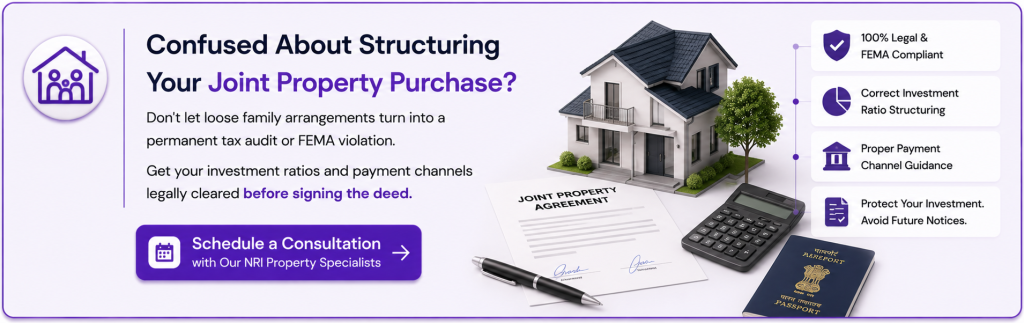
Need help structuring your joint property purchase the right way? Talk to an NRI property and tax expert before you sign get your FEMA compliance, ownership documentation, and tax planning sorted in one conversation.
Disclaimer
The content published on NriTaxs is intended for informational purposes only and does not constitute legal, tax, or financial advice. Readers are encouraged to consult qualified professionals before making any decisions based on the information provided.




Related Articles