

India has formally brought the amended India-Mauritius tax treaty into effect. The central government notified the protocol on 13 October 2026, and it added a Principal Purpose Test (PPT) to the treaty. In simple words, treaty benefits can now be denied if getting that benefit was one of the main reasons behind a transaction or structure.
Quick Summary
- ✔ What changed: A revised treaty preamble and a new Article 27B (the PPT).
- ✔ Notified in India: 13 October 2026, under Section 159(1) of the Income-tax Act, 2025.
- ✔ In force from: 10 August 2026, as per the notification.
- ✔ Grandfathering: Not expressly repealed. Share gains on investments made before 1 April 2017 stay outside the PPT, as per CBDT Circular 1/2025.
- ✔ Who should care most: Funds, holding companies and investors who use Mauritius structures to claim treaty benefits.
What has happened?
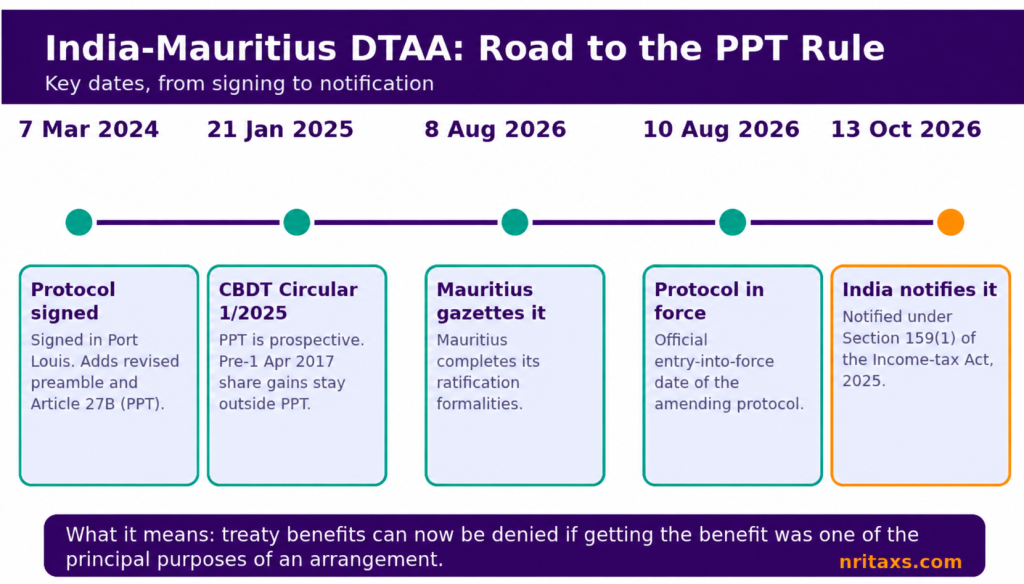
India and Mauritius signed the amending protocol on 7 March 2024 in Port Louis. It took more than two years to get through approvals on both sides. Mauritius gazetted the protocol on 8 August 2026, and the Indian government followed with its notification on 13 October 2026. Note that a few news reports carry 14 October, but the notification itself is dated 13 October.
This is a big moment because the Mauritius route has been one of the most talked-about channels for investing in India for decades. The original 1982 treaty let Mauritius residents pay capital gains tax only in Mauritius, and Mauritius did not tax such gains. The 2016 protocol changed that for shares bought on or after 1 April 2017. The 2026 protocol now adds a general anti-abuse test on top.
What is the Principal Purpose Test (PPT)?
The PPT is an anti-abuse rule that comes from the OECD’s BEPS project. Under Article 27B, tax authorities can deny a treaty benefit if, looking at all the facts, it is reasonable to conclude that getting that benefit was one of the principal purposes of an arrangement or transaction. The taxpayer can still keep the benefit if it can show that granting it fits the object and purpose of the treaty provisions.
Simple Example (Hypothetical)
A company is set up in Mauritius with no staff, no office and no real business there. Its only job is to hold Indian shares so that it can claim treaty benefits. That structure is exactly the kind of arrangement the PPT is designed to examine. A Mauritius company with real operations, people and a genuine commercial reason is in a very different position.
One more thing to understand: tax authorities are now expected to look beyond a Tax Residency Certificate (TRC). Earlier, a TRC from Mauritius was widely treated as enough to claim benefits, a position backed by a 2004 Supreme Court ruling. With the PPT, the TRC is still needed, but it may not be the end of the discussion.
What exactly changes in the treaty?
| Change | What it means |
| Revised preamble | The treaty now says clearly that the aim is to remove double taxation without creating chances for non-taxation or reduced taxation through evasion or avoidance (including treaty shopping). |
| New Article 27B (PPT) | Treaty benefits can be denied for tax-driven arrangements, subject to the “object and purpose” safeguard. |
| Wide coverage | Experts note the PPT can apply to different kinds of income covered by the treaty, such as capital gains, dividends and fees for technical services. |
Effective date: from when does the PPT apply?
As per the notification, the protocol entered into force on 10 August 2026. Article 3 of the protocol says its provisions take effect from the entry-into-force date, regardless of when the tax is levied or which tax year it relates to. Businesses should therefore separate two dates: the date the protocol came into force (10 August 2026) and the date it was published in the Gazette (13 October 2026).
Key dates in the India-Mauritius DTAA amendment (source: official notification as reported by EY and India Briefing).
Grandfathering: what about investments made before 1 April 2017?
This is the question most investors are asking. Here is what is clear so far:
- The 2026 protocol does not expressly repeal the grandfathering rules brought in by the 2016 protocol for qualifying investments made before 1 April 2017.
- CBDT Circular 1/2025 (21 January 2025) clarified that PPT provisions added through bilateral treaty changes are prospective. It also said qualifying capital gains on Indian company shares acquired before 1 April 2017, by residents of Mauritius, Singapore and Cyprus, remain outside the PPT.
However, tax professionals advise against assuming that grandfathering settles every possible anti-avoidance question. India’s domestic General Anti-Avoidance Rules (GAAR) work separately. The Supreme Court’s January 2026 ruling in the Tiger Global case is being read as a reminder that a TRC alone has limits.
Impact on investors: tax benefits and what to expect
- New investments: The PPT should be part of the structuring decision from day one, not something to check only when income arrives or at exit.
- Existing Mauritius structures: Investments made on or after 1 April 2017 need to be able to show a genuine commercial reason and real substance in Mauritius.
- Funds and holding companies: Documentation matters more now, including board minutes, local decision-making, office and staff, and a clear business purpose.
- Dividends, interest and fees: Treaty rates on these items are also subject to the PPT test, so claims need proper support.
- Market sentiment: Mauritius has long been a major source of foreign investment into India, so market participants will watch for how the tax department applies the test in practice.
Separately from tax, investors should also keep in mind that India’s foreign investment framework has changed this year. Read our explainer on the new FEMA non-debt investment rules 2026 for NRIs and OCIs for the FEMA side of cross-border investing.
What does this mean for NRIs?
The PPT is aimed at arrangements and structures, so most NRIs who invest in India directly are not the target of this change. Still, the larger message is useful for every NRI: a DTAA benefit is never automatic. It depends on your country of residence, valid residency papers and the type of income.
- Your treaty position starts with your residential status. If you are not sure where you stand, read Who is an NRI? Meaning, eligibility and tax rules.
- To see how DTAA works for a specific country in practice, our guide on NRI tax on mutual funds in India for UAE NRIs (TDS, capital gains and DTAA) is a good example.
- If you earn money from an Indian business or freelance clients, see TDS on NRI business income in India and the refund process to understand how tax deducted at source is handled.
What should investors do now?
- Map every India investment that depends on the Mauritius treaty and note the date each investment was made.
- Separate investments made before 1 April 2017 from those made on or after that date.
- Collect substance evidence: TRC, board and management records, office and employee details, and the commercial rationale for the structure.
- Review upcoming exits, dividends and fee payments where a treaty rate is being claimed.
- Speak to a qualified tax advisor before the next transaction, not after it.

Final Thoughts
The India-Mauritius DTAA amendment marks an important step towards preventing the misuse of tax treaty benefits. With the introduction of the Principal Purpose Test (PPT), investors and businesses may need to demonstrate that their Mauritius-based structures have genuine commercial purposes and are not primarily designed to obtain tax advantages.
For NRIs, funds and other investors, the key is to understand how the revised treaty applies to their specific investments, review the relevant documentation and avoid assuming that a Tax Residency Certificate alone guarantees treaty benefits. Although grandfathering provisions remain important for qualifying pre-1 April 2017 investments, each case should be assessed on its own facts, including the potential application of domestic anti-avoidance rules.
Disclaimer
The content published on NriTaxs is intended for informational purposes only and does not constitute legal, tax, or financial advice. Readers are encouraged to consult qualified professionals before making any decisions based on the information provided.









Related Articles