
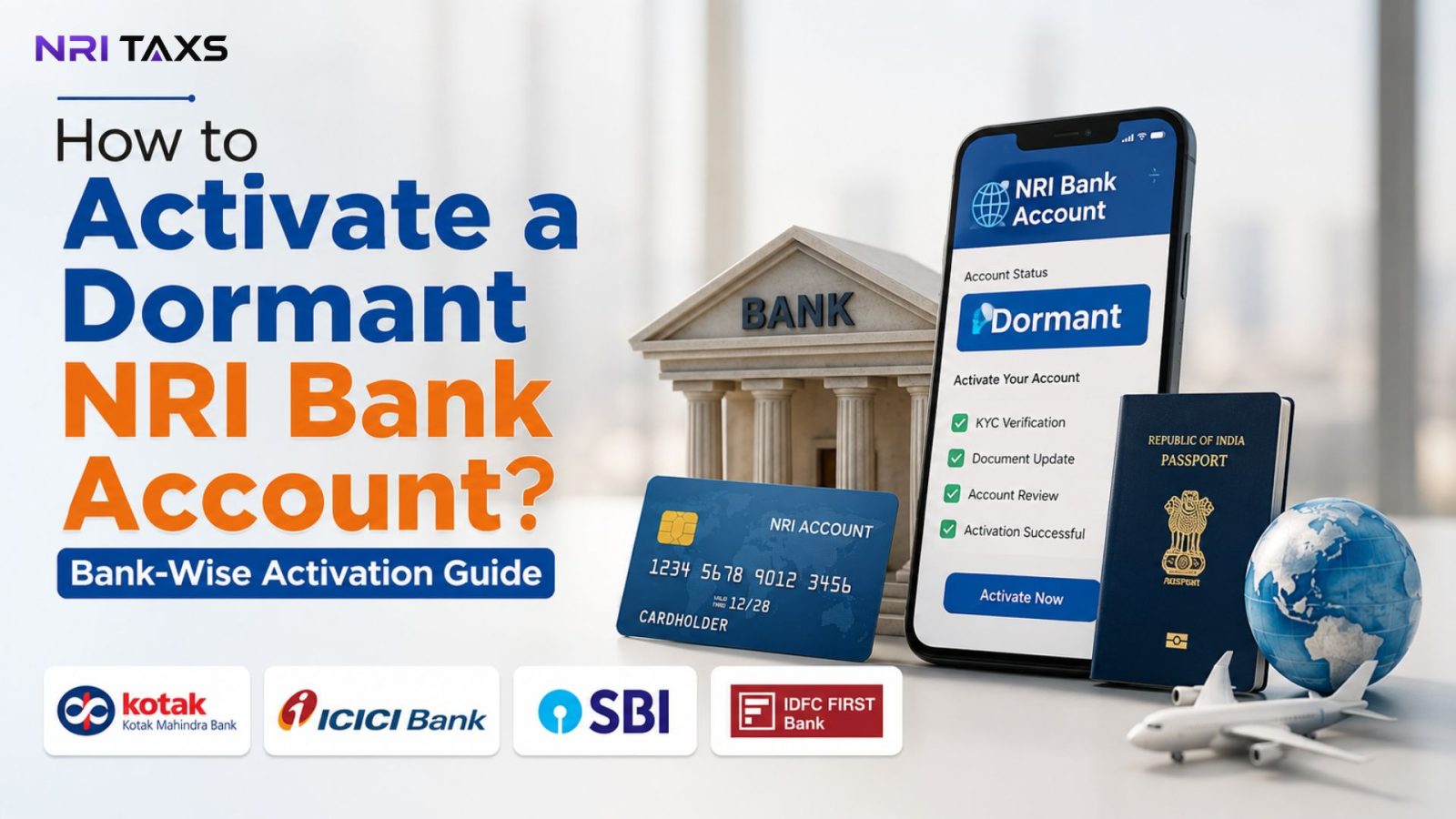
Has your NRI bank account suddenly become inactive or stopped allowing transactions? A dormant account can make it difficult to access your funds, make banking transactions, or manage your NRE or NRO account when you need it most. Reactivating a dormant NRI bank account usually involves submitting a reactivation request, updating KYC details, and completing the bank’s required verification and documentation. The exact requirements and process can vary depending on the bank and account type.
In this guide, you’ll learn how to activate dormant NRI bank account step by step, which documents you may need, and the bank-wise activation process for Kotak, ICICI, SBI, and IDFC FIRST Bank.
Quick Answer
A dormant NRI bank account can generally be reactivated by submitting a reactivation request, completing KYC verification, and providing the documents required by the bank. The exact process may vary by bank and account type. NRIs may be able to complete the process remotely through available banking or KYC channels.
What Is a Dormant NRI Bank Account?
A dormant or inoperative account is a bank account in which there have been no customer-induced transactions for an extended period. Under RBI guidelines, if there are no customer-induced transactions in a savings or current account for more than 24 months, the bank classifies it as inoperative or dormant. If there is no such activity for more than 12 months, the account may be classified as inactive before reaching dormant status. This can apply to NRE and NRO accounts as well, depending on the account and bank’s applicable rules. Once an account becomes dormant, debit transactions and access to certain banking services may be restricted until the account is reactivated.
Why Does an NRI Bank Account Become Dormant?
- Long periods of inactivity because the account is not regularly used.
- The NRI stops using an older account after opening a new NRE or NRO account.
- Outdated contact or KYC details can make it difficult to receive bank communications or complete required updates.
- Having multiple bank accounts may result in one account remaining unused for a long period.
- The account holder may not be aware of the bank’s dormancy rules or the need to maintain regular customer-induced activity.
What Happens When an NRI Bank Account Becomes Dormant?
- Debit transactions such as ATM withdrawals and certain fund transfers may be restricted until the account is reactivated.
- Certain banking services and debit transactions through internet or mobile banking may be restricted until the account is reactivated.
- Cheque payments and certain fund transfers may be restricted until the account is reactivated.
- Certain debit-based standing instructions or recurring payments may be affected.
- Applicable interest continues to be credited to the account as per the applicable rules, even while the account is inoperative.
How to Activate Dormant NRI Bank Account?
Regardless of which bank you use, the general reactivation process is roughly the same. Here’s the step-by-step process most banks follow.
Step 1: Check Your Account Status
First, confirm whether your account is inactive or fully dormant. Try logging into net banking, call customer care, or check with your branch. The exact process depends on which status your account is in.
Step 2: Contact Your Bank
Reach out to your bank’s NRI banking helpline, email support, or your registered branch, and request the reactivation form along with the required document list.
Step 3: Submit Reactivation Request
Fill out the dormant account activation form signed by all joint holders, if applicable and submit it via email, internet banking portal, or in person at the branch.
Step 4: Complete KYC Verification
If your KYC has expired, you’ll need to submit updated documents/passport, visa/OCI card, and overseas address proof. Keeping your NRI KYC details updated can help avoid delays when accessing or managing your bank account.
Step 5: Complete Additional Verification
Many banks offer Video KYC (V-CIP) or accept notarized/apostilled documents if you can’t visit India in person. Some banks may also ask for NRI status proof, such as a work permit or residency card.
Step 6: Wait for Bank Verification
The bank verifies your submitted documents. Under RBI rules, banks are required to reactivate an account within 3 working days of receiving a complete application though for NRI cases, overseas document verification can take a bit longer.
Step 7: Account Reactivation Confirmation
Once verification is complete, the bank sends an email/SMS confirmation, and your account is restored to full banking access.

Documents Required to Reactivate a Dormant NRI Account
| Document | Purpose |
| Dormant Account Activation Form | The bank’s official reactivation request form |
| Valid Passport | Identity proof |
| Valid Visa / Work Permit / Residency Card | Proof of NRI status |
| Overseas Address Proof | Utility bill, bank statement, or residency card |
| PAN Card | KYC and tax compliance |
| Recent Passport-Size Photograph | KYC documentation |
| Updated KYC Form | Required if your existing KYC has expired |
Bank-Wise Dormant NRI Account Activation Process
Kotak Dormant Account Activation
- Contact Kotak’s NRI banking helpline or your relationship manager.
- Download and fill out the dormant account activation form.
- Attach your passport, visa, and overseas address proof.
- Send the documents to the branch via email or courier.
- Once verified, the account is reactivated and you’ll receive a confirmation.
ICICI Dormant Account Activation
- Raise an activation request through the ICICI Bank NRI portal or net banking.
- If your KYC is still valid, a single customer-induced transaction (financial or non-financial) can reactivate an inactive account.
- If the account is inoperative/dormant, submit a re-KYC request form at the branch.
- Attach KYC documents (ID proof such as passport/visa, and address proof).
- The account is activated once the branch completes verification.
SBI Dormant Account Activation
- Contact your home branch or SBI’s NRI banking cell.
- Fill out the dormant account activation form along with the updated KYC form.
- Attach your passport, visa, PAN, and overseas address proof. If you don’t have a PAN Card then you can easily apply for an NRI PAN Card online.
- Submit the signed documents to the branch via courier or as self-attested copies.
- The account becomes operative once the bank completes verification.
IDFC FIRST Bank Dormant Account Activation
- Start the reactivation request through IDFC FIRST’s NRI banking support or app.
- Check for a Digital KYC or Video KYC (V-CIP) option — this can help you avoid an in-person branch visit.
- Upload your passport and address proof.
- Wait for the bank’s reminder or verification call.
- The account is typically reactivated quickly once KYC is cleared.
How Long Does It Take to Reactivate a Dormant NRI Account?
| Scenario | Approximate Time |
| KYC already valid, simple transaction-based reactivation | Same day to 3 working days |
| KYC expired, documents submitted correctly | 3–7 working days |
| Overseas document verification / courier delays | 7–15 working days |
Are There Any Charges for Reactivating a Dormant NRI Account?
Under RBI guidelines, banks cannot charge for reactivating a dormant account, the process itself is free. However, if your account has a minimum balance requirement that wasn’t maintained during the dormant period, non-maintenance charges may apply once it’s reactivated. It’s worth confirming your balance requirement with the bank while initiating reactivation.
What If You Cannot Reactivate Your Dormant NRI Account?
If you’re running into issues with documents or verification, ask your bank for written clarification on the exact problem. In some cases, if an account has been unclaimed for a very long time, the balance gets transferred to the RBI’s Depositor Education and Awareness (DEA) Fund — but this money isn’t permanently lost. You can still claim it through your bank, no matter how much time has passed. If you’re unable to handle the process yourself, you can also grant Power of Attorney (POA) to a trusted family member so they can complete the reactivation on your behalf.
Reactivating a dormant NRI account isn’t complicated — it just takes the right documents and a bit of patience. The sooner you start the process, the sooner your account will be fully functional again. If your NRE account situation is also tangled up with a change in residential status, or you’re unsure when to convert it to an RFC/Resident account, our NRE to Resident Account Conversion Guide is worth a read.
Disclaimer
The content published on NriTaxs is intended for informational purposes only and does not constitute legal, tax, or financial advice. Readers are encouraged to consult qualified professionals before making any decisions based on the information provided.








Related Articles