
As an NRI, you’ve worked hard to build your savings in a foreign currency. When it comes to investing that money back in India, a common question always comes up: should you play it safe or aim for higher growth? Many people get stuck here, either leaving their money in a low-interest savings account or making rushed decisions without understanding the difference. The choice between safety and growth isn’t just about numbers; it’s about your financial goals, how much risk you’re comfortable with, and how long you plan to stay invested.
This decision has become even more important as India’s economy continues to present unique opportunities. Understanding the Safe Vs Growth Investments For Nris is the first step toward building a solid financial foundation back home.
Before diving into Safe vs Growth Investments for NRIs, it is essential to first understand each category individually, including their key features, advantages, and disadvantages.
Read Also:- Operational Differences Between USD Investments vs INR Investments (NRI Guide)
What Are Safe Investments?
Safe investments, often called capital preservation or fixed-income instruments, are all about protecting the money you put in. Their main purpose is not to make you wealthy overnight but to ensure your initial investment remains secure while earning a modest, predictable return. Think of these as the foundation of your financial house—strong, stable, and reliable. When you put your money here, you have a very clear idea of what you’ll get back and when, which brings a great deal of peace of mind, especially when you’re managing finances from another country.
Key Features of Safe Investments
- Low Risk:- These instruments are generally insulated from market volatility. For example, a government bond’s value does not fluctuate as wildly as a stock’s.
- Predictable Returns:- When you open a Fixed Deposit (FD), the bank specifies the exact interest rate you will earn, ensuring there are no surprises.
- High Degree of Capital Security:- They offer a high level of capital protection. Many safe investments, such as bank FDs and government-backed schemes, are supported by strong institutions, making the risk of losing your principal extremely low.
- Simple and Easy to Manage:- Safe investments are generally straightforward to understand and manage, which is a significant advantage for NRIs who may not have the time to track complex market movements.
Advantages of Safe Investments
- Stability:- The most significant advantage of safe investments is stability. Knowing that a portion of your portfolio is secure and generating a steady, albeit small, income can be very reassuring. This is particularly important if you have short-term financial goals, like saving for a down payment on a property in India within the next few years.
- Regular Income Stream:- Another key benefit is the regular income stream they can provide. Instruments like FDs or government bonds pay interest periodically, which can act as a reliable source of passive income.
Disadvantages of Safe Investments
- Low Return Potential:- The main drawback is their relatively low return potential. Returns from safe investments often struggle to beat inflation over the long term. For example, if inflation in India is 6% and your FD is offering 7%, your real return is only 1%. This means your money’s purchasing power grows very slowly.
- Limited Wealth Creation:- Another disadvantage is limited wealth creation. Since the returns are modest, these investments do not significantly multiply your wealth over time. They are primarily designed to preserve capital rather than grow it aggressively.
Examples of Safe Investments for NRIs
For NRIs, some of the best safe options include NRE Fixed Deposits (FDs), which are incredibly popular because the interest earned is tax-free in India. Another is the Public Provident Fund (PPF), a government-backed scheme offering attractive, tax-free returns, though eligibility rules for NRIs can be specific. Government of India Bonds are another solid choice, as they are backed by a sovereign guarantee, making them one of the safest options available.
What Are Growth Investments?
Growth investments are focused on capital appreciation. The primary goal is to grow your initial investment into a significantly larger sum over time. Unlike safe investments that offer predictability, growth investments embrace market volatility with the expectation of higher returns. These investments act as the engines of your portfolio, designed to build long-term wealth that can significantly outpace inflation. To succeed with growth investments, you need a longer investment horizon and a higher tolerance for risk, as their value can fluctuate considerably in the short term.
Key Features of Growth Investments
- High Return Potential:- The defining feature is their higher return potential. Investments like stocks and mutual funds have the ability to generate returns well into double digits over the long term.
- Market-Linked Performance:- These investments are market-linked, meaning their value depends on the performance of the stock market, real estate market, or the overall economy. This connection creates both the opportunity for higher returns and the risk of losses.
- Long-Term Investment Horizon:- Growth investments require a longer time horizon. Investors typically need to stay invested for at least five to seven years to ride out market cycles and fully realize their growth potential.
- Higher Risk Exposure:- They come with higher risk, including the possibility of losing a portion or even all of the initial capital, especially in the short term.
Advantages of Growth Investments
- Strong Wealth Creation Potential:- The most compelling advantage is wealth creation. Historically, investments like equities have delivered returns that significantly exceed inflation, allowing your money to grow substantially over time. This makes them ideal for building a corpus for major life goals such as retirement or children’s education.
- Power of Compounding:- Another major benefit is the power of compounding. When you reinvest your earnings from growth assets, your money grows exponentially over time. This effect is far more impactful compared to low-return safe investments.
Disadvantages of Growth Investments
- Market Risk and Volatility:- The most obvious disadvantage is market risk and volatility. The value of your investment can go down as well as up, and there are no guarantees. This can be stressful for investors who are not prepared for such fluctuations.
- No Guaranteed Returns:- Another drawback is the lack of guaranteed returns. Unlike a Fixed Deposit (FD), no one can predict exactly what return your mutual fund will generate next year. It depends entirely on market performance, which can be unpredictable.
Examples of Growth Investments for NRIs
NRIs have excellent access to growth opportunities in India. Equity Mutual Funds via a Systematic Investment Plan (SIP) are a great way to start, as they allow you to invest a fixed amount regularly, managed by professionals. Direct Equity (buying stocks of Indian companies) is another option for those with more experience. Real Estate, both commercial and residential, has traditionally been a popular growth asset for NRIs, offering potential appreciation and rental income.
Safe Vs Growth Investments For NRIs: Key Differences
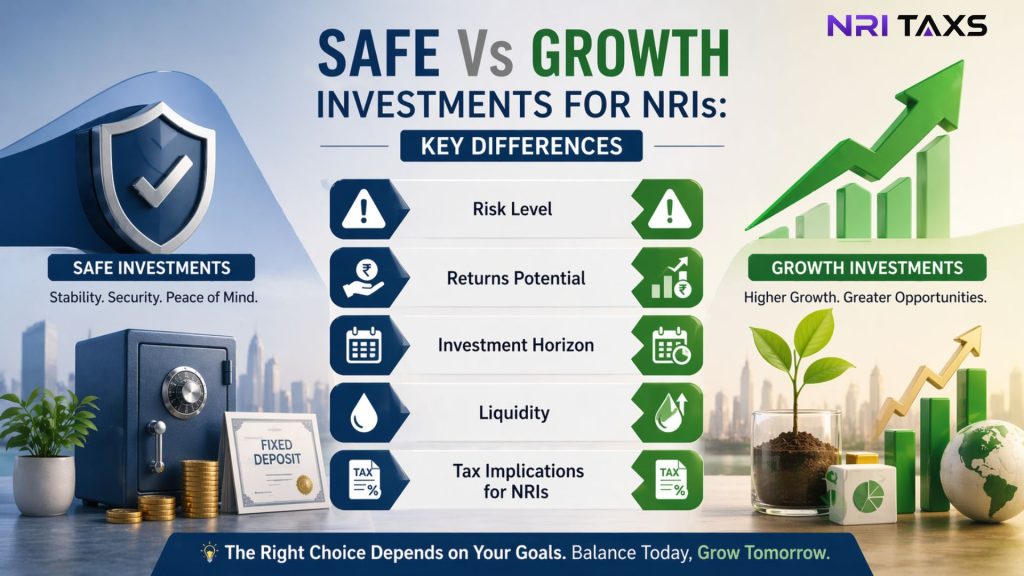
Now it’s time to understand Safe vs Growth Investments for NRIs.
Risk Level
This is the most fundamental difference. Safe investments have a very low risk of capital loss. Your principal is largely protected. Growth investments, on the other hand, carry a much higher risk. Market downturns can lead to a temporary or, in worst-case scenarios, permanent loss of capital if you are forced to sell at the wrong time.
Returns Potential
Safe investments offer modest, often fixed, returns, typically in the range of 6-8%. Growth investments have a much higher potential for returns, with equities historically delivering 12-15% or more on average over the long term. However, these returns are not guaranteed and come with the risk we just discussed.
Investment Horizon
Your investment timeline plays a crucial role. If you need the money in the next 1-3 years, safe investments are the logical choice. You can’t afford to risk a market crash right before you need to withdraw. Growth investments are suitable for long-term goals that are 5+ years away, giving your money enough time to recover from any downturns and benefit from compounding.
Liquidity
Liquidity refers to how easily you can convert an investment back into cash. Many safe investments like NRE FDs are quite liquid, though you may pay a small penalty for premature withdrawal. Growth investments vary. Stocks and mutual funds are highly liquid; you can sell them on any business day. However, real estate is highly illiquid; selling a property can take months or even years.
Tax Implications for NRIs
For NRIs, tax rules are a critical factor. Interest from NRE FDs is tax-free in India. In contrast, returns from growth investments are subject to capital gains tax. If you sell stocks or equity mutual funds after holding them for more than a year, you pay a Long-Term Capital Gains (LTCG) tax. If sold within a year, a higher Short-Term Capital Gains (STCG) tax applies.
Best Safe Investment Options For Nris
- NRE Fixed Deposits:- The tax-free interest makes them a top choice. They are simple to set up and manage through an NRE account.
- FCNR (B) Deposits:- These are foreign currency denominated FDs. They protect you from INR-USD currency fluctuations, as you invest and receive returns in a foreign currency.
- Government of India Bonds:- These offer supreme safety as they are backed by the government. The returns are decent and predictable.
Best Growth Investment Options For Nris
- Equity Mutual Funds (via SIP):- This is perhaps the most effective way for NRIs to invest in the Indian stock market. A SIP automates the process and helps average out purchase costs over time.
- Portfolio Management Services (PMS):- For those with a larger investment amount, PMS offers a professionally managed portfolio of stocks and other securities tailored to your risk profile.
- Commercial Real Estate:- Instead of residential property, which can be difficult to manage from abroad, investing in smaller commercial properties or Real Estate Investment Trusts (REITs) can offer both rental income and capital appreciation.
Conclusion: Safe Vs Growth Investments for NRIs
Ultimately, the debate of Safe vs Growth Investments for NRIs is not about choosing one over the other. The most effective approach is to build a well-diversified portfolio that includes both. Your allocation should be based on your age, financial goals, risk tolerance, and investment horizon. A younger NRI with a longer time until retirement may lean more toward growth investments, while someone closer to retirement may prefer the stability of safe investments.
Looking ahead to 2026 and beyond, India is poised for continued economic growth, making it an attractive destination for investment. By striking the right balance between safety and growth, NRIs can not only protect their hard-earned wealth but also create meaningful long-term value. The key is to stay informed, invest consistently, and align your portfolio with your evolving financial goals.
Disclaimer
The content published on NriTaxs is intended for informational purposes only and does not constitute legal, tax, or financial advice. Readers are encouraged to consult qualified professionals before making any decisions based on the information provided.










Related Articles