

Understanding How IPO Pricing Works is essential for investors entering the stock market. The IPO pricing process determines a company’s initial share value when it transitions from private to public. This pricing is influenced by factors such as company performance, market demand, industry trends, and investor sentiment. Investment banks and underwriters play a key role in evaluating these elements to set an appropriate price range. For investors, knowing this process helps in assessing whether an IPO is fairly valued and worth investing in, enabling smarter and more informed financial decisions.
What Is Ipo Price?
An IPO price, often called the offer price, is the specific price per share at which a company first sells its stock to the public. Before an IPO, a company is private, with its ownership held by a small number of founders, investors, and employees. The IPO marks the transition to public ownership, and the offer price is the starting point for the stock’s journey on a public exchange like the New York Stock Exchange or Nasdaq. This price is set before the stock begins trading and is the amount that initial institutional and retail investors pay for each share.
The primary goal of setting an IPO price is to find a balance. The company aims to raise the maximum amount of capital possible by selling its shares. At the same time, the price needs to be attractive enough to generate strong demand from investors. If the price is too high, there might not be enough buyers, and the IPO could be unsuccessful. If it is too low, the company leaves potential capital on the table. This is why the pricing stage is a critical part of the entire IPO journey.
Read Also:- Best Sectors for IPO Investment From NRI Perspective
Key Components Of Ipo Pricing
- Underwriter Due Diligence
Underwriters review financials, business model, management quality, and risks to assess company strength and establish a solid base for accurate IPO pricing decisions. - Company Valuation
Valuation determines a company worth using methods like comparable analysis and discounted cash flow, helping set a logical price range before shares are offered publicly. - Issue Size and Structure
Issue size defines total shares offered, while structure balances new and existing shares, impacting capital raised, ownership dilution, and overall investor confidence. - Market Demand
Investor demand plays a crucial role in pricing, as strong interest can push prices higher, while weak demand may force companies to lower the IPO price. - Industry and Market Conditions
Overall market trends, economic conditions, and industry performance influence IPO pricing, as favorable environments attract investors and support higher valuations, while uncertainty reduces pricing potential.
Ipo Pricing Methods
- Fixed Price Method
In the fixed price method, the company and its underwriters determine a single, fixed price for the shares before the IPO opens. This price is announced in advance, and investors apply to buy shares at this set price. The main advantage of this method is its simplicity and certainty. However, it does not allow the price to adjust based on real-time investor demand discovered during the subscription period.
- Book Building Method
The book building method is more common in many markets today. Instead of setting one price, the underwriters announce a price range, or price band. They then invite institutional investors to submit bids for the number of shares they want to buy and the price they are willing to pay within that range. This process of collecting bids is called “building the book” and helps gauge true market demand, allowing the final price to be set where demand is strongest.
How Ipo Pricing Works In The Stock Market?
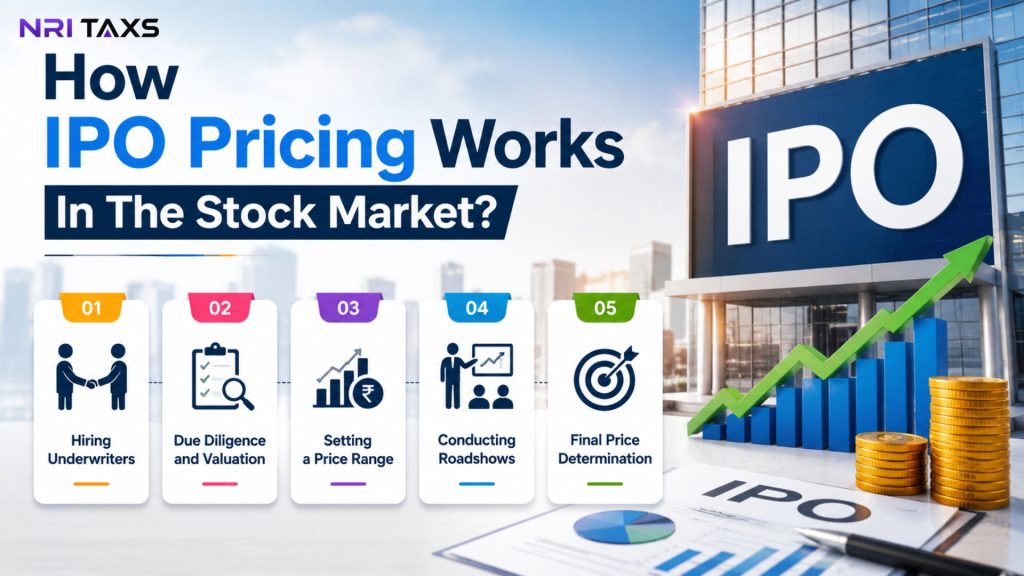
The IPO pricing process follows a structured sequence where each stage helps determine the most accurate and market-driven share price for a company going public.
Hiring Underwriters
The company first appoints investment banks (underwriters) to manage the IPO process. These experts guide the entire offering, handle regulatory requirements, and design the pricing strategy based on market conditions and company strength.
Due Diligence and Valuation
Underwriters conduct a deep financial and operational review of the company. They study revenue, profit trends, risks, and growth potential to estimate a fair valuation range that supports IPO pricing discussions.
Setting a Price Range
Based on valuation results, a price band is created instead of a single price. This range is shared with institutional investors to understand how the market perceives the company’s value.
Conducting Roadshows
Company management and underwriters meet large institutional investors in different locations. These presentations explain the business model and future growth plans, while also collecting feedback and measuring demand.
Final Price Determination
After collecting investor bids during the book-building process, demand is analyzed. The final IPO price is set at the level where demand and supply balance most effectively, ensuring a fair market valuation.
Factors Affecting Ipo Pricing
Beyond the formal methods and processes, several external and internal factors can influence the final IPO price. These factors reflect the broader economic environment and the specific circumstances of the company.
- Company Financials and Growth:- A company with strong revenue growth, consistent profitability, and a healthy balance sheet is often able to command a higher IPO price from investors.
- Market Conditions:- The overall health of the stock market plays a significant role. A bullish market with rising stock prices generally supports higher IPO valuations and greater investor interest.
- Industry and Competitor Performance:- The performance of similar companies already trading in the public market provides a benchmark. A thriving industry can boost the valuation of a new entrant.
- Investor Demand:- Ultimately, the level of interest from institutional and retail investors is a critical factor. High demand for an offering can push the final price toward the higher end of the range.
Conclusion
The IPO pricing process is a balanced exercise that combines company valuation with real-time market demand. It is guided by underwriters who use methods like book building to find an optimal price that satisfies both the company’s need for capital and investors’ expectations. Looking ahead to 2026, we may see technology play an even greater role in gauging investor sentiment, potentially making the price discovery phase more efficient. Understanding how the IPO offer price is set is key for anyone interested in public market debuts.
Disclaimer
The content published on NriTaxs is intended for informational purposes only and does not constitute legal, tax, or financial advice. Readers are encouraged to consult qualified professionals before making any decisions based on the information provided.








Related Articles