
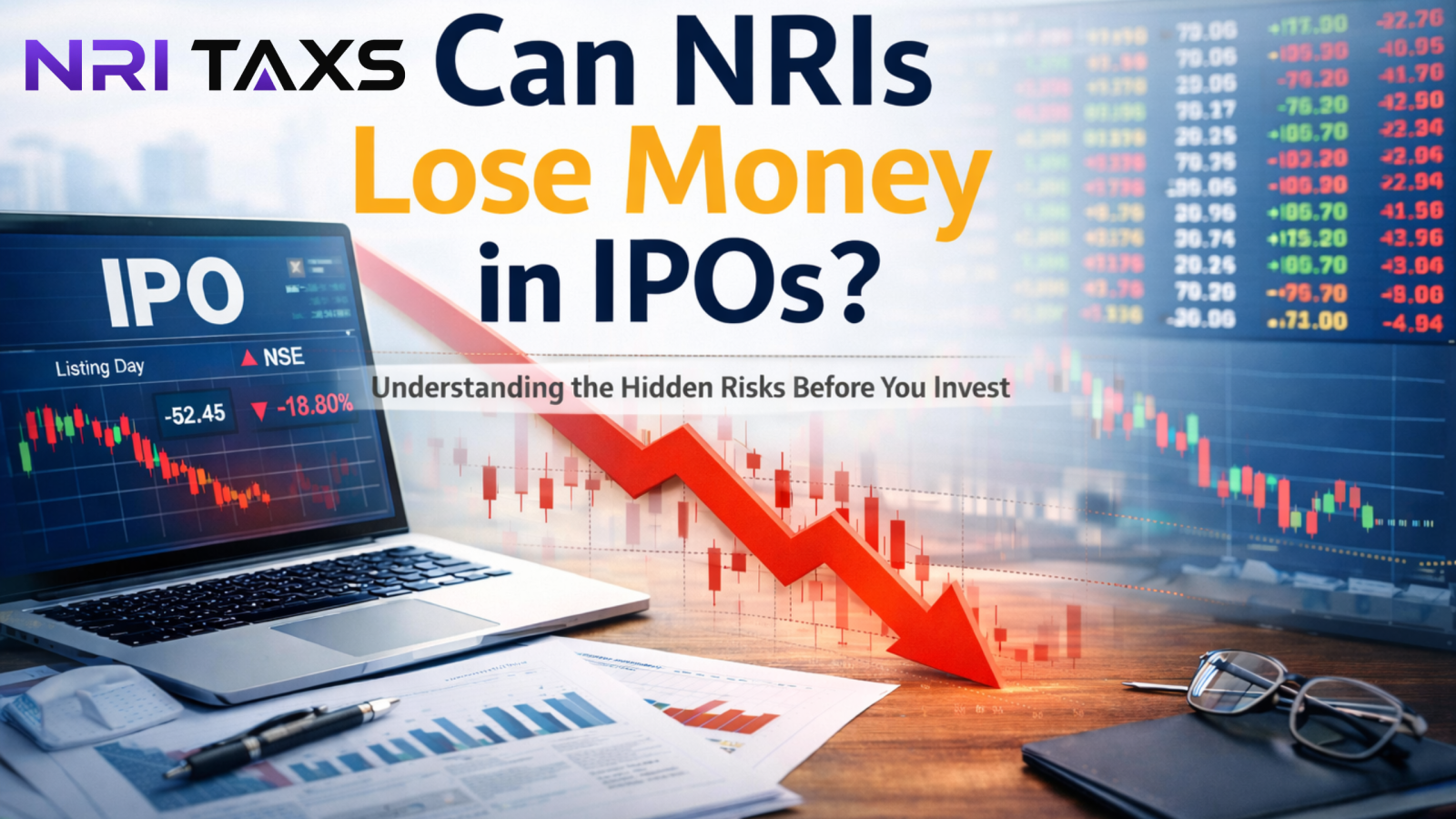
We see the headlines all the time, an Indian IPO lists with a 70% gain, and suddenly, every NRI with a DEMAT account gets a flood of messages from friends and family back home. The hype is real. It feels like free money, a chance to get in on the ground floor of India’s next big success story.
People are searching for this because the fear of missing out (FOMO) is powerful, but so is the fear of losing hard-earned foreign currency. They see the potential upside but have a nagging feeling that it can’t be that simple. They’re right. This isn’t about whether you can invest; it’s about whether you should and what happens when the hype dies down. We’re going to walk Can NRIs Lose Money in IPOs and more information.
Read Also:- What is Expense Ratio in Mutual Funds (NRI Tax Impact Included)
What is an IPO?
An Initial Public Offering (IPO) is when a private company first sells its shares to the public. It’s a transition from being owned by a few founders and investors to being owned by many shareholders. The company does this to raise capital for expansion, pay off debt, or allow early investors to cash out. For us, it’s the first opportunity to buy a piece of that company on the open stock market.
Can NRIs Invest in IPOs in India?
Yes, NRIs can invest in IPOs in India, and the process is quite straightforward. They can apply using their NRE (Non-Resident External) or NRO (Non-Resident Ordinary) bank accounts. The application is done through the ASBA (Application Supported by Blocked Amount) facility. This means the investment amount is simply blocked in your bank account and only deducted if shares are actually allotted to you.
So, from a process and regulatory point of view, everything is well-defined and accessible. However, the real question isn’t just whether you can invest it’s whether the investment will deliver the returns you expect.
Can NRIs Lose Money in IPOs? (The Reality)
Yes, they can and it’s important to understand this clearly. The idea that every IPO guarantees profits is a common misconception. While some IPOs deliver strong listing gains, many others either list at lower prices or decline shortly after listing.
A big reason for this is hype. During the IPO phase, valuations can get pushed to unrealistic levels due to high demand and market excitement. But once the stock is listed, that initial enthusiasm often fades, and prices can correct.
So, when we ask, “Can NRIs lose money in IPOs?”—the answer is straightforward. Yes, it’s a real possibility, and it happens more often than many investors expect.
Key Risks NRIs Face in IPO Investments
Here are the risks NRIs face in IPO investments.
Overvaluation Risk
This is one of the biggest risks. By the time a company launches its IPO, it is often heavily marketed. The price band is usually set to maximize returns for the company and its early investors, not necessarily to provide the best value for new investors. In many cases, companies come to the market with very high valuations based on future growth expectations rather than current performance. If those expectations are not met, the stock price can fall after listing, sometimes quite sharply.
Market Volatility After Listing
Stock prices on listing day are driven by demand, supply, and market sentiment. This can lead to sharp price movements. A stock might open with strong gains but fall significantly by the end of the day. After the initial excitement fades, the price starts reflecting the company’s actual performance and overall market conditions. If the market turns negative, even fundamentally strong companies can see their prices drop.
Listing Day Losses
Not all IPOs deliver listing gains. Some stocks list at the issue price, while others open at a discount. If a stock lists below your purchase price, the loss is immediate. This happens more often than expected, especially in weak market conditions or when the IPO is overpriced.
Limited Financial History of Companies
Many IPOs involve new-age or growth-focused companies. These businesses may have a limited track record, inconsistent profits, or even ongoing losses. Investing in such companies means relying heavily on future potential, which is uncertain. Unlike established companies with long financial histories, IPO investments often involve higher risk.
Currency Risk for NRIs
This is a major factor for NRIs. While your investment is in Indian Rupees, your actual wealth is measured in currencies like USD, AED, or EUR. For example, even if your IPO investment gains 8% in rupee terms, a depreciation of the rupee can reduce or completely offset those gains when converted back to your home currency. This risk quietly impacts your real returns.
Liquidity & Exit Risk
After the initial hype, trading activity in some IPO stocks can reduce significantly, especially for smaller companies. This can make it difficult to sell large quantities of shares without affecting the price. While entering an IPO is easy, exiting at the right price can sometimes be challenging.
Tax Implications for NRIs Investing in IPOs
Taxes are not an afterthought; they directly impact your net returns.
Short-Term vs Long-Term Capital Gains
If you sell your allotted IPO shares within one year of listing, the profit is a Short-Term Capital Gain (STCG). This is taxed at a flat rate of 15% (plus cess and surcharge). If you hold the shares for more than one year, the profit is a Long-Term Capital Gain (LTCG). This is taxed at 10% (plus cess and surcharge) on gains exceeding ₹1 lakh in a financial year.
TDS on IPO Gains
This is critical. For NRIs, tax is deducted at source (TDS) on capital gains. When you sell your shares, the brokerage will deduct TDS at the applicable rates (e.g., 15% for STCG, 10% for LTCG). This happens automatically. You will receive the post-TDS amount.
DTAA Benefits
India has Double Taxation Avoidance Agreements (DTAA) with many countries. Depending on the treaty with your country of residence, you may be able to claim a credit for the tax paid in India or pay a lower rate. However, this requires paperwork and understanding the specific DTAA clauses. It is not automatic. You need to provide a Tax Residency Certificate (TRC) and other documents to your broker.
Common Mistakes NRIs Make in IPO Investing
From our day-to-day work, we see the same patterns repeat.
- Chasing Hype:- Investing solely based on news headlines or the “Grey Market Premium” (GMP). GMP is an unofficial, unregulated indicator of demand. It’s often manipulated and is no guarantee of listing gains.
- Ignoring the Prospectus:- Not reading the Draft Red Herring Prospectus (DRHP). This document contains everything, the company’s business model, financials, and, most importantly, the “Risk Factors” section.
- No Exit Strategy:- Applying for an IPO without a plan. You must decide beforehand: Are you selling on listing day for a quick profit, or are you holding for the long term? Having no plan leads to emotional decisions.
- Overallocation:- Putting too much of your investment capital into a single IPO. This is a concentrated bet. If it fails, it can significantly impact your portfolio.
How NRIs Can Reduce IPO Investment Risk?
You can’t eliminate risk, but you can manage it.
- Do Your Research:- Go through the DRHP (Draft Red Herring Prospectus). Understand what the company does, its business model, competitors, and why it is raising funds. Pay close attention to financials and risk factors.
- Diversify Your Investments:- Avoid putting all your money into a single IPO. It’s better to invest smaller amounts across multiple fundamentally strong IPOs rather than relying on one.
- Look Beyond Listing Gains:- Don’t invest just for listing day profits. Think about whether you would hold the company for the long term. If not, it may not be the right IPO for you.
- Understand Valuation:- Check if the IPO is reasonably priced. Compare valuation metrics like P/E or P/S ratio with similar listed companies. If the pricing looks too high, it’s better to be cautious.
Conclusion- Can NRIs Lose Money in IPOs
The question “Can NRIs lose money in IPOs?” has a simple and direct answer: yes. The glamorous headlines of multi-bagger listing gains hide the harsh reality of overpriced offerings, post-listing slumps, currency risks, and outright losses. The Indian IPO market is not a free lunch. It’s a high-stakes table where institutional investors and company insiders often have the upper hand.
Looking towards 2026, we expect the market regulator (SEBI) to continue tightening disclosure norms, which is good for retail investors. However, the fundamental nature of IPOs will remain the same. They will always be a mix of solid long-term opportunities, overhyped duds, and everything in between. Your job is not to play every hand but to wait for the right opportunity, backed by solid research, not just hype.
Disclaimer
The content published on NriTaxs is intended for informational purposes only and does not constitute legal, tax, or financial advice. Readers are encouraged to consult qualified professionals before making any decisions based on the information provided.









Related Articles