
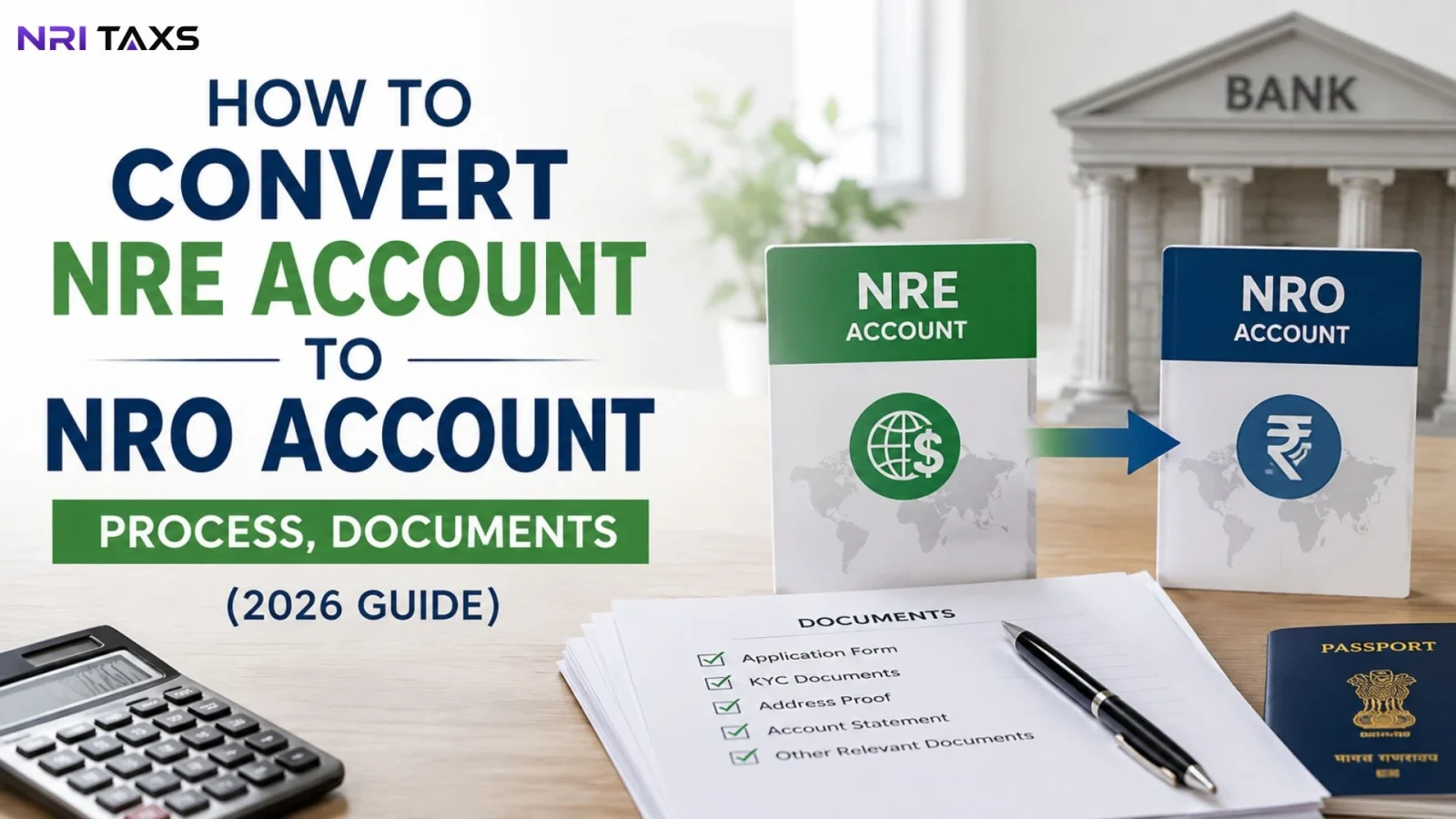
You just moved back to India, and someone told you to convert NRE account to NRO account. That advice is dead wrong and following it will send you chasing the wrong paperwork. Here is the compliance reality: when you return to India permanently, an NRE-to-NRO move is legally impossible. Under RBI regulations, your NRE account must be redesignated as a Resident Savings Account, or the balance must shift into an RFC (Resident Foreign Currency) account.
The actual NRE to NRO account conversion rule runs in the exact opposite direction, it is what happens to a resident savings account when you leave India, not when you come back. Getting this direction wrong means you are sitting on a severe FEMA breach without even knowing it. This 2026 guide clears the confusion, maps out the exact documentation, and highlights the massive tax angle that most returning NRIs completely miss.
What Is an NRE Account, and When Does It Actually Need to Be Converted?
An NRE (Non-Resident External) account is a rupee-denominated bank account that only an NRI, PIO, or OCI can hold. It helps you park foreign earnings in India while keeping the money fully repatriable, with interest that’s completely tax-free under Section 10(4)(ii) of the Income Tax Act, 1961.
That tax-free, fully repatriable status is tied to your residential status under FEMA, not your visa, not your passport, and not how long you’re planning to stay. The moment your status flips from “person resident outside India” to “person resident in India,” your NRE account stops being eligible, whether or not you’ve told your bank yet.
Your FEMA residential status typically changes when:
- You return to India intending to stay for an uncertain or indefinite period not a short visit
- You’ve been in India for more than 182 days in a financial year with no clear plan to go back abroad
- You take up employment, start a business, or otherwise settle in India long-term
This is a separate test from your Income Tax residential status under Section 6, which is based purely on day-count. You can be a FEMA “resident” while still qualifying as RNOR (Resident but Not Ordinarily Resident) for income tax and that distinction matters a lot for the tax section further down.
Once your FEMA status changes, you’re required to stop operating the account as NRE. RBI doesn’t specify an exact number of days the standard language is “immediately on return.” In practice, banks usually give you a working window of a few weeks to a few months to complete the paperwork, but the obligation starts the day your status changes, not the day you get around to it.
Ensure FEMA Compliance Upon Your Return! Miscalculating your residency status or missing account deadlines can lead to severe regulatory scrutiny. Let our specialized cross-border team handle your transition safely. Consult Our NRI Tax Advisory Team
RBI & FEMA Rules: What Actually Happens to an NRE Account on Return
This is the part most guides get backwards, so let’s be precise. Two different redesignations exist under FEMA, and they run in opposite directions:
| Situation | What Happens to the Account |
| A resident Indian leaves India and becomes an NRI | Existing resident savings account → redesignated as an NRO account |
| An NRI returns to India and becomes a resident | Existing NRE account → redesignated as a Resident Savings Account, or balance moved to an RFC account |
| Same returning NRI, if they also held an NRO account | Existing NRO account → also redesignated as a Resident Savings Account (it does not remain NRO) |
If you’re returning to India, the “NRO” step simply isn’t the one you need. Your NRE account has two acceptable destinations:
- Resident Savings Account — the account is redesignated, the account number usually stays the same, and the balance converts to a normal rupee savings account.
- RFC (Resident Foreign Currency) Account — instead of converting the balance to rupees immediately, you move it into an RFC account and keep holding it in USD, GBP, EUR, or another foreign currency until you choose to convert it.
Getting the direction backwards isn’t just a wording issue asking your bank for an “NRO conversion form” when you actually need a resident redesignation form can waste weeks.
The legal basis: this requirement flows from the Foreign Exchange Management Act, 1999, detailed in RBI’s Master Directions and Regulations on deposits held by persons resident outside India. Authorised Dealer banks update your account classification once you inform them of your change in residential status RBI doesn’t expect the bank to detect this on its own. The onus is on you to notify them.
Not doing this is treated as a continuing contravention under Section 13(1) of FEMA, 1999 covered in detail in the penalty section below.
Step-by-Step Process to Redesignate NRE Accounts After Returning to India
Step 1: Inform Your Bank
The moment your residential status changes, write to your bank (a simple letter or email works at most banks) declaring the change. This notification is what triggers everything else; banks don’t pick this up automatically from immigration records.
Step 2: Fill the Account Re-designation Form
Your bank will provide a Resident Account Conversion / Re-designation Form (the exact name varies by bank). All account holders, including joint holders, typically need to sign.
Step 3: Submit Supporting Documents
Attach the KYC and residency-proof documents listed in the next section. Joint accounts where one holder remains an NRI usually need an additional declaration from the bank.
Step 4: Bank Verification
The bank verifies your new residential status, checks your documents against KYC/FATCA/CRS requirements, and updates its internal account flags.
Step 5: Account Status Updated
Your account is redesignated from an NRE Savings account to a Resident Savings Account (or the balance is moved to a newly opened RFC account, if you’ve requested one). The account number generally stays the same when the classification changes.
(Note: As stated in the introduction, your funds move into a Resident Savings Account, not an NRO account, as NRE-to-NRO conversion upon return is legally prohibited under RBI and FEMA regulations).

Documents Required for Resident Account Redesignation
| Document | Why It’s Needed |
| Passport | Confirms identity and travel history; shows date of return where relevant |
| Proof of return / visa status (cancelled work visa, OCI/PIO card, etc.) | Establishes the change in residential status |
| Indian address proof (Aadhaar, utility bill, etc.) | Required for resident KYC |
| PAN card | Mandatory for resident savings/FD accounts and TDS purposes |
| Resident Account Conversion / Re-designation Form | The bank’s formal application for redesignation |
| FEMA declaration (bank format, if applicable) | Some banks require an explicit declaration of FEMA-resident status |
| Joint holder consent / declaration (if applicable) | Needed when a co-holder is still an NRI |
What Happens After Your NRE Account Is Converted?
It becomes a normal resident savings account once redesignated (or an RFC account, if that’s what you chose).
- Foreign-currency privileges and unlimited repatriation go away. Once it’s a resident rupee account, outward transfers fall under the resident Liberalised Remittance Scheme (LRS) limit, currently USD 250,000 per financial year not the NRE account’s unlimited repatriation.
- Taxation changes immediately: the Section 10(4)(ii) exemption on NRE interest ends the day your FEMA status changes not when your RNOR window ends. This is the detail most people miss: many returning NRIs assume RNOR status keeps their (now resident) NRE interest tax-free for 2–3 years. FEMA residency and income-tax RNOR status are two separate tests, and getting this wrong means under-reporting interest income.
- You can keep holding mutual funds, stocks, or other investments made through the account nothing forces a liquidation but updates your KYC status to “resident” with each fund house or broker.
- TDS on the new resident savings/FD interest follows resident rules: 10% under Section 194A once interest crosses ₹40,000 a year (₹50,000 for senior citizens), instead of the higher NRI TDS rate. You can file Form 15G/15H to avoid TDS if your total income is below the taxable threshold.
NRE Fixed Deposits: What Happens to Existing FDs
You don’t have to break an existing NRE FD just because your status changed. RBI allows NRE FDs to run to maturity at the originally contracted rate premature closure is a choice, not a requirement.
- On maturity, you decide: redesignate the proceeds as a resident FD, or move them into an RFC account to keep the foreign-currency exposure.
- Watch for bank staff who push for premature closure this can cost you the original (often higher) NRE rate. If challenged, ask the bank to point to the specific Master Direction clause, and escalate in writing if needed.
- Interest earned from the date your FEMA status changes until FD maturity becomes taxable in India, even though the contracted rate itself doesn’t change.
Common Mistakes to Avoid
- Assuming NRE converts to NRO and requesting the wrong form from your bank.
- Not informing the bank promptly after returning, and continuing to operate the account as NRE (a continuing FEMA contravention) Letting bank staff talk you into breaking an NRE FD prematurely.
- Forgetting to update KYC across mutual funds, demat, and insurance providers linked to the account.
- Confusing RNOR (income tax) status with FEMA residency, and assuming NRE-turned-resident interest stays tax-free during the RNOR window.
- Overlooking joint accounts where one holder is still an NRI these need a separate declaration.
How Long Does the Account Redesignation Process Take?
There’s no statutory turnaround time written into RBI’s regulations. In practice:
- Most banks complete the redesignation in 1–2 weeks once documents are submitted and verified.
- Delays usually come from incomplete KYC, missing address proof, or joint-holder paperwork not from the bank’s internal process.
- RBI’s expectation is that you start the process “immediately” on your change in status that word governs when you begin, not how long the bank takes to finish.
Can You Keep an NRE Account After Becoming a Resident?
No. Under FEMA, once you’re a person resident in India, you cannot hold an NRE account it has to be redesignated as a resident savings account or moved into an RFC account. The same applies to any NRO account you hold; it also gets redesignated as a resident account rather than continuing as NRO. The one NRI-status account RBI lets you keep without forced redesignation is an FCNR(B) deposit, which can run to its original maturity.
Penalty for Not Redesignating Your NRE Account on Time
Operating an NRE account after your FEMA status has changed is a contravention under Section 13(1) of FEMA, 1999:
- A penalty of up to three times the amount involved, where the amount is quantifiable.
- Or up to ₹2 lakh, where the amount isn’t directly quantifiable.
- An additional ₹5,000 per day for every day the contravention continues after the first day.
If you’ve already missed the window, RBI’s compounding mechanism under Section 15 lets you voluntarily disclose the lapse and settle it under the Compounding Rules, 2024 typically at a lower cost than a full enforcement action. This route needs a formal application (₹10,000 + GST fee) and supporting documents, so it’s worth speaking to your bank’s NRI desk or a CA before the non-compliance period stretches on.
Conclusion
Returning to India is a major transition, and updating your financial footprint is a critical legal requirement under FEMA. Redesignating your NRE and NRO accounts immediately upon your return is not just about avoiding steep RBI penalties it ensures your global income and domestic earnings remain fully compliant with Indian tax laws.
Still Not Sure Which Account Move Applies to You? FEMA residency, income-tax residency, and your bank’s internal timelines don’t always line up neatly and the cost of getting the direction wrong is weeks of delay or a FEMA penalty. Talk to our NRI tax advisory team!
Disclaimer
The content published on NriTaxs is intended for informational purposes only and does not constitute legal, tax, or financial advice. Readers are encouraged to consult qualified professionals before making any decisions based on the information provided.









Related Articles