
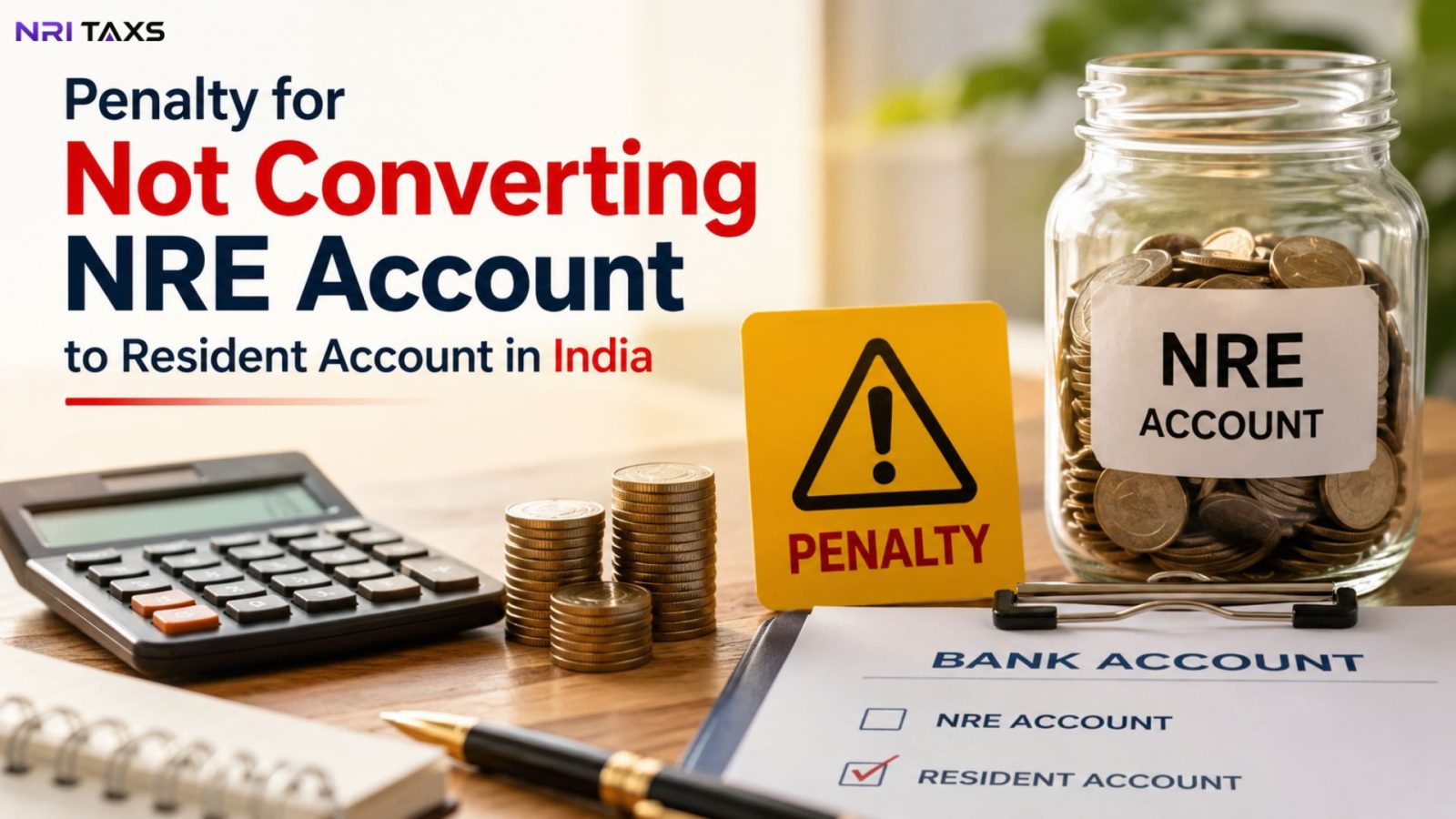
If you’ve permanently returned to India but are still using your NRE account, you could be violating RBI and FEMA regulations without realizing it. An NRE account is meant only for Non-Resident Indians, and once your residential status changes, it must be redesignated as a resident account or shifted to an RFC account, depending on your situation. Delaying this conversion can lead to compliance issues, loss of tax benefits, banking restrictions, and, in certain cases, penalties under FEMA. In this guide, you’ll learn when you must convert your NRE account, the possible consequences of delaying it, and Penalty for Not Converting NRE Account to Resident Account.
What Is an NRE Account?
An NRE (Non-Resident External) account is a rupee-denominated bank account that only Non-Resident Indians are allowed to hold. It exists to let NRIs park their foreign earnings in India in rupees, while keeping the money fully repatriable.
Key Features of an NRE Account
- Tax-free interest: Interest earned on an NRE account is exempt from Indian income tax but only while you genuinely qualify as a non-resident under FEMA.
- Free repatriation: Funds in an NRE account can be sent abroad without any limit or RBI approval.
- Only for NRIs: The account is meant exclusively for individuals classified as non-resident under FEMA. A resident cannot legally continue holding one.
Who Needs to Convert NRE Account to Resident Account?
Not every NRI returning to India needs to convert their NRE account immediately after landing. The requirement applies only when your residential status changes from Non-Resident to Resident under FEMA. Once you return to India with the intention of settling permanently, your NRE account is no longer eligible to remain in its existing form and must be redesignated.
You generally need to convert your NRE account if you:
- Permanently return to India for employment.
- Retire and settle in India.
- Relocate your family back to India.
- End your overseas employment and no longer qualify as an NRI under FEMA.
You generally do not need to convert your NRE account if you:
- Are visiting India for a holiday.
- Are on a temporary work assignment.
- Plan to return overseas after a short stay.
? If you are confused between account types, read our guide on NRE vs NRO Account differences to understand tax, repatriation, and usage rules clearly.
When Should You Convert NRE Account to Resident Account?
This is where most returning NRIs get the timing wrong usually because they’re waiting for a deadline that doesn’t actually exist.
- RBI rule: RBI’s regulations for accounts held by non-residents are clear once you return to India, your NRE account should be redesignated as a resident account, or the funds should be moved to an RFC account, immediately.
- FEMA rule: Your status under FEMA changes the moment you return with the intent to stay not on a fixed calendar date, and not after some waiting period.
- Date of return matters more than people assume. The clock on your obligation starts from your actual date of return, not from the start of the next financial year.
- Intent to stay is the real test. If you’ve returned for good new job in India, sold your home abroad, brought your family back your status has changed even if you haven’t “official” notified anyone yet.
- The 182-day myth: Many NRIs believe they get 182 days of grace before anything needs to change. That number actually applies to determining residential status for income tax purposes across a financial year it is not a grace period for converting your NRE account. There is no such cushion under FEMA. The obligation begins as soon as your status changes, not after 182 days of being back.
Penalty for Not Converting NRE Account to Resident Account
If you continue using your NRE account after becoming a resident in India, it may be treated as a contravention under the Foreign Exchange Management Act (FEMA). The consequences depend on your individual circumstances, how long the account remained unchanged, and whether the non-compliance was corrected voluntarily or identified by the bank or authorities.
1. FEMA Financial Penalty
Under Section 13 of FEMA, if the amount involved can be determined, the penalty may be up to three times the amount involved. If the amount cannot be quantified, the penalty may be up to ₹2 lakh. In cases where the violation continues, an additional penalty of up to ₹5,000 per day may apply until the contravention is resolved.
| Violation | Possible Consequence |
| Continued use of NRE account after becoming a resident | Penalty up to 3× the amount involved |
| Amount cannot be determined | Penalty up to ₹2 lakh |
| Continuing non-compliance | Additional penalty up to ₹5,000 per day |
2. Banking Consequences
In practice, the first issue many returning NRIs face is not a monetary fine but banking restrictions. Once your bank becomes aware that your residential status has changed, it may:
- Restrict or freeze transactions
- Stop outward remittances
- Ask you to complete account redesignation before allowing further operations
- Request updated KYC and residency documents
3. Tax Consequences
The tax-free status of an NRE account is available only while you qualify as an NRI under FEMA. Once your residential status changes:
- Future interest on the account may become taxable in India.
- Claiming tax exemption after becoming a resident may create tax compliance issues.
- You may also need to report the interest correctly in your income tax return.
Important: Not every returning NRI automatically receives a FEMA penalty. Many cases are resolved by promptly informing the bank and redesignating the account. However, delaying the conversion for months or continuing to use the account after becoming a resident can increase the risk of banking restrictions and regulatory action.
What Happens If You Continue Using an NRE Account After Becoming a Resident?
- Account freeze: Once a bank identifies that an account holder’s status no longer matches the account type, it can restrict or freeze operations until the account is redesignated.
- Loss of NRE benefits: Tax-free interest and unrestricted repatriation are non-resident privileges. They don’t carry over once you’re a resident, regardless of how the account is labeled in your bank’s system.
- Taxable interest: Interest credited after your status change is generally treated as taxable income, which means your future tax filings need to account for it correctly.
- Compliance notices: Mismatches between your declared status, your bank records, and your tax filings can eventually draw scrutiny from your bank’s compliance team, the tax department, or both.
Common Mistakes Returning NRIs Make
- Waiting for 182 days: Treating the 182-day income tax rule as a grace period for account conversion it isn’t one.
- Not informing the bank: Assuming the bank will somehow know about the move back, rather than proactively notifying them.
- Continuing transactions: Keep using the NRE account for regular banking deposits, withdrawals, EMIs without realizing each transaction technically happens under the wrong account classification.
- Assuming automatic conversion: Believing the system updates itself. It doesn’t. Redesignation requires you to inform the bank and submit the relevant documentation.
RBI & FEMA Rules Every Returning NRI Should Know
- Your NRE account must be redesignated as a resident account, or the balance moved to an RFC account, as soon as you return to India for good.
- This is not the same as converting to an NRO account that conversion runs in the opposite direction, for residents who are leaving India and becoming NRIs.
- There’s no fixed grace period under FEMA for this conversion.
- Tax-free NRE interest stops applying once your FEMA status changes.
- Penalties scale with both the amount involved and how long the violation continues.
Can Banks Freeze Your NRE Account?
Yes. If a bank becomes aware through KYC updates, branch visits, or other disclosures that an account holder is now a resident but still holding an NRE account, it can restrict withdrawals, repatriation, and other transactions until the account is properly redesignated. This isn’t usually instant or punitive in intent; it’s the bank protecting itself from facilitating a FEMA violation. But from your side, it can mean sudden, inconvenient access restrictions at exactly the time you’re trying to settle back into life in India.
What Happens to Your NRE Fixed Deposits?
- FD: Existing NRE fixed deposits don’t need to be broken immediately. They typically continue until maturity at the original contracted interest rate, after which the matured proceeds are credited to your now-redesignated resident account.
- FCNR: Foreign currency deposits (FCNR) can usually run until maturity as well, after which the funds can be converted to rupees or moved into an RFC account if you want to retain them in foreign currency.
- Interest: Interest already accrued and credited before your status change generally retains its tax-free treatment. Interest credited after your status change typically does not.
Can You Avoid FEMA Penalties?
- Inform your bank immediately after returning don’t wait for a scheduled visit or KYC renewal to bring it up.
- Update your status with all financial institutions, not just your primary bank — this includes any NRO accounts, demat accounts, or investment platforms.
- Maintain records of your date of return, communications with your bank, and any documentation related to your change in status.
- Seek advice if unsure especially if you have significant NRE balances, fixed deposits, or have already been back for several months without converting.
Conclusion
If you have permanently returned to India, updating your NRE account should be one of your first financial tasks. Timely conversion helps you comply with FEMA regulations, avoid unnecessary banking issues, and ensure your accounts continue to operate smoothly. If you’re unsure about your status or tax obligations, seek professional guidance before continuing to use your NRE account.
Disclaimer
The content published on NriTaxs is intended for informational purposes only and does not constitute legal, tax, or financial advice. Readers are encouraged to consult qualified professionals before making any decisions based on the information provided.





Related Articles