
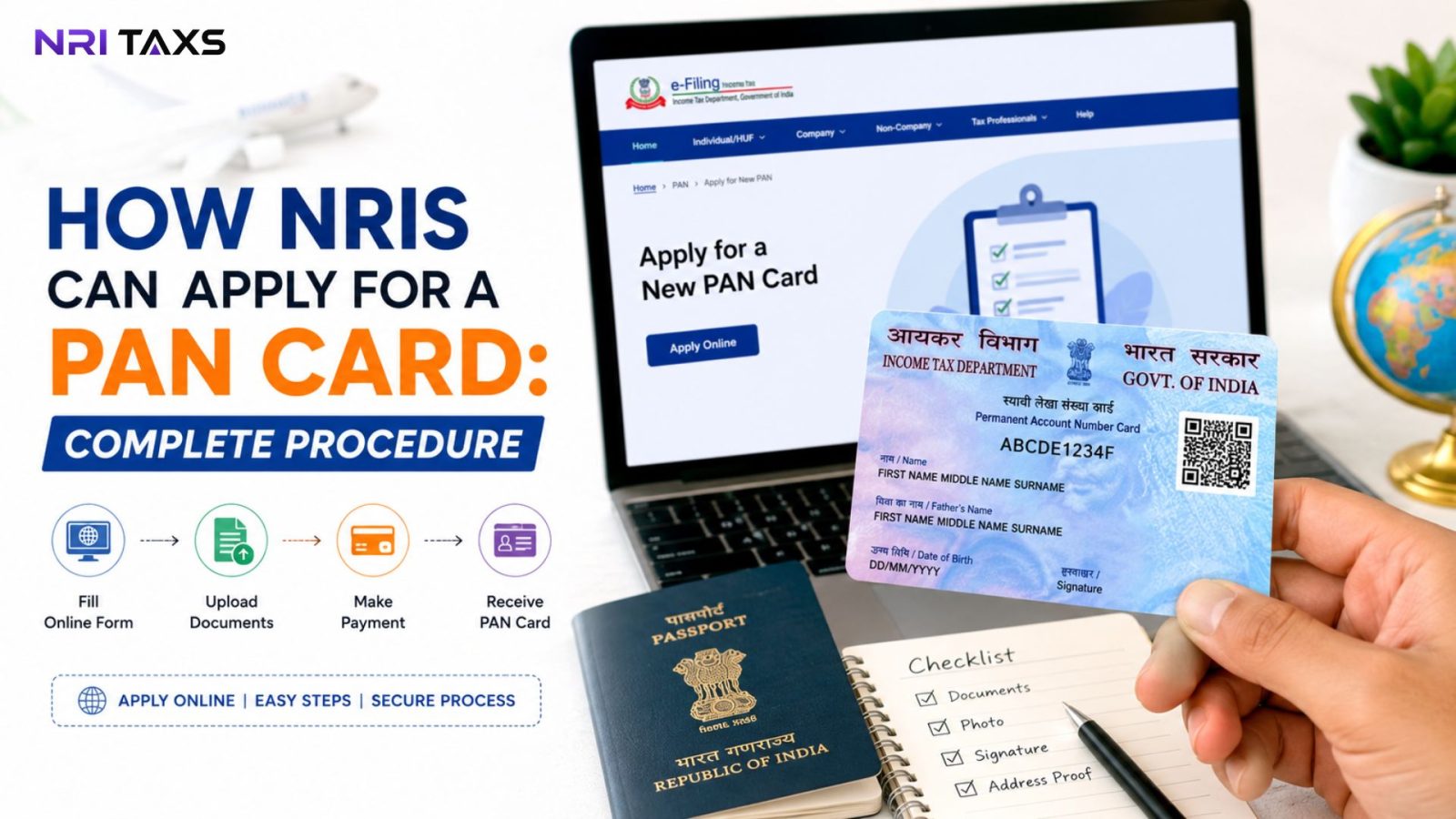
Need a PAN card as an NRI but not sure where to start? Whether you are buying property in India, investing in mutual funds, opening an NRO/NRE account, or filing your Indian income tax return, a PAN card is often mandatory and in some cases, the absence of one means a higher tax deduction at source (TDS).
The good news is that the entire process can be completed online from abroad. In this guide, you will learn exactly who can apply, which documents are required, how to fill in the application step by step, what fees you will pay based on your chosen delivery address, how long it takes to receive your PAN, and the most common mistakes that cause rejections or delays.
Important note: If you already hold an Indian PAN from your resident days, you do not need to apply for a new one. Your existing PAN remains valid after you become an NRI. This guide is for those who are applying for a PAN card for the first time.
What Is a PAN Card?
A Permanent Account Number (PAN) is a 10-character alphanumeric identifier issued by the Income Tax Department of India. It is unique to each taxpayer individual or entity and does not change throughout your lifetime, regardless of how many times you change your address, name, or residential status.
For NRIs, a PAN card acts as the single most important tax identity document when dealing with Indian financial institutions, property transactions, investments, and tax filings. Banks, brokers, mutual fund companies, and the income tax department all require your PAN for high-value transactions.
Who Can Apply for a PAN Card?
A PAN card can be obtained by any individual who has a taxable income or a financial interest in India. For the purposes of this guide, the following categories of non-residents are eligible:
Non-Resident Indians (NRIs)
Indian citizens who reside outside India typically for employment, business, or other purposes and who satisfy the residency test under Section 6 of the Income Tax Act qualify as NRIs. They must use Form 49A.
Overseas Citizens of India (OCI)
OCI cardholders are foreign nationals of Indian origin who have been granted OCI status by the Government of India. They are treated similarly to NRIs for most financial and tax purposes and must use Form 49AA.
Persons of Indian Origin (PIO)
PIOs are foreign nationals who were previously Indian citizens, or whose parents or grandparents were Indian citizens. Since the PIO card scheme was merged with OCI in 2015, most PIOs now hold an OCI card and must use Form 49AA.
Foreign Citizens with Indian Income
Any foreign national who has a source of income in India rental income, capital gains, dividends, royalties or who intends to invest in India is also eligible and must use Form 49AA.
Already have a PAN Card? If your citizenship status has changed after moving abroad or becoming a foreign citizen, read our complete guide on How to Update Citizenship Status in PAN Card for NRIs to update your PAN details correctly.
Key Benefits of Having a PAN Card as an NRI
- Mandatory for property transactions: Any purchase or sale of property in India above ₹50 lakh requires PAN quoting for both buyer and seller.Planning to sell property in India? Learn whether an NRI can sell property without Aadhaar or a PAN card and understand the tax implications before completing the transaction.
- Opens banking facilities: Required to open NRO or NRE accounts and for remittances above specified thresholds.
- Enables mutual fund & stock investments: SEBI mandates PAN for all investment accounts including NRI demat accounts.
- Prevents excess TDS: Without a PAN, TDS is deducted at the maximum applicable rate (up to 20% on interest income instead of 10%, and 20% on property sales). Quoting PAN ensures the correct rate applies.
- Required for ITR filing: If you have any taxable income in India, you must file an ITR, and PAN is the mandatory identifier to do so.If you’re unsure whether you need to file taxes in India or which ITR form applies to NRIs, read our detailed guide on How to File Income Tax Return for NRI before submitting your return.
- DTAA benefits: To claim Double Taxation Avoidance Agreement (DTAA) benefits on Indian income (e.g., reducing TDS on interest), you need a PAN along with a Tax Residency Certificate.
Documents Required for PAN Card Application
The documents required depend on whether you are an Indian citizen (Form 49A) or a foreign citizen/OCI/PIO (Form 49AA). The table below covers both categories.
| Document Category | NRI (Indian Citizen) — Form 49A | OCI / Foreign Citizen — Form 49AA |
| Identity Proof | Passport (copy of first & last page) | Passport (copy of first & last page) or OCI card |
| Address Proof (Overseas) | Overseas bank statement (last 3 months) OR utility bill in your name | Overseas bank statement (last 3 months) OR overseas utility bill |
| Address Proof (India) | Aadhaar card / voter ID / utility bill (if communication address is Indian) | Aadhaar card / voter ID / utility bill (if applicable) |
| Date of Birth Proof | Passport (DOB page) OR birth certificate | Passport (DOB page) OR birth certificate |
| Photograph | 2 recent passport-size photos (white background) | 2 recent passport-size photos (white background) |
| Signature / Thumb Impression | As per passport or official documents | As per passport or official documents |
| Additional for OCI/PIO | Not applicable | OCI card or PIO card (if available); Court order for name change if applicable |

How NRIs Can Apply for a PAN Card (Step-by-Step Guide)
You can apply through either UTIITSL or Savetax. The process below covers the NSDL portal, which is most widely used.
Step 1 Determine the Correct Form
Use Form 49A if you are an Indian citizen (NRI by residency). Use Form 49AA if you are a foreign national, OCI cardholder, or PIO. Selecting the wrong form is the single most common reason for rejection. Do not skip this step.
Step 2 Visit the NSDL Portal
Go to the nsdl portal and select ‘New PAN Indian Citizen (Form 49A)’ or ‘New PAN Foreign Citizen (Form 49AA)’ from the application type dropdown.
Step 3 Fill in the Online Application Form
Enter your personal details carefully: full name (as in passport), date of birth, gender, email address, and mobile number. For OCI holders, enter your OCI number in the ‘OCI’ field under ‘Citizenship’. Ensure that every detail matches your supporting documents exactly even a middle name mismatch can cause rejection.
Step 4 Select Your Submission Mode
You have two options: (a) e-KYC using Aadhaar instant verification using OTP on your Aadhaar-linked mobile number (only for Indian citizens who have an Aadhaar); (b) Physical document submission download the acknowledgement slip and send physical documents to the NSDL office in Pune. NRIs without Aadhaar must choose the physical option.
Step 5 Choose Communication Address
This is where your PAN card will be dispatched. Select ‘Office’ or ‘Residence’ address. If you choose an overseas address, the fee increases significantly (see the Fees section below). If you have a trusted person in India, using an Indian address is faster and cheaper.
Step 6 Pay the Application Fee
You can pay by credit/debit card, net banking, or demand draft. International debit and credit cards are accepted on the portal. Payment must be completed to generate the 15-digit acknowledgement number save this number for tracking.
Step 7 Submit Physical Documents (If Required)
Print the acknowledgement slip, paste 2 photographs in the space provided (do not staple, use glue), sign across the photographs, and send the slip along with self-attested copies of your documents to:
Step 8 Track Your Application
Use your 15-digit acknowledgement number on nsdl.com to track the status of your application. You will receive SMS and email updates at each stage.
If you’re specifically applying from the United Kingdom, don’t miss our detailed guide on How to Apply for an NRI PAN Card from the UK, where we’ve covered the complete online process, required documents, fees, and common mistakes UK-based NRIs should avoid.
NRI PAN Card Application Fees (India vs Overseas Address)
The fee structure depends entirely on where you want the physical PAN card delivered. Note that fees are subject to 18% GST.
| Delivery Destination | Fee (Approx.) | What Is Included |
| Communication address within India | ₹107 (incl. GST) | Processing fee + domestic dispatch via Speed Post |
| Communication address outside India | ₹1,017 (incl. GST) | Processing fee + international dispatch via registered post |
| e-PAN (digital PDF only, no physical card) | ₹72 (approx.) | Instant PDF delivery to registered email; no physical card dispatched |

NRI PAN Card Processing Time: What to Expect
| Stage | Approximate Timeline |
| Online form submission + fee payment | Day 1 |
| Physical documents received at NSDL Pune (if applicable) | Day 3–7 (depending on courier speed from your country) |
| Document verification by NSDL | Day 7–12 |
| PAN allotment by Income Tax Department | Day 10–15 |
| Physical card dispatch (India address) | Day 15–20 business days from form submission |
| Physical card dispatch (Overseas address) | Day 20–30 business days; allow 4–6 weeks for international delivery |
| e-PAN delivery (if opted) | Typically within 24–48 hours of verification |
Once your PAN application is approved, you can instantly access a digital copy by following our step-by-step guide on How to Download Your e-PAN Card Online, including all official methods through Protean, UTIITSL, and the Income Tax portal.
Common Mistakes That Lead to Rejection or Delay
Mistake 1 Using the Wrong Form (49A vs 49AA)
Indian citizens who have become NRIs must use Form 49A. OCI cardholders and foreign citizens, even those of Indian origin must use Form 49AA. Mixing these up is an automatic rejection.
Mistake 2 Address Mismatch Between Form and Documents
The address you enter on the form must match the address on your supporting document (bank statement or utility bill) exactly. Even minor differences like ‘Apt’ vs ‘Apartment’, or a missing zip code, can trigger rejection.
Mistake 3 Expired Passport
Your passport must be valid at the time of application. An expired passport is not an acceptable identity proof, even if it is the only document with your complete name and date of birth. Renew your passport first if it has expired.
Mistake 4 Signature Mismatch
Your signature on the acknowledgement slip must match the signature in your passport. If you have changed your signature, use the one that appears in your current valid passport. NSDL officers do cross-check this.
Mistake 5 Wrong Category or Citizenship Selection
On the form, you must correctly indicate your citizenship status. OCI holders sometimes incorrectly select ‘Indian Citizen’, which triggers a form mismatch. Always read the dropdown descriptions carefully before selecting.
Mistake 6 Wrong or Incomplete Communication Address
Entering a P.O. Box or a partial overseas address (missing country code, postal code, or state/province) frequently causes dispatch failures. NSDL may allot the PAN but fail to deliver the card. Ensure your overseas address is complete down to the zip/postal code.
Real-Life Example — How Rahul Applied for His PAN Card from Canada
Rahul is a 38-year-old software engineer living in Toronto. He moved to Canada in 2018 and had never applied for a PAN card while living in India. In 2025, he decided to sell an ancestral flat in Pune that he had inherited from his parents.
- His real estate agent told him that without a PAN, TDS would be deducted at 20% on the entire sale considering a significant amount on a property valued at ₹85 lakh.
- Rahul visited the NSDL portal and selected Form 49A (since he is an Indian citizen who became an NRI).
- He uploaded his Indian passport, a Canadian bank statement dated within 3 months as his overseas address proof, and a photograph.
- Since he has an Indian sibling in Pune, he used his sibling’s address as the communication address to avoid the ₹1,017 overseas fee and to receive the card faster.
- He paid ₹107 online using his Canadian Visa card. The portal accepted it without any issues.
- His physical documents reached the NSDL Pune office in 6 days via DHL. Verification was completed within 4 more days.
- His PAN card was allotted on Day 14 he received the PAN number via SMS before the physical card arrived.
- With his PAN in hand, Rahul applied for a Lower TDS Certificate (Form 13) from the Income Tax Department, which allowed TDS to be deducted at a lower rate on the property sale.
- He subsequently filed ITR-2 for the financial year, reported the capital gains, and successfully claimed a DTAA benefit under the India-Canada tax treaty to avoid double taxation.
Can OCI Holders Apply for a PAN Card?
Yes, absolutely. OCI holders are fully eligible to apply for an Indian PAN card, and in many cases they must have one especially if they invest in Indian markets, receive Indian income, or own property in India.
OCI holders must use Form 49AA and submit their OCI card as identity proof along with their foreign passport. Since OCI holders are not Indian citizens, they cannot use Form 49A.
One important distinction: OCI holders cannot invest in agricultural land, plantation property, or farmhouses in India. However, for all other categories of investment and financial activity, their PAN card works identically to that of an NRI.
PAN Card vs Aadhaar Card for NRIs — Key Differences
NRIs are sometimes confused about whether they need both a PAN card and an Aadhaar card, or whether one can substitute for the other. The table below clarifies:
| Feature | PAN Card | Aadhaar Card |
| Issued by | Income Tax Department of India | UIDAI (Unique Identification Authority of India) |
| Who can get it | Any taxpayer including NRIs, OCIs, foreign citizens | Indian residents (physical presence in India required) |
| NRI eligibility | ✅ Fully eligible, apply from abroad | ❌ NRIs not eligible unless resident in India for 182+ days in the preceding year |
| Primary use | Tax filings, financial transactions, investments | Domestic identity & address verification, DBT benefits |
| Mandatory for ITR filing | ✅ Yes (mandatory) | ⚠️ Mandatory to link with PAN, but NRIs may be exempt from mandatory Aadhaar-PAN linking |
| Can substitute the other | PAN cannot replace Aadhaar for domestic ID | Aadhaar cannot replace PAN for financial transactions |
| Apply from abroad | ✅ Yes — NSDL/UTIITSL online portal | ❌ No — must be physically present in India |

Conclusion
Applying for a PAN card as an NRI is a straightforward process once you know which form to use, which documents to gather, and how to avoid the common pitfalls. The entire application can be completed online in under 30 minutes, and in most cases you will have your PAN allotted within 15–20 business days.
To summarise the key points: use Form 49A if you are an Indian citizen and Form 49AA if you are an OCI holder or foreign citizen; your documents must exactly match what you enter on the form; using an Indian delivery address saves time and money; and your PAN remains valid for life regardless of your residential status.
Once you have your PAN, the next logical steps are opening an NRO/NRE account, applying for a Lower TDS Certificate before selling property, or filing your Indian ITR all become significantly easier. If any of those steps apply to you, the relevant guides are linked below.
Disclaimer
The content published on NriTaxs is intended for informational purposes only and does not constitute legal, tax, or financial advice. Readers are encouraged to consult qualified professionals before making any decisions based on the information provided.


Related Articles