
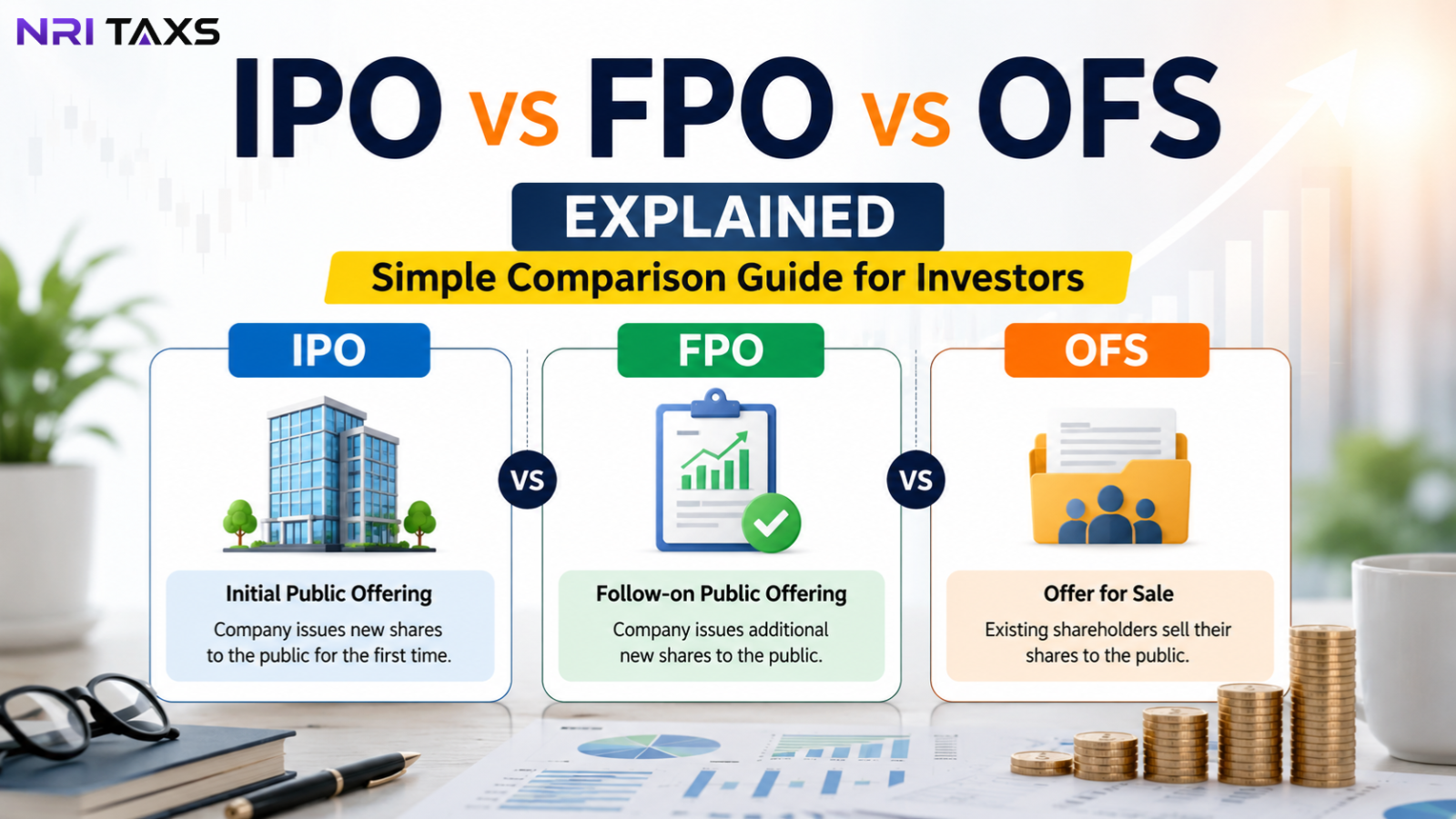
An IPO, FPO, and OFS are all ways through which shares of a company are sold to the public, but each one works differently. In an IPO, a private company comes to the stock market for the first time and offers its shares to investors. In an FPO, an already listed company issues new shares to raise more funds. In an OFS, existing shareholders like promoters sell their shares to the public instead of the company issuing new ones.
These terms are often confusing for beginners because they look similar, but the purpose behind each is different. The main difference is who is selling the shares and whether the company is raising fresh money or not. Thus,understanding IPO vs FPO vs OFS helps investors choose and analyze opportunities better.
Read Also:- How IPO Pricing Works in the Stock Market?
What is Initial Public Offering (IPO)?
When considering the IPO vs FPO vs OFS debate, the IPO is the very first step. An Initial Public Offering, or IPO, is the process through which a privately-held company becomes a publicly-traded company by offering its shares to the general public for the first time. Before an IPO, a company has a small number of shareholders, typically its founders, family, friends, and early investors. By going public, the company raises money from public investors to fund its growth, pay off debt, or for other business needs. For example, if a successful private food delivery startup wants to expand its operations across the country, it might launch an IPO. It sells new shares to public investors, and the capital raised from this sale goes directly to the company to build new kitchens and hire more staff.
Features Of Ipo
- First Public Issue:- IPO is the first time a private company offers shares to the public and becomes listed on the stock exchange.
- SEBI Regulation:- The entire IPO process is strictly regulated by SEBI to ensure transparency, fairness, and protection of retail investor interests.
- Price Discovery Process:- IPO price is decided through book building, where investor demand at different prices helps finalize the issue price.
- Capital Raising Purpose:- Companies launch IPOs mainly to raise funds for expansion, debt repayment, acquisitions, and overall business growth.
What is Follow-on Public Offering (FPO)?
A Follow-on Public Offering, or FPO, is a process where a company that is already listed on a stock exchange issues additional shares to investors. This is also known as a secondary offering. Since the company has already gone through an IPO and its shares are trading in the market, an FPO is a way to raise more capital for further expansion or new projects. For example, a publicly-listed car manufacturer that wants to build a new factory for electric vehicles might decide to issue an FPO. It offers more shares to the public, and the funds collected are used to finance the construction of the new factory. The company’s existing public performance data helps investors make a more informed decision.
Features Of Fpo
- For Already Listed Companies:- An FPO is issued only by companies that are already listed on the stock exchange and actively traded.
- Capital Raising After IPO:- The main purpose of an FPO is to raise additional funds after the company has already completed its IPO.
- Price Based on Market Value:- FPO pricing is linked to the current market price and is often offered at a discount to attract investors.
- Better Transparency for Investors:- Investors can analyze past performance, financial reports, and stock history, making investment decisions more informed and data-driven.

What is Offer for Sale (OFS)?
An Offer for Sale (OFS) is a method where existing shareholders of a listed company, such as promoters or large investors, sell their shares directly to the public through the stock exchange. In this process, the company does not issue new shares. The main purpose of OFS is to allow promoters or investors to reduce their stake and provide liquidity in the market. The money from the sale goes to the selling shareholders, not to the company. OFS is usually quicker and simpler compared to IPO or FPO, and it is mainly used by already listed companies to meet SEBI’s minimum public shareholding norms.
Features Of OFS
- Existing Shareholders Sell Shares:- In OFS, promoters or large investors sell their existing shares directly to the public instead of the company issuing new shares.
- No Fresh Capital for Company:- The company does not receive any money from OFS; funds go to the selling shareholders.
- Used by Listed Companies Only;- OFS is available only for companies that are already listed on stock exchanges.
- Quick and Transparent Process:- It is a fast and transparent method conducted through the stock exchange platform, making it easier for investors to participate.
Difference Between IPO And FPO and OFS
| Feature | IPO (Initial Public Offering) | FPO (Follow-on Public Offering) | OFS (Offer for Sale) |
| Full Form | Initial Public Offering | Follow-on Public Offering | Offer for Sale |
| Definition | When an unlisted company issues shares to the public for the first time. | When an already listed company issues additional shares to the public. | When existing shareholders (promoters) sell their shares to the public. |
| Listing Status | Company is unlisted before the IPO. | The company is already listed on the stock exchange. | The company is already listed on the stock exchange. |
| Who Gets the Money? | The Company receives the funds for growth/expansion. | The Company receives the funds for debt reduction or expansion. | The Selling Shareholders receive the money, not the company. |
| Share Capital | The total share capital of the company increases. | The total share capital of the company increases. | The share capital remains unchanged (only ownership shifts). |
| Process Length | Long process (takes 3–4 days for subscription). | Long process (similar to IPO). | Very fast (usually completed in one trading day). |
| Price Setting | Fixed price or a Book Building process (Price Band). | Usually offered at a slight discount to the current market price. | Floor price is set, and investors bid at or above that price. |
IPO vs FPO vs OFS – Key Differences
Purpose of the Offer and Recipient of Funds
In an IPO, the primary goal is for a private company to raise capital from the public for the first time. The money raised from selling new shares goes directly to the company’s treasury. This capital is then used for specified objectives like business expansion, purchasing new equipment, or paying off debt.
An FPO is similar in that the company issues more shares to raise additional capital for its needs.
However, an Offer for Sale (OFS) is fundamentally different. In an OFS, the money does not go to the company. Instead, it goes to the selling shareholders, who are typically the promoters or major early investors. They use the OFS mechanism to reduce their stake in the company.
Company Status and History
The most basic difference in the IPO vs FPO vs OFS comparison is the status of the company. An IPO is the first step for a private company to become public. Before the IPO, its shares are not available on any stock exchange.
An FPO can only be conducted by a company that is already public and whose shares are trading on the market. This means the company has a track record of financial reporting and market performance that investors can analyze.
An OFS is also only for publicly listed companies. This history provides a level of transparency for FPO and OFS investors that is not available to IPO investors, who must rely solely on the prospectus.
Risk and Information Availability
Investing in an IPO is generally considered riskier than investing in an FPO. With an IPO, there is no prior market price or trading history for the stock. Investors must base their decision on the company’s financials and future projections as stated in the offer document. The stock’s performance after listing is uncertain.
For an FPO, investors can look at the company’s past stock performance, dividend history, and quarterly financial results. This wealth of public information allows for a more detailed analysis, reducing the level of uncertainty.
The risk in an OFS depends on why the promoters are selling, but the company’s performance data is still available.
Share Pricing
The method for determining the share price varies significantly. In an IPO, the price is set through a “price discovery” mechanism like book building. The company sets a price band, and investors bid for shares within that band. The final price is determined based on the demand received.
For an FPO, the process is simpler. Since the stock is already trading, the offer price is usually set close to the current market price, often at a small discount to make the offer attractive to investors.
In an OFS, a floor price is announced, which is the minimum price for bids. The final allocation happens at or above this floor price based on the bids received through the stock exchange platform.
Conclusion- IPO vs FPO vs OFS
The choice between an IPO vs FPO vs OFS depends entirely on the company’s stage and objective. An IPO is the path for a private company to enter the public market and raise its first major round of public capital. An FPO is a tool for an already listed company that needs more funds for new projects or expansion. An OFS is not a capital-raising tool for the company; it is a mechanism for its promoters or large shareholders to sell their existing shares. For investors, understanding this distinction is key. IPOs offer high growth potential but come with higher risk, while FPOs provide an opportunity to invest in a known company.
Disclaimer
The content published on NriTaxs is intended for informational purposes only and does not constitute legal, tax, or financial advice. Readers are encouraged to consult qualified professionals before making any decisions based on the information provided.







Related Articles