
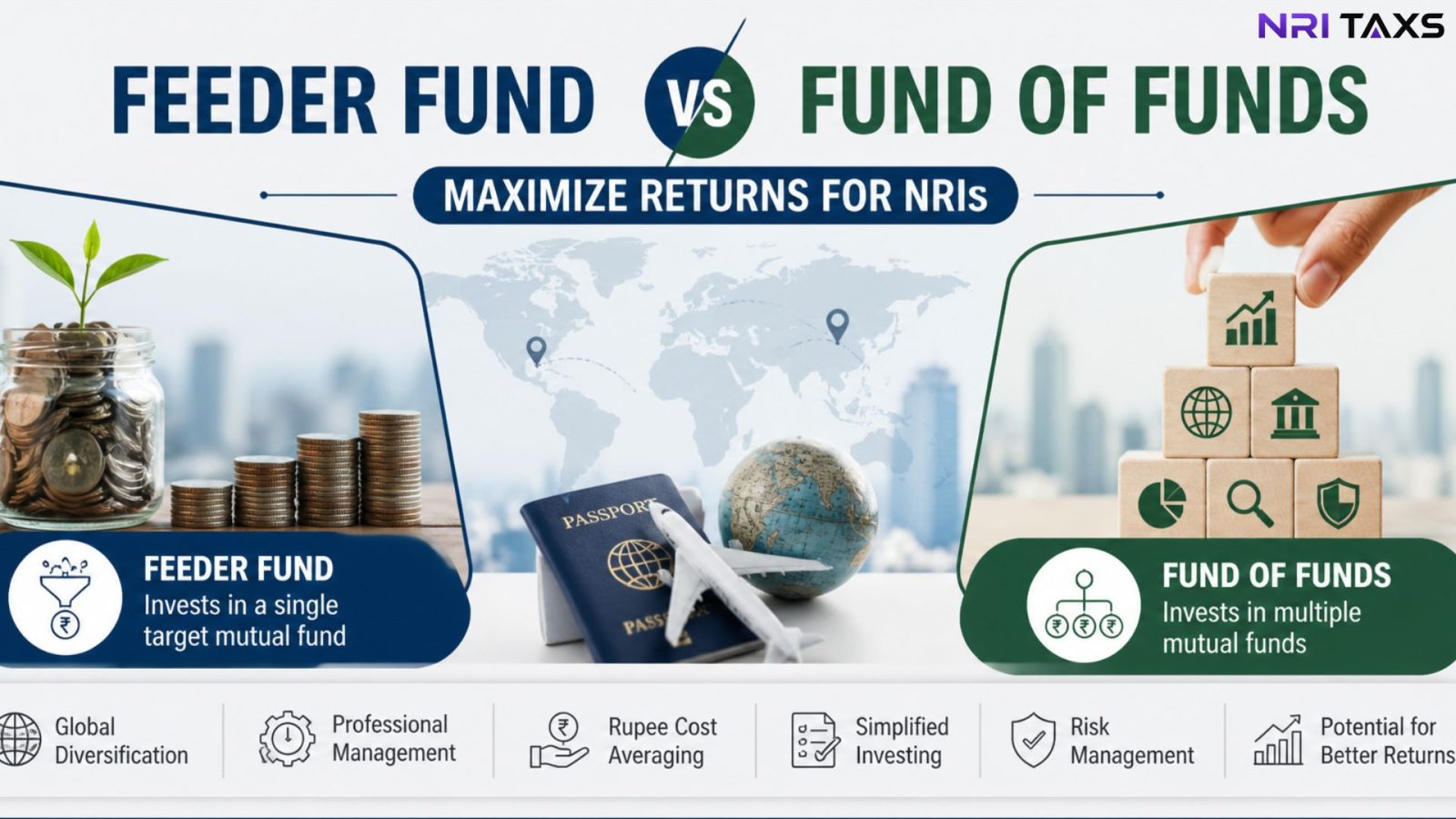
For NRIs looking to diversify their investments, understanding how different fund structures work can make a big difference in long-term returns. Two commonly used options are Feeder Funds and Fund of Funds (FoFs), and both play an important role in global investing strategies. While they may sound similar, their structure, purpose, and risk-return profile are quite different.
In simple terms, both allow investors to access professionally managed global or diversified portfolios without directly picking individual assets. However, the way they pool money and the underlying investment approach can impact your returns, taxation, and overall flexibility. In this blog, we’ll break down Feeder Funds vs Fund of Funds in a clear, practical way so NRIs can understand which option may better suit their financial goals, risk appetite, and investment strategy for 2026 and beyond.
What Is Feeder Fund?
When considering Feeder Fund vs Fund of Funds, it’s important to understand each structure individually. A feeder fund operates on a simple, direct model. It acts as a channel, or a “feeder,” that gathers capital from a group of investors in one country and invests it entirely into one specific “master fund,” which is often located in another country. The feeder fund itself does not make any independent investment decisions. Its performance is directly linked to the performance of the single master fund it invests in.
For example, an Indian mutual fund company could launch a feeder fund that collects money in Rupees from Indian investors, including NRIs. This fund’s sole purpose would be to invest all its collected assets into a specific, well-known technology fund based in the United States.
Read Also:- Operational Differences Between USD Investments vs INR Investments (NRI Guide)
Features Of Feeder Fund
- Single Master Fund Exposure:- All money is invested into one master fund, giving focused exposure to a single investment strategy.
- No Internal Diversification:- The feeder fund itself does not diversify; all risk and return depend on one underlying fund only.
- Dependent Strategy:– Performance fully follows the master fund’s strategy, decisions, and market movements without independent adjustments at feeder level.
- Focused Investment Theme:- Invests in specific sectors or regions, such as healthcare, technology, or a particular global market theme.
- Access to Global Funds:- Enables NRIs to invest in international funds that are otherwise difficult to access directly.
- Expert Fund Management:- Investors benefit from professional fund managers handling complex investment decisions in the master fund.
- Simple Operational Structure:– Mainly handles pooling of money, administration, and currency conversion without active investment selection.
- Regulatory Convenience:-Helps investors bypass cross-border restrictions and invest more smoothly in foreign or niche markets.
What Is Fund of Funds
A Fund of Funds (FoF) is a type of mutual fund that builds its portfolio by investing in other mutual funds. Instead of holding individual stocks or bonds, its assets are units of various other funds. This approach allows an investor to achieve broad diversification with a single investment. The manager of the FoF is responsible for selecting a suitable mix of underlying funds based on the FoF’s investment objective.
For example, an NRI looking to invest in the Indian market could put money into an Indian equity FoF. The FoF manager would then allocate that capital across several different Indian equity mutual funds from various fund houses, perhaps mixing large-cap, mid-cap, and small-cap funds to create a balanced portfolio.

Features Of Fund Of Funds
- Inherent Diversification:- FoF spreads investments across multiple underlying funds, reducing overall portfolio risk and providing more stable returns compared to investing in a single fund.
- Multi-Manager Exposure:- Investments are managed by various fund managers, allowing access to different expertise, strategies, and styles, enhancing potential returns while mitigating individual manager risk.
- Professional Fund Selection:- The FoF manager researches, selects, and monitors the best performing funds, offering investors expert guidance without needing to pick individual funds themselves.
- Portfolio of Funds:- Functions like a pre-packaged, ready-to-invest portfolio of multiple funds, giving investors a balanced approach without manually managing different investments.
- Simplified Investing:- Investors avoid the complexity of choosing multiple funds individually, as the FoF provides a convenient, all-in-one investment solution.
- Active Monitoring:- The fund manager regularly reviews the performance of underlying funds, ensuring allocations are optimized according to market trends and investment goals.
Feeder Fund Vs Fund Of Funds
| Aspect | Feeder Fund | Fund of Funds (FoF) |
| Definition | A fund that invests all its assets into a single underlying master fund. | A fund that invests its assets in a portfolio of multiple other mutual funds. |
| Investment Strategy | Follows the exact strategy of the one master fund it invests in. | Creates a diversified strategy by selecting and combining multiple funds. |
| Diversification | Offers no diversification beyond what the single master fund provides. | Its main purpose is to provide diversification across many funds and strategies. |
| Manager’s Role | Primarily administrative; facilitates investment into the master fund. | Actively researches, selects, and monitors a portfolio of underlying funds. |
| Cost Structure | Two layers of fees: the feeder fund’s fee plus the master fund’s fee. | Multiple layers of fees: the FoF’s fee plus the fees of all underlying funds. |
| Ideal Investor | An investor with a strong conviction in a specific fund, manager, or strategy. | An investor seeking broad diversification and professional fund selection. |
| Investor Control | The investor chooses a specific, targeted investment strategy via the master fund. | The investor delegates the fund selection decisions to the FoF manager. |
| Primary Use Case | Gaining access to a specific, often international, fund that is otherwise inaccessible. | Building a diversified portfolio with a single investment without picking individual funds. |
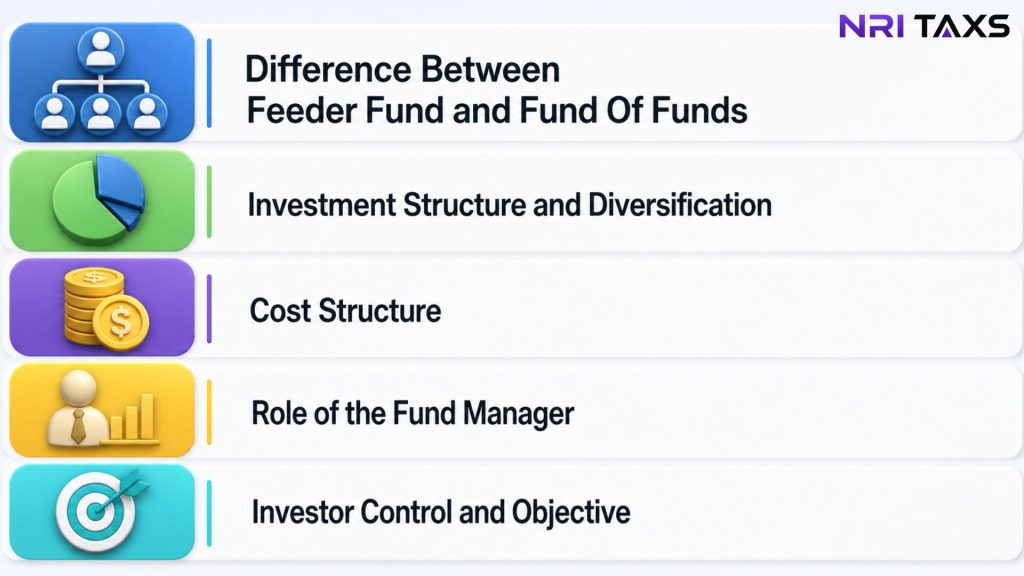
Difference Between Feeder Fund and Fund Of Funds
Here is the detailed difference between Feeder Fund and Fund of Funds.
Investment Structure and Diversification
One of the main difference between Feeder Fund and Fund Of Funds is structure and diversification. A feeder fund has a one-to-one investment structure. It invests 100% of its capital into a single master fund. This means the investor’s risk and return are completely tied to the performance of that one fund. There is no diversification at the feeder fund level; it is a concentrated bet on a specific strategy. For instance, an NRI wanting to invest specifically in a top-performing U.S. Nasdaq-100 index fund could use a feeder fund for that purpose.
In contrast, a Fund of Funds has a one-to-many structure. Its core purpose is to provide diversification by investing in a portfolio of different funds. An FoF manager might select 10-15 different mutual funds to create a balanced portfolio, spreading risk across various managers and investment approaches.
Cost Structure
When it comes to Feeder Fund vs Fund of Funds then let us tell you that both investment types have a layered fee structure, but it works differently. A feeder fund has two layers of expenses: the expense ratio of the feeder fund itself (for its administrative costs) and the expense ratio of the master fund it invests in.
A Fund of Funds also has its own expense ratio, but it additionally bears the expense ratios of all the underlying funds in its portfolio. Because it holds multiple funds, the total cost can sometimes be higher compared to a feeder fund. For an NRI investor, it is important to check the total expense ratio (TER) to understand the full cost, as these layered fees directly impact the final returns.
Role of the Fund Manager
The role of the fund manager differs greatly in the Feeder Fund vs Fund of Funds debate. In a feeder fund, the manager’s role is largely operational and administrative. Their main job is to ensure the smooth flow of capital from investors to the master fund, handle currency conversions, and manage compliance. They do not make active investment decisions about where the money goes. The investment intelligence lies with the manager of the master fund.
In a Fund of Funds, the manager is an active portfolio allocator. Their expertise is in analyzing and selecting other funds, deciding how much to allocate to each, and when to buy or sell them to meet the FoF’s objective.
Investor Control and Objective
“Feeder Fund vs Fund of Funds” The choice between these two depends heavily on the investor’s goal. An investor choosing a feeder fund is making a very specific and targeted decision. They have likely researched the master fund and have high conviction in its strategy, manager, or market focus. They retain control over the specific strategy they are exposed to.
An investor choosing a Fund of Funds is delegating the selection process. They want broad exposure to a market or asset class but prefer to have a professional manager choose the best funds for them. Their objective is simplification and diversification, giving up direct control over individual fund selection in exchange for a managed portfolio.
Conclusion
The choice in the Feeder Fund vs Fund of Funds comparison depends entirely on your investment goal. A feeder fund is the right tool if you want to invest in a single, specific fund that is otherwise hard to access, such as a particular international fund. It is for targeted investing where you have a strong belief in one manager or strategy. A Fund of Funds is better suited for investors who want broad, built-in diversification without the hassle of researching and selecting multiple funds themselves. It offers a managed portfolio of funds in a single package. For NRIs, a feeder fund is ideal for gaining specific global exposure, while a Fund of Funds is useful for creating a diversified portfolio within the Indian market.
Disclaimer
The content published on NriTaxs is intended for informational purposes only and does not constitute legal, tax, or financial advice. Readers are encouraged to consult qualified professionals before making any decisions based on the information provided.










Related Articles