
Filing an ITR for business income in India from abroad is not like filing a salary return. You need more papers, and missing even one can delay your filing or cause a notice later. NRIs also face a special problem: your records are in two countries, and your CA cannot see them unless you share them. So, this guide gives you a simple checklist of every Documents Required for NRI Business ITR Filing (ITR-3) for FY 2025-26. It is divided into groups, so you can collect them one by one. We also explain what each paper is used for, so you never send the wrong one.
Quick Answer
To file a business ITR as an NRI, you need your PAN, passport and visa or residency proof, Indian bank statements, books of accounts (profit and loss, balance sheet), sales and expense invoices, GST returns, TDS certificates, Form 26AS and AIS, advance tax challans, and the tax audit report if your turnover is above the limit. Treaty claims also need a tax residency certificate and Form 10F.
Master Checklist at a Glance
| Document | Why it is needed | Needed by |
| PAN card | Identity and e-filing login | Everyone |
| Passport, visa or OCI, residence proof | Proves residential status | Everyone |
| Indian bank statements | Verifies receipts, expenses and interest | Everyone |
| Books of accounts, P&L and balance sheet | Basis of business income | Everyone |
| Sales and purchase invoices | Support your income and expense figures | Everyone |
| GST returns and certificate | Reconciles turnover with the ITR | GST-registered businesses |
| TDS certificates, Form 26AS and AIS | Claim credit for tax already deducted | Everyone with TDS |
| Advance tax and self-assessment challans | Proof of tax paid | Everyone who paid tax |
| Tax audit report | Mandatory above the audit limit | Audit cases only |
| TRC and Form 10F | Claim tax treaty benefit | Treaty claims |
| Previous year ITR | Loss carry-forward and consistency | Where earlier returns exist |
Why the Right Documents Matter for ITR-3?
NRIs with business or professional income in India must file ITR-3, and it asks for much more detail than a basic return. It has schedules for business income, balance sheet and profit and loss details, and GST turnover. The department also matches your return with your AIS and TDS data, so every figure should have a document behind it. To understand the form itself, read our guide on the ITR form for NRI business income.
One more point: Section 44AD is not available to non-residents, as per the CBDT validation rules for ITR-3. So you cannot file on a simple presumptive basis. You need proper books and papers.
Identity and Residential Status Documents
Your residential status decides how your income is taxed, so your CA needs proof of it.
- PAN card: It must be active. Your e-filing account is linked to it.
- Passport copy: Needed for your name, date of birth and travel entry and exit stamps.
- Visa, OCI card or residence permit: Shows where you live and your status abroad.
- Travel dates: A list of the days you spent in India during the year. This is used to count your stay.
- Address proof: Your overseas address and, if you have one, your Indian address.
- Registered mobile number and email: Keep them working, because OTPs are needed to log in and e-verify.
Documents Required for NRI Business ITR Filing
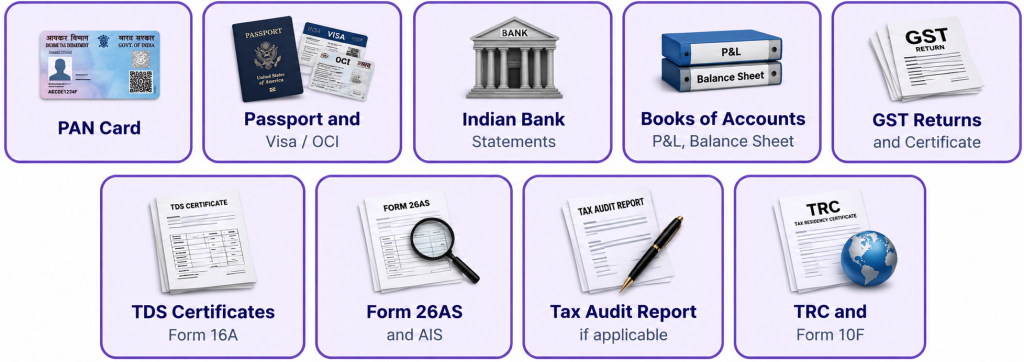
These papers prove how much you earned and spent in India.
Books of Accounts
Keep your ledger, cash book, profit and loss account and balance sheet. If a CA maintains your books, ask for final signed copies.
Invoices and Receipts
Collect sales invoices, purchase bills, expense receipts, rent agreements for business premises, and salary or contractor payment records.
Bank Statements
Keep a full-year statement for every Indian account used for business, including current accounts, NRO accounts and any payment gateway settlement reports. Keep business and personal transactions separate wherever possible.
Assets, Stock and Loans
Prepare a fixed asset list for depreciation, stock or inventory records, and loan statements with interest certificates.
Proof of Business Structure
| Business type | Extra documents needed |
| Proprietorship | Business registration or GST certificate, capital account statement |
| Partnership firm | Partnership deed, partner capital account, share of profit statement |
| LLP | LLP agreement, partner account and profit share statement |
| Freelancer or consultant | Contracts or client invoices, payment proofs, professional expense bills |
| E-commerce or online seller | Platform sales reports, settlement statements, GST returns |
| Director of an Indian company | Director fee or salary slips, TDS certificates, board approvals |
Tax and TDS Documents
These papers show the tax that has already been paid or deducted, so you get full credit.
- TDS certificates: For FY 2025-26, these are Form 16A. From tax year 2026-27, Form 16A becomes Form 131.
- Form 26AS and AIS: Download both from the e-filing portal and compare. From tax year 2026-27, Form 26AS is renumbered as Form 168. If numbers do not match, resolve them before filing. See our guide on AIS vs Form 26AS mismatch for NRIs.
- Advance tax and self-assessment challans: Proof of tax you paid yourself.
- Previous year ITR and acknowledgement: Needed for carry-forward of losses and for consistency.
- Form 10-IEA: If you want to choose the old tax regime with business income, this form must be filed by the due date.
GST Documents (If Registered)
ITR-3 reports GST turnover, so your GST data must match your books.
- GST registration certificate
- Monthly or quarterly GSTR-1 and GSTR-3B returns
- Annual return (GSTR-9), if applicable
- A reconciliation of GST turnover with your books of accounts
You can download these from the GST portal.

Tax Audit Documents (If Your Turnover Is Above the Limit)
If your business turnover is above ₹1 crore (or ₹10 crore with low cash transactions), or professional receipts are above ₹50 lakh, a tax audit applies.
- Audit report in Form 3CA or 3CB, with Form 3CD, for FY 2025-26
- CA details and UDIN
- Signed financial statements
For FY 2025-26, the audit-case ITR date is 31 October 2026. From tax year 2026-27, the audit form changes to Form 26. Read our full guide on the tax audit Form 26 for NRI business.
DTAA and Foreign Documents
If you want to claim a tax treaty benefit between India and your country of residence, you need extra papers.
- Tax Residency Certificate (TRC): Issued by the tax authority of your country of residence.
- Form 10F: A statement of details that goes along with the TRC.
- Proof of Indian tax paid: Keep a copy of your Indian ITR and tax payment proof if you need to claim credit in your country of residence.
- Payer details: If an Indian client deducts TDS on your fees, keep their TAN and TDS details.
For a deeper look at TDS rules, see our guide on TDS on NRI business income and the refund process.
Bank Details for Refund
If you have excess tax deducted, the refund goes to a bank account that you have added and validated on the e-filing portal.
- Account number and IFSC of an Indian bank account in your name
- A cancelled cheque or recent statement for verification
- Net banking or other e-verification access
If the refund is on NRO interest or similar income, read how to claim an NRO account TDS refund.
How to Organise Your Documents
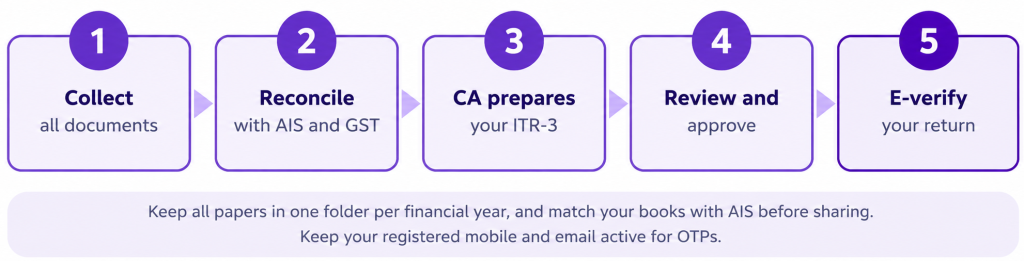
- Create a separate folder for each financial year. Organise your files into subfolders for identity documents, bank statements, accounting records, GST returns, tax filings, and audit reports.
- Use clear and consistent file names. For example, name your file FY2025-26_GSTR3B_March.pdf so you can quickly identify the document and the period it covers.
- Reconcile your records before submission. Match your books of accounts with bank statements, GST returns, and relevant AIS information to identify discrepancies before filing your ITR.
- Share documents securely. Provide clear, readable PDF copies through a secure file-sharing link or your tax professional’s approved document portal. Avoid sharing sensitive financial documents through unsecured channels.
- Retain records for the required period. Keep copies of your financial statements, tax returns, supporting documents, and audit reports for the applicable statutory retention period. The exact period may vary depending on the type of record and your tax or audit requirements.
Common Mistakes NRIs Make
- Sending only bank statements. Statements alone cannot replace books of accounts.
- Ignoring AIS differences. Unmatched figures can trigger a notice.
- Mixing personal and business transactions. This makes your accounts hard to verify.
- Missing TDS certificates. You may lose credit for tax already deducted.
- Forgetting TRC and Form 10F. Treaty benefit can be denied without them.
- Not updating the bank account on the portal. Refunds then get delayed.
- Sharing documents at the last minute. Late papers lead to rushed and risky filing.
Key Dates for FY 2025-26 (AY 2026-27)
| Case | ITR-3 due date |
| Business income, no tax audit | 31 August 2026 |
| Business income, tax audit applies | 31 October 2026 |
If your audit-case date is close, send your documents to your CA today. Please also confirm dates on the official income tax portal.
Conclusion
Filing an NRI business ITR becomes easier when you have all the required documents ready. Keep your books of accounts, bank statements, invoices, GST returns, TDS records and tax payment details organised before filing. If applicable, also prepare your tax audit report, TRC and Form 10F.
Before submitting your ITR-3, reconcile your financial records with AIS and Form 26AS to identify discrepancies and avoid unnecessary delays. If you are unsure which documents apply to your business, professional guidance can help you prepare your return accurately and stay compliant with Indian tax requirements.
Disclaimer
The content published on NriTaxs is intended for informational purposes only and does not constitute legal, tax, or financial advice. Readers are encouraged to consult qualified professionals before making any decisions based on the information provided.








Related Articles