

We see this all the time, an NRI earning in dollars, dirhams, or pounds sends a large part of their savings back to India. They invest in real estate, fixed deposits, or the stock market. The logic feels simple: invest in a fast-growing economy you understand and trust. It feels safe. It feels like home.
But lately, that sense of safety is starting to get questioned.
Many NRIs have noticed that while their investments are growing in rupee terms, the returns don’t look as strong when converted back into their home currency. A big reason is the long-term depreciation of the rupee against stronger currencies like the dollar. At the same time, global markets especially the US have been hitting new highs, making investors feel like they might be missing out.
This raises an important question:
Risks of Investing Only in Indian Markets for NRIs
This isn’t about avoiding India altogether. It’s about understanding the risks of putting all your investments in one country and making smarter, more balanced decisions for long-term wealth. So, in this blog we will discuss Risks of investing in Indian markets for NRIs, Currency risk for NRIs India and Should NRIs invest only in India.
Read Also:- What is Expense Ratio in Mutual Funds (NRI Tax Impact Included)
Why NRIs Prefer Investing in Indian Markets?
Before understanding NRI investment risks in India, it is important to know why NRIs prefer investing in India. NRIs often prefer investing in Indian markets because of a strong sense of familiarity and comfort. They understand the economy, the way businesses operate, and the overall growth story of the country. Having grown up in India, it feels easier to trust and invest in something they already know.
Another major reason is the growth potential. India is seen as one of the fastest-growing economies, and over the years, investments in equities and real estate have delivered solid returns. This makes it an attractive option for NRIs who want to grow their wealth.
There’s also an emotional factor involved. Investing in India gives many NRIs a sense of staying connected to their roots while contributing to the country’s growth.
However, while this approach feels natural and rewarding, it can sometimes lead to over-investing in a single market, which increases overall risk.
Risks of Investing Only in Indian Markets for NRIs
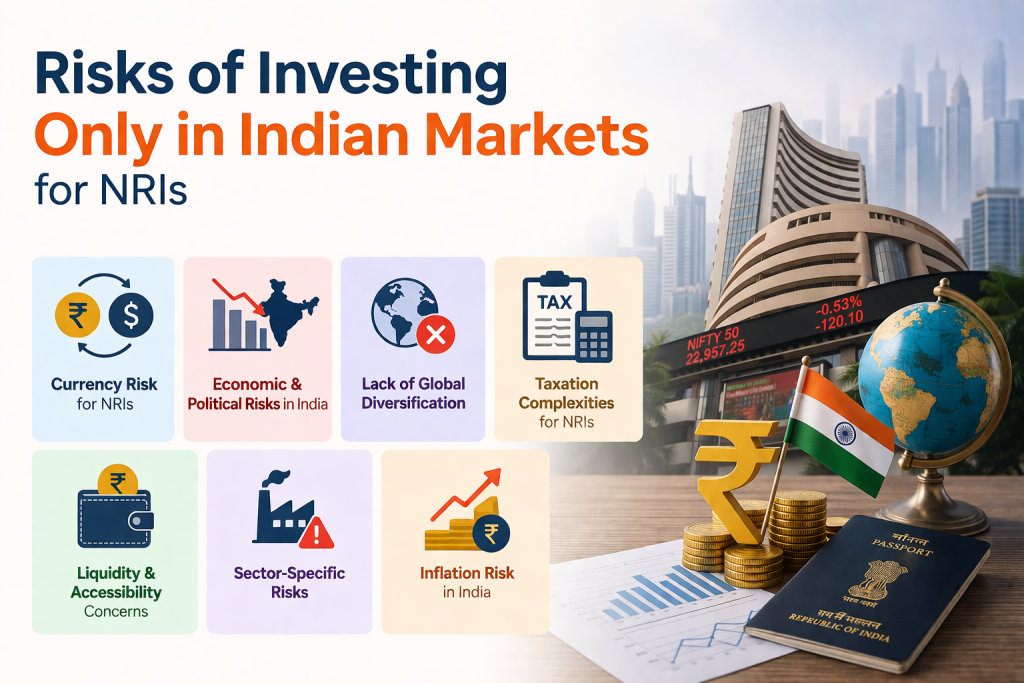
Risks of Investing Only in Indian Markets for NRIs- Putting all your financial faith in one country, even one as promising as India, is a concentrated bet. Over the years, we’ve seen this strategy backfire for reasons that have nothing to do with picking the wrong stock or mutual fund. The risks are structural.
Currency Risk for NRIs India
You earn in dollars, dirhams, or pounds—but you invest in rupees. This is where currency risk for NRIs in India becomes a serious concern.
Your overall returns don’t just depend on how your investments perform, but also on exchange rates like USD-INR or AED-INR. And historically, the Indian rupee has weakened against stronger currencies like the US dollar.
Let’s understand this with a simple example:
You invest $10,000 when the exchange rate is ₹75 per dollar, giving you ₹7,50,000. Over five years, your investment grows by 30%, reaching ₹9,75,000. That looks like a solid return.
But during the same period, the rupee depreciates, and the exchange rate moves to ₹83 per dollar. When you convert your money back, you receive around $11,746. So while your investment delivered a 30% return in India, your actual return in dollars is just over 17%.
This is exactly how currency risk for NRIs in India works—it quietly reduces your real returns. You often don’t notice it until you convert your money back to your home currency.
Economic & Political Risks in India
India is an emerging market, that means high growth potential comes with high volatility. Government policies can change overnight. A new tax law, a sudden change in import/export duties, or a shift in foreign investment rules can directly impact your portfolio.
We saw this during demonetization and with changes to long-term capital gains tax. These aren’t theoretical risks; they are events that have real financial consequences. The market’s performance is tightly linked to domestic political stability, election outcomes, and RBI’s monetary policy. Your portfolio is completely exposed to the ups and downs of a single country’s political and economic cycle.
Lack of Global Diversification
When you only invest in India, you are missing out on the entire world of opportunity. You have no exposure to the US tech giants that define our modern world, European luxury brands, or Japanese industrial leaders. A truly diversified portfolio has assets spread across different economies.
If the Indian market is going through a rough patch, a well-performing US or European market can balance out your returns. Without this geographic asset allocation, your entire net worth rides on the singular performance of the Indian economy. If India sneezes, your portfolio gets a cold.
Taxation Complexities for NRIs
Tax is a minefield, while India has Double Taxation Avoidance Agreements (DTAA) with many countries, they don’t eliminate the complexity. You still have to navigate the tax laws of both your country of residence and India.
We often deal with clients confused about where to pay capital gains tax, how to claim tax credits, and the immense paperwork involved. The tax implications in India for things like property or mutual funds can be very different from the laws in, say, Canada or the UK. Getting it wrong can lead to paying tax in both countries or facing penalties for non-compliance. It’s a significant operational headache.
Liquidity & Accessibility Concerns
Getting your money out of India isn’t always as simple as clicking a button. While things have improved, repatriating large sums of money, especially from property sales, involves significant paperwork like Form 15CA/CB and can face delays.
Furthermore, NRIs face restrictions on certain types of investments. You can’t just buy agricultural land, for instance. These access and liquidity issues mean your capital might not be as readily available as it would be in a more developed market.
Sector-Specific Risks
The Indian stock market is often top-heavy. Its performance is heavily influenced by a few key sectors like financials, IT, and energy. If you are investing in broad market indices like the Nifty 50, you are making a concentrated bet on the health of these sectors. If the global IT industry faces a downturn, the Indian market feels it disproportionately. This lack of sectoral diversification within a single country adds another layer of risk.
Inflation Risk in India
India has historically had higher inflation than most developed nations. A 7% return on a fixed deposit might look amazing to someone used to 1% in Europe. But if Indian inflation is running at 6%, your real return is only 1%. Inflation erodes the purchasing power of your money. Your returns must significantly outpace domestic inflation to be meaningful, and when you factor in currency depreciation, the challenge becomes even greater.

Should NRIs invest only in India?
Should NRIs invest only in India? From a tax and compliance perspective, the answer is no.
While India offers strong growth opportunities, concentrating all your investments in one country can create risks not just in returns, but also in taxation and compliance. NRIs often deal with issues like TDS deductions, capital gains tax, and repatriation rules when moving money abroad. Proper planning is required to manage these efficiently.
Diversifying globally helps reduce not only investment risk but also tax complexity across jurisdictions, especially when using benefits like DTAA to avoid double taxation.
So, should NRIs invest only in India? Ideally, no. A balanced approach, combining Indian and global investments, helps in better tax efficiency, smoother repatriation, and long-term wealth stability.
How NRIs Can Mitigate These Risks?
Diversifying Across Geographies
This is the most fundamental solution. Don’t put more than a certain percentage of your portfolio in any single country. A good rule of thumb we often suggest is to align your investments with global GDP weights as a starting point, then adjust for your risk appetite. This means a significant portion should be in developed markets like the US and Europe.
Investing in Global Assets
The easiest way to diversify is through global assets. You can do this from your country of residence. Look into low-cost ETFs (Exchange Traded Funds) that track global indices like the S&P 500 (for US exposure) or the MSCI World Index (for global exposure). This gives you a stake in thousands of companies across dozens of countries in one simple investment.
Currency Hedging Strategies
For sophisticated investors, there are currency hedging tools. But for most people, the simplest hedge is to keep a significant portion of your investments in the currency you earn and will likely spend in the future (e.g., USD, AED). Don’t convert every spare dollar into rupees. Invest that dollar in dollar-denominated assets.
Seeking Professional Financial Advice
Work with a financial advisor who understands the complexities of cross-border investing for NRIs. They need to be aware of the tax laws in both your country of residence and India. A local Indian advisor might not understand the tax implications you face in the US, and vice-versa.
Conclusion
India remains one of the most exciting growth stories in the world, and it absolutely deserves a place in an NRI’s investment portfolio. But it shouldn’t be the only place. The emotional pull to invest back home is strong, but building robust, long-term wealth requires a disciplined, global approach. The biggest risk is not being aware of the risks.
Looking towards 2026, we expect India’s markets to become even more integrated with the global economy. This is a good thing, but it also means they will be more susceptible to global trends. A diversified portfolio will be more important than ever. Your goal should be to participate in India’s growth, not be held captive by its volatility.
FAQ
1. How much of my total investment portfolio should I allocate to India?
From what we’ve seen work best, most NRIs should aim to have no more than 20-30% of their total investment portfolio in the Indian market. The exact number depends on your risk tolerance and financial goals, but going beyond this level significantly increases your concentration risk.
2. Are NRE Fixed Deposits a completely safe bet?
While the principal and interest are secure and tax-free in India, they are not free from risk. The primary risk is currency depreciation. If the rupee weakens by 5% in a year and your FD is paying 7%, your real return in your home currency is only 2%. You’re still losing purchasing power if you plan to use that money outside India.
3. What is the easiest way for an NRI in the UAE or USA to invest globally?
The most straightforward method is to open an investment account with a global brokerage firm in your country of residence (e.g., Interactive Brokers, Charles Schwab, Fidelity). Through these platforms, you can buy low-cost ETFs that track major global indices like the S&P 500 (for the US) or a global index like VWRA or IWDA, giving you instant diversification across thousands of companies worldwide.
Disclaimer
The content published on NriTaxs is intended for informational purposes only and does not constitute legal, tax, or financial advice. Readers are encouraged to consult qualified professionals before making any decisions based on the information provided.










Related Articles