

Non-Resident Indians (NRIs) investing in United States real estate often seek ways to minimize tax obligations to improve investment returns. A common area of interest is identifying states with no property tax for NRIs or regions with favorable tax structures. This leads to frequent inquiries about states that do not impose property tax. Understanding the distinction between different types of taxes, including property tax and income tax, is fundamental for making informed investment decisions in the US property market.
The concept of states with no property tax for NRIs is a significant point of confusion for many foreign investors. Property tax is a primary source of funding for local governments across the United States. It supports essential public services such as schools, law enforcement, fire departments, and infrastructure maintenance. Therefore, its application is universal, although the rates and assessment methods vary considerably from one jurisdiction to another. This article clarifies the facts surrounding property taxes for NRIs and provides insights into the broader US tax landscape.
Read Also:- Capital Gains Taxation for NRIs (Complete Guide)
Overview Of Property Tax In The Us For Nris
Property tax in the United States is a tax levied on real estate. The tax is paid by the owner of the property and is based on the value of the land and any improvements on it. For NRIs who own property in the US, this tax is a mandatory and recurring expense, just as it is for resident owners. Ownership, not residency status, determines the obligation to pay property tax. This tax is not administered at the federal level but is instead managed by local government entities, such as counties, municipalities, and school districts.
The amount of property tax due is calculated based on two main factors: the property’s assessed value and the local tax rate, often called a millage rate. A local assessor’s office determines the assessed value through a formal appraisal process. The millage rate is then set by local governing bodies to generate the revenue needed for their annual budgets. Consequently, property tax amounts can differ significantly, not just between states but even between neighboring towns or counties within the same state.
Why Nris Search For States With No Property Tax?
The search for States with No Property Tax for NRIs is primarily driven by financial objectives. Real estate investment involves significant capital outlay, and ongoing expenses can impact the overall return on investment (ROI). Property tax represents one of the largest carrying costs associated with property ownership, alongside mortgage payments and maintenance. Eliminating or minimizing this expense is a logical goal for any investor looking to enhance profitability and cash flow from a rental property.
Furthermore, navigating the US tax system can be complex for foreign investors. The desire for simplicity often leads to a search for straightforward investment environments. A state without property tax would appear to offer a less complicated and more profitable option. This search is often based on a misunderstanding that conflates different types of state-level taxes. Investors may incorrectly assume that states known for being “tax-friendly,” particularly those with no state income tax, also lack property taxes.
Do Any US States Have No Property Tax? (Reality For Nris)
There are no US states without a property tax. All 50 states levy a tax on real property to fund local government services. This is a critical fact for any NRI investor to understand. The revenue generated from these taxes is essential for the functioning of local communities, paying for public schools, police and fire services, road maintenance, and other civic infrastructure. Without property tax revenue, local governments would be unable to provide these essential services.
While no state is free of property tax, the rates at which this tax is applied vary dramatically across the country. Some states have very low effective property tax rates, while others have significantly higher rates. The effective tax rate is the average amount of property tax residents pay as a percentage of their property’s market value. Investors should focus their research on states with low effective property tax rates rather than searching for states that have no such tax at all.
States With No Income Tax In The Us For Nris
The common confusion about tax-free states often stems from the existence of states with no state-level income tax. For an NRI earning rental income, this can be an important consideration. These states do not tax personal income, including wages or rental profits, at the state level. However, federal income tax still applies.
Alaska
This state has no state income or sales tax. Its economy is heavily based on the oil and gas industry, which funds state operations.
Florida
A popular destination for real estate investment, Florida has no state income tax. It relies on high sales and property taxes to generate revenue.
Nevada
Known for its tourism and gaming industries, Nevada does not levy a state income tax. It has relatively high sales tax rates to compensate.
New Hampshire
New Hampshire does not tax earned income but does tax interest and dividend income. It has some of the highest property tax rates in the nation.
South Dakota
With no state income tax, South Dakota attracts businesses and investors. The state depends on sales and property taxes for its budget.
Tennessee
Tennessee phased out its tax on interest and dividend income in 2021, making it a true no-income-tax state. It has a high sales tax.
Texas
A major economic hub, Texas has no personal income tax. It balances its budget with high sales and property taxes, which investors must factor in.
Washington
Washington has no state income tax but does levy a high state sales tax and a capital gains tax on certain high-value asset sales.
Wyoming
Wyoming has no personal or corporate state income tax. It derives significant revenue from taxes on mineral extraction and property.
How Property Tax Works In The Us?
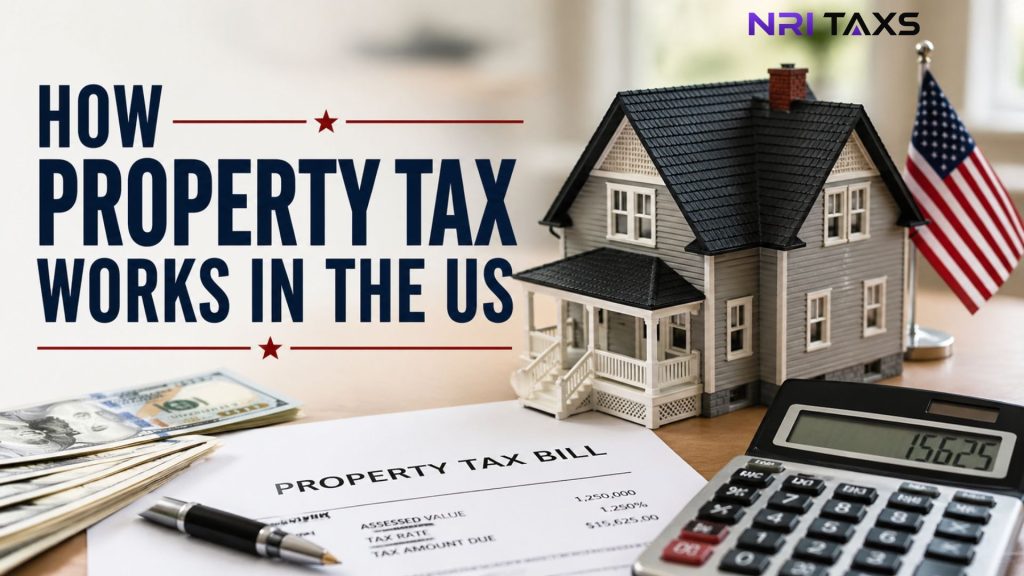
Understanding the mechanics of property tax is essential for NRI investors. The process is systematic and follows a clear structure administered at the local level. It involves property assessment, rate setting, and collection.
Property Assessment
Local government assessors determine the value of each property within their jurisdiction. This is known as the assessed value. The assessment may be based on the property’s fair market value or a percentage of it, depending on state law. Assessments are typically conducted on a regular cycle, such as annually or every few years, to reflect changes in property values. Property owners are notified of their assessed value and usually have a right to appeal if they believe it is inaccurate.
Tax Rate Calculation
Once property values are assessed, local taxing authorities such as counties, cities, and school districts determine their budget needs for the upcoming year. Based on these budgets and the total assessed value of all property in the jurisdiction, they set a tax rate. This rate, often expressed as a “millage rate,” is applied to the assessed value of each property. One mill represents one-tenth of a cent, or $1 in tax for every $1,000 of assessed value.
Tax Bill and Payment
The final property tax bill is calculated by multiplying the property’s assessed value by the combined tax rates of all applicable local jurisdictions. For example, a property owner’s total tax rate may be a sum of the county rate, city rate, and school district rate. The local tax collector’s office sends the tax bill to the property owner, typically on an annual or semi-annual basis. Payment is mandatory, and failure to pay can result in penalties, interest, and eventually a lien on the property.
Tax Implications For Nris Investing In Us Real Estate
NRIs investing in US real estate face several tax obligations beyond property tax. These taxes are levied at the federal level and, in some cases, at the state level. A clear understanding of these implications is necessary for compliance and financial planning.
Rental Income Tax
Rental income generated from a US property is subject to US federal income tax. NRIs have two options for how this income is taxed. The default method is a flat 30% withholding tax on the gross rental income. A more common and often more advantageous method is to make an election to treat the rental income as “Effectively Connected Income” (ECI). This allows the NRI to file a US tax return and be taxed on the net rental income (gross rents minus allowable expenses like property taxes, mortgage interest, insurance, and depreciation) at standard progressive tax rates.
Capital Gains Tax
When an NRI sells a US property, the profit from the sale is subject to capital gains tax. The tax rate depends on how long the property was held. If held for one year or less, the profit is considered a short-term capital gain and is taxed at ordinary income tax rates. If held for more than one year, it is a long-term capital gain and is taxed at lower preferential rates, which are typically 0%, 15%, or 20%, depending on the NRI’s total US-sourced income.
FIRPTA Withholding
The Foreign Investment in Real Property Tax Act (FIRPTA) is a federal law designed to ensure foreign sellers of US real estate pay their capital gains tax. Under FIRPTA, when an NRI sells a US property, the buyer is generally required to withhold 15% of the gross sales price and remit it to the Internal Revenue Service (IRS). This is not the final tax but a prepayment. The NRI must file a US tax return to report the sale, calculate the actual capital gains tax owed, and claim a refund for any overpayment from the FIRPTA withholding.

Common Myths About States With No Property Tax For Nris
Myth 1: Certain states have zero property tax
Fact: This is incorrect. All 50 states have property taxes. The rates and methods of calculation differ, but the tax itself is universal.
Myth 2: States without income tax also lack property tax
Fact: These are separate taxes. States with no income tax often rely more heavily on property and sales taxes to fund public services.
Myth 3: NRIs are exempt from US property taxes
Fact: Property tax is tied to property ownership, not the owner’s residency or citizenship status. All property owners must pay it.
Myth 4: A low tax rate means a low tax bill
Fact: A low millage rate in an area with very high property values can result in a larger tax bill than a high rate in an area with low values.
Conclusion: States with No Property Tax for NRIs
For NRIs investing in US real estate, the idea of states with no property tax is more of a misconception than reality. Property tax is a fundamental part of the US taxation system and is levied across all states to fund essential local services. Instead of searching for tax-free states, investors should focus on understanding varying property tax rates, local market conditions, and overall cost structures.
Additionally, NRIs must consider other tax implications such as rental income tax, capital gains tax, and FIRPTA withholding, which significantly impact overall returns. A state with no income tax may still have high property taxes, making it crucial to evaluate the complete tax picture rather than relying on a single factor.
By taking a well-informed and strategic approach considering tax efficiency, location, and long-term investment goals NRIs can make smarter real estate decisions in the US and optimize their overall returns while staying fully compliant.
Disclaimer
The content published on NriTaxs is intended for informational purposes only and does not constitute legal, tax, or financial advice. Readers are encouraged to consult qualified professionals before making any decisions based on the information provided.








Related Articles