

Non-Resident Indians (NRIs) are increasingly exploring India’s financial markets for new investment opportunities. With strong economic growth and improving market performance, traditional options like Indian equities continue to attract significant interest. At the same time, the rise of GIFT City as an International Financial Services Centre (IFSC) has introduced a modern and tax-efficient route, making GIFT City investment for NRI an attractive option for global investors.
Both avenues offer distinct advantages in terms of returns, taxation, and ease of investment. As a result, NRIs are now comparing these options more closely to determine which best aligns with their financial goals and portfolio strategy.
Read Also:- Transfer Funds From Icici Bank NRE Account To Gift City
What Are Indian Equities?
Indian equities represent ownership stakes in companies listed on domestic stock exchanges, such as the National Stock Exchange (NSE) and the Bombay Stock Exchange (BSE). Investing in these equities allows individuals to participate directly in the growth of Indian corporations. These instruments are denominated in Indian Rupees (INR) and are regulated by the Securities and Exchange Board of India (SEBI). For NRIs, investing in the Indian stock market has historically been a primary method to gain exposure to the nation’s economic expansion.
Are Indian Equities Becoming A Top Pick For Nris?
The appeal of Indian equities among NRIs has grown significantly in recent years, driven by multiple factors. India’s consistent GDP growth, expanding middle class, and ongoing pro-business reforms have created a strong foundation for corporate earnings. This has contributed to robust market performance over the past decade, attracting increasing global capital.
For NRIs, investing in Indian equities offers a direct opportunity to participate in the country’s growth story. Additionally, diversification plays a key role, as Indian markets often show relatively low correlation with developed economies, helping balance global portfolios.
What Is Gift City?
GIFT City is India’s first operational smart city and International Financial Services Centre (IFSC). It is designed to function as an offshore financial hub, comparable to jurisdictions like Singapore, Dubai, and Hong Kong, but located within India’s geographical boundaries. The primary objective of GIFT City is to provide a globally competitive financial services platform for both Indian and foreign entities. It operates under a special regulatory framework managed by the International Financial Services Centres Authority (IFSCA), which acts as a unified regulator.
Are Gift City Investment For Nri Becoming Top Picks?
GIFT City is rapidly gaining traction as a preferred investment destination for NRIs. Its structure offers a unique proposition: access to global and Indian financial products from a jurisdiction that provides significant tax and regulatory advantages. The ability to transact and hold assets in foreign currencies like the US Dollar eliminates the currency risk associated with traditional onshore investments. This combination of benefits makes a GIFT City investment for NRI an increasingly compelling choice for those seeking international-standard financial services within an Indian framework.
Gift City Investment For Nri: Why It’s Gaining Attention
The growing interest in GIFT City among NRIs is attributable to a specific set of structural advantages. These benefits address common challenges faced by overseas investors, such as taxation, currency fluctuation, and repatriation complexities.
Tax benefits
One of the most significant attractions of GIFT City is its favorable tax regime for non-residents. Investments made through the IFSC are exempt from several domestic taxes. This includes no securities transaction tax (STT), no commodity transaction tax (CTT), and no stamp duty on transactions. Furthermore, long-term and short-term capital gains arising from the transfer of specified securities by a non-resident on an IFSC exchange are exempt from tax, creating a highly attractive fiscal environment.
USD-based investments
Unlike the Indian domestic market where transactions are in INR, GIFT City allows for investments to be made and held in foreign currencies, primarily the US Dollar. This feature is a critical advantage for NRIs, as it mitigates the risk of currency depreciation. It simplifies the investment process for those who earn and save in foreign currency, allowing them to manage their portfolios without exposure to INR volatility. This makes a GIFT City investment for NRI a more stable option from a currency perspective.
Easy repatriation
The regulatory framework in GIFT City facilitates the free repatriation of funds for non-residents. Profits and capital can be moved out of the country without requiring extensive approvals that are sometimes associated with onshore investments. The process is governed by liberalized rules under the Foreign Exchange Management Act (FEMA), which allows for smoother and faster fund transfers. This ease of exit provides investors with greater control and liquidity over their assets.
Regulatory advantages
GIFT City is regulated by a single, unified authority—the IFSCA. This structure simplifies compliance and creates a more agile regulatory environment compared to the multiple regulators governing the onshore market. The IFSCA is mandated to develop a financial hub that aligns with global best practices, ensuring that the legal and operational frameworks are modern and investor-friendly. This provides clarity and confidence for NRIs looking to invest.
Indian Equities Vs Gift City: Which Is Better For Nris?
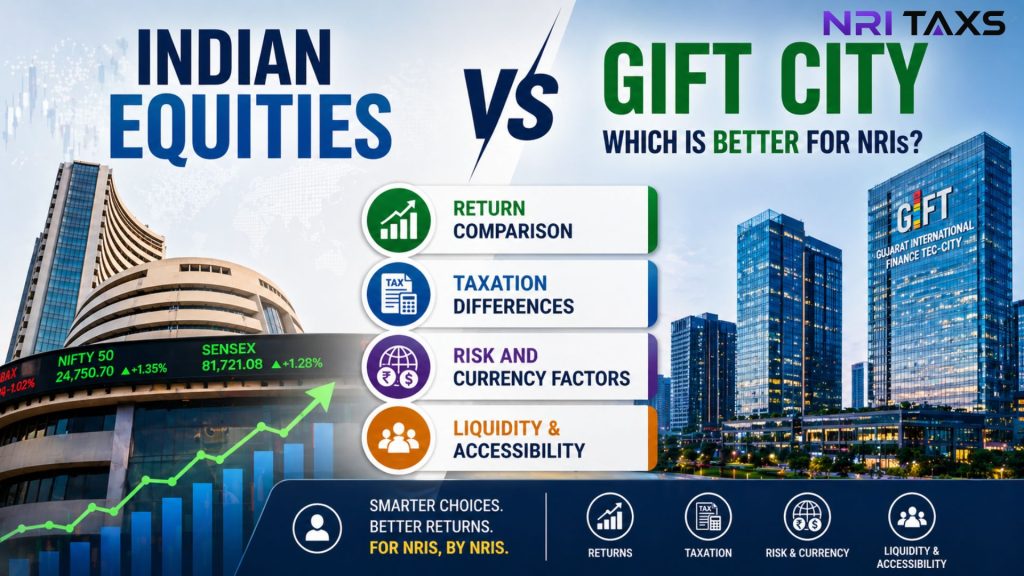
The choice between Indian Equities vs GIFT City depends on an NRI’s financial goals, risk appetite, and investment horizon, as both offer distinct opportunities and benefits.
Return comparison
When it comes to Indian Equities Vs Gift City then let us tell you that Direct investment in Indian equities offers exposure to the domestic growth story, with returns directly linked to the performance of Indian companies and the broader economy. GIFT City, on the other hand, provides access to a wider array of instruments, including global stocks, derivatives, and depository receipts of Indian shares (e.g., NSE IFSC Receipts). Returns in GIFT City are influenced by both Indian and global market trends and are denominated in a foreign currency.
Taxation differences
The tax implications are a key differentiator. In the Indian domestic market, NRIs are subject to short-term capital gains (STCG) tax at 15% and long-term capital gains (LTCG) tax at 10% on gains exceeding ₹1 lakh. In contrast, a GIFT City investment for NRI in specified securities is exempt from capital gains tax. This tax arbitrage is a powerful incentive for routing investments through the IFSC.
Risk and currency factors
If we talk about Indian Equities Vs Gift City then let us tell you, Investing in Indian equities carries direct exposure to INR currency risk. A depreciation of the rupee against an NRI’s home currency can erode investment returns. GIFT City investments are conducted in foreign currencies, primarily USD, which neutralizes this risk. However, GIFT City is a newer market, and its products may have different liquidity profiles and market risks compared to the well-established domestic exchanges.
Liquidity & accessibility
The Indian stock market is mature and highly liquid, with deep participation from retail and institutional investors. Accessibility for NRIs requires setting up specific accounts (NRE/NRO, Demat, Trading) and obtaining PIS permission. GIFT City’s ecosystem is still developing, and liquidity is growing. However, the account opening and investment process is designed to be more direct and aligned with international standards, potentially offering greater ease for global investors.
How Nris Can Invest In Indian Equities?
- Account setup:- To invest directly in Indian stocks, an NRI must first open an NRE (Non-Resident External) or NRO (Non-Resident Ordinary) bank account. Following this, a Demat account is required to hold securities in electronic form, and a trading account is needed to execute transactions. These accounts must be linked, and the NRI must obtain a Portfolio Investment Scheme (PIS) permission from the Reserve Bank of India (RBI) through their designated bank.
- Investment routes:- Once the accounts are active, NRIs can invest directly in stocks listed on the NSE and BSE. They can also invest through mutual funds, which offer a diversified and professionally managed approach. Investments can be made on either a repatriable basis (through an NRE account) or a non-repatriable basis (through an NRO account).
- Basic compliance:- All investments must comply with FEMA regulations, which dictate the rules for foreign exchange transactions. NRIs are also responsible for filing income tax returns in India for any gains or income earned from their investments and for paying taxes as per the applicable slabs and regulations.

How To Start Gift City Investment For Nri?
- IFSC account setup:- Investing in GIFT City requires opening a Demat and trading account with a broker registered in the GIFT City IFSC. The process is typically conducted in a foreign currency. NRIs can fund this account from their foreign bank account directly, without needing to route it through an NRE/NRO account in India.
- Investment process:- After the account is funded with foreign currency (e.g., USD), the NRI can start trading on the IFSC exchanges, such as NSE IFSC and India INX. Transactions are executed and settled in the chosen foreign currency. The process is designed to mirror the experience of investing in other major international financial centers.
- Platforms and options:- GIFT City offers a growing range of investment products. NRIs can invest in select Indian stocks via NSE IFSC Receipts, which are similar to American Depository Receipts (ADRs). Other available instruments include global stock derivatives, index derivatives, and various debt securities. The product landscape continues to expand as the IFSC matures.
Final Verdict
Both Indian equities and GIFT City offer compelling but different propositions for NRIs. Indian equities provide direct participation in the country’s domestic economic growth, backed by a mature and liquid market. This path is ideal for investors with a long-term bullish outlook on India who are comfortable managing INR-denominated assets.
Conversely, a GIFT City investment for NRI serves as a tax-advantaged, currency-hedged gateway to both Indian and global markets. It is better suited for investors who prioritize tax benefits, want to avoid currency risk, and prefer a regulatory framework aligned with global standards. The choice is not necessarily one over the other; a diversified portfolio could strategically include both to balance domestic growth exposure with international diversification and tax advantages. Looking toward 2026, GIFT City’s role is expected to expand, making it an integral part of the global investment landscape for NRIs.
Disclaimer
The content published on NriTaxs is intended for informational purposes only and does not constitute legal, tax, or financial advice. Readers are encouraged to consult qualified professionals before making any decisions based on the information provided.







Related Articles