

As Non-Resident Indians (NRIs), we often find ourselves looking back at India’s growth story with a mix of pride and a desire to participate. The Indian stock market, especially the dynamic world of Initial Public Offerings (IPOs), presents a direct way to invest in the country’s future. With a surge in new-age companies going public, it’s no surprise that many NRIs are asking which sectors offer the most promising opportunities. This isn’t just about making a quick profit on listing day; it’s about making informed choices that align with India’s long-term potential. This article will walk you through the key considerations and highlight some of the best sectors for IPO investment from NRI perspective.
Understanding Ipo Investments For Nris
Before we dive into specific sectors, it’s important to get the basics right. Investing from abroad comes with its own set of rules and considerations, but the process has become much more straightforward over the years. Understanding these fundamentals helps build a solid foundation for your investment journey.
What is an IPO?
An Initial Public Offering (IPO) is the process through which a private company offers its shares to the public for the first time. It is a major milestone for a company, allowing it to raise capital from the public market to fund expansion, pay off debt, or enable its early investors to sell their stakes. For investors, it presents an opportunity to buy a stake in a growing company at the beginning of its public journey. Once issued, the shares are listed on stock exchanges such as the National Stock Exchange (NSE) or the Bombay Stock Exchange (BSE), where they can be freely traded.
Can NRIs Invest in IPOs in India?
NRIs are permitted to invest in Indian IPOs on a repatriable or non-repatriable basis. To do this, you need a PIS (Portfolio Investment Scheme) permission letter from the Reserve Bank of India (RBI), an NRE or NRO bank account, and a Demat and trading account with an Indian broker. Most of the process is now digital and can be managed from anywhere in the world. IPO applications are typically made using the ASBA (Application Supported by Blocked Amount) facility, where your application money is blocked in your bank account and only debited if you are allotted shares.
Read Also:- Risks of Investing Only in Indian Markets for NRIs
Factors Nris Should Consider Before Choosing Ipo Sectors
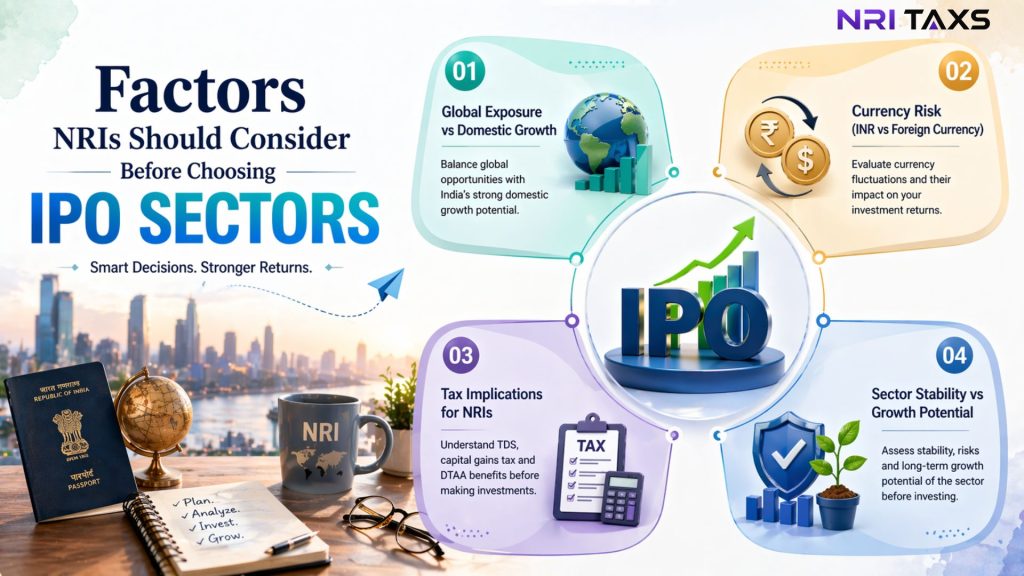
Choosing a sector is not just about selecting the one that’s currently in the news. As an NRI, your decision is influenced by a unique set of factors that domestic investors might not weigh as heavily.
Global Exposure vs Domestic Growth
Many NRIs are already invested in global markets and may have exposure to international tech or healthcare giants. When looking at an Indian IPO, consider if it offers something different. For instance, investing in an Indian consumer goods company gives you direct access to the country’s massive domestic consumption story, something you can’t get by buying shares of a multinational in New York or London. The goal is to find sectors that complement your existing global portfolio rather than just duplicating it.
Currency Risk (INR vs Foreign Currency)
This is a critical point for any NRI investor. Your returns are not just based on the stock’s performance but also on the exchange rate between the Indian Rupee (INR) and your home currency (like USD, AED, or GBP). If the INR weakens against your currency, your gains could be reduced when you convert the money back. For this reason, some NRIs prefer sectors with strong export earnings (like IT or Pharmaceuticals), as they have a natural hedge against a depreciating rupee.
Tax Implications for NRIs
The profits you make from selling IPO shares are subject to capital gains tax in India. If you sell within one year of listing, it’s considered a Short-Term Capital Gain (STCG) and is taxed accordingly. If you hold the shares for more than a year, it falls under Long-Term Capital Gains (LTCG). The tax rates can vary, and you should also check the Double Taxation Avoidance Agreement (DTAA) between India and your country of residence to understand the full tax picture.
Sector Stability vs Growth Potential
Every investment is a balance between risk and reward. Some sectors, like consumer staples or utilities, offer stability and steady, predictable growth. Others, like technology startups or renewable energy, offer very high growth potential but come with greater risk and volatility. As an investor, you need to decide what fits your risk appetite. A balanced approach often involves a mix of both stable and high-growth sectors in your portfolio.
Best Sectors For Ipo Investment from Nri Perspective
With the Indian economy on a strong growth trajectory, several sectors are poised for significant expansion. Here are some of the best sectors for IPO investment from NRI perspective.
Technology & IT Sector
One of the best IPO sectors for NRI is the technology and IT sector. India is a global powerhouse in IT services, and this sector continues to be a favorite. Indian IT companies have a global client base, which means a large portion of their earnings is in foreign currency, providing a natural cushion against INR fluctuations. Beyond traditional services, we are seeing IPOs from new-age SaaS (Software-as-a-Service) companies, data analytics firms, and digital engineering businesses. These companies are at the forefront of global innovation and offer a chance to invest in high-growth, knowledge-based industries.
Fintech & Financial Services
The financial services landscape in India is undergoing a massive transformation. The rise of digital payments, online lending platforms, and insure-tech companies has created a vibrant fintech ecosystem. With a huge under-banked population and increasing smartphone penetration, the growth runway is immense. IPOs in this space, including those from small finance banks, wealth management platforms, and insurance companies, provide a direct way to invest in India’s financial deepening.
Pharmaceuticals & Healthcare
Another best sectors for IPO investment from NRI perspective. Known as the “pharmacy of the world,” India’s pharmaceutical sector is a global leader in generic drug manufacturing. The sector benefits from strong export demand and a growing domestic market driven by rising health awareness and increased medical spending. Beyond pharmaceuticals, the broader healthcare sector, including hospitals, diagnostics, and medical device companies, is also seeing strong interest. These businesses are relatively resilient to economic downturns, making them a defensive addition to a portfolio.
Renewable Energy & ESG Companies
There is a massive global and domestic push towards clean energy and sustainable business practices. The Indian government has set ambitious targets for renewable energy capacity, creating huge opportunities for companies in solar, wind, and green hydrogen. IPOs from companies in this sector are not just financially attractive but also align with Environmental, Social, and Governance (ESG) principles, which are becoming increasingly important for modern investors.
Consumer & FMCG Sector
This is the classic India consumption story. With a young population and rising disposable incomes, the demand for everything from branded food products to consumer electronics is growing rapidly. IPOs from Fast-Moving Consumer Goods (FMCG) companies, retail chains, and direct-to-consumer (D2C) brands allow you to invest directly in the purchasing power of over a billion people. These sectors tend to be stable and offer consistent, long-term growth.
Infrastructure & Capital Goods
The next best sectors for IPO investment from NRI perspective are infrastructure and capital goods. The government’s focus on building world-class infrastructure roads, railways, ports, and manufacturing facilities is a key economic driver. This creates a ripple effect, benefiting companies in construction, engineering, and capital goods manufacturing. IPOs from companies that supply essential materials or services to these large-scale projects are well-positioned to gain from India’s industrial and infrastructure development.
How Nris Can Evaluate An Ipo Sector Before Investing?
Choosing a promising sector is the first step. The next is to evaluate the specific company coming out with the IPO.
Industry Growth Trends
Before looking at the company, look at the industry. Is the sector growing? What are the key drivers and potential challenges? For example, if you’re looking at an electric vehicle (EV) component manufacturer, you should research the overall growth projections for EVs in India, government policies, and the competitive landscape. A company in a declining industry will struggle, no matter how good its management is.
Company Fundamentals
The Draft Red Herring Prospectus (DRHP) is your most important document. It contains detailed information about the company’s business, financials, management team, risks, and the reason for raising money. Pay close attention to revenue growth, profitability, and debt levels over the past few years. A consistent track record is always a positive sign.
IPO Valuation Analysis
Evaluate whether the IPO is fairly priced by checking metrics like P/E, P/B, and EV/EBITDA. Compared with industry averages. If valuation is too high without strong growth potential, it may indicate an overpriced IPO and higher investment risk.
IPO Valuation Metrics
Valuation tells you whether the IPO price is reasonable. While there are many metrics, two simple ones to look at are the Price-to-Earnings (P/E) ratio and the Price-to-Book (P/B) ratio. The P/E ratio tells you how much you are paying for every rupee of the company’s profit. A very high P/E ratio suggests high growth expectations are already built into the price, which adds to the risk.
Tips To Build A Balanced Ipo Investment Strategy
- Look Beyond Listing Gains:- While the excitement of a 50% listing gain is tempting, real wealth is created by holding fundamentally strong companies for the long term. Avoid building your strategy solely around short-term listing profits.
- Use the NRI Quota, But Don’t Rely on It:- The NRI or retail quota may improve your chances of allotment in popular IPOs, but it is never guaranteed. Allotment is largely based on luck, so apply wisely without depending entirely on it.
- Diversify Your IPO Investments:- Avoid investing all your money in IPOs from a single trending sector. Spread your investments across sectors like technology, consumer goods, and healthcare to build a balanced and resilient portfolio.
- Watch the Anchor Investor Lock-in Period:-Anchor investors buy shares before the IPO opens, and their shares are locked in for a specific period (usually 30–90 days). Once this lock-in ends, selling pressure may arise, impacting the stock price.
Conclusion: Ipo Investment For Nris
Investing in Indian IPOs offers NRIs a powerful way to participate in one of the world’s fastest-growing economies. The key is to move beyond the hype and make decisions based on solid research and a clear understanding of the underlying sectors. For NRIs, sectors like Technology, Healthcare, and Renewable Energy offer a blend of global relevance and domestic growth, while Consumer and Infrastructure sectors provide a direct play on the India story. As we look towards 2026, we expect to see more IPOs from companies focused on digitalization, sustainability, and manufacturing. By aligning your investments with these long-term trends, you can build a portfolio that is well-positioned for sustainable growth.
Disclaimer
The content published on NriTaxs is intended for informational purposes only and does not constitute legal, tax, or financial advice. Readers are encouraged to consult qualified professionals before making any decisions based on the information provided.










Related Articles